Announcement of the "Creative Economy Innovation Center Development Roadmap"
The government has decided to create four startup cities ranked within the top 100 worldwide by 2030.
On the 21st, the Ministry of SMEs and Startups announced this goal while unveiling the 'Creative Economy Innovation Center Development Roadmap' at the '10th Anniversary Event of the Creative Economy Innovation Center' held at the Daegu Jungang Convention Center.
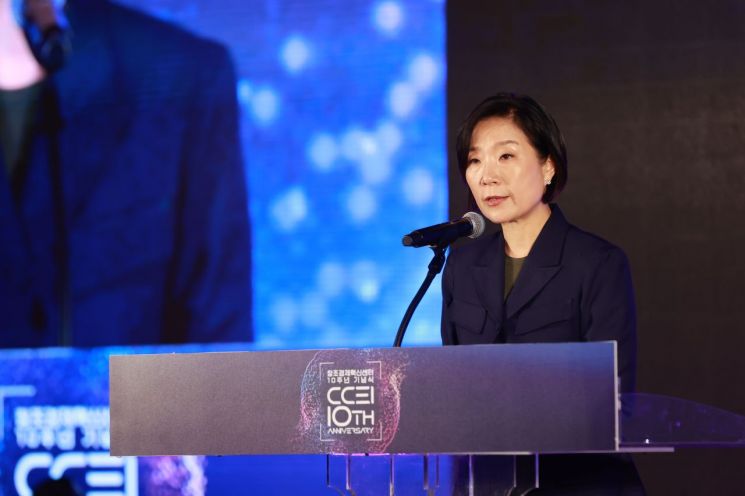 Oh Young-joo, Minister of SMEs and Startups, is delivering a congratulatory speech at the '10th Anniversary Ceremony of the Creative Economy Innovation Center' held at Daegu Central Convention Center on the 21st. Photo by Ministry of SMEs and Startups
Although South Korea's startup ecosystem is internationally advanced, only a few cities have well-developed startup ecosystems. Therefore, through the Creative Economy Innovation Centers, the government aims to accelerate the growth rate of technology startup companies outside the metropolitan area. The event was attended by over 200 people, including executives from 15 major corporations such as Samsung, Hyundai Motor, SK, and LG, as well as officials from 17 cities and provinces and nationwide Creative Economy Innovation Centers.
According to the 'Global Startup Ecosystem Report by Country' released by Startup Blink, a startup ecosystem research institute, South Korea ranks 20th overall, but Seoul is the only city within the top 100, ranking 21st. Busan ranks 366th, Daejeon 429th, and Incheon 458th.
The roadmap announced by the Ministry of SMEs and Startups on this day includes three major policy directions to resolve the polarization of regional startup ecosystems: 'Deeper,' 'Broader,' and 'Closer.'
First, the Innovation Centers will strengthen public investment functions to help promising startups grow rapidly through direct and indirect investments. They also plan to focus on SAFE (Simple Agreement for Future Equity) investments, which allow startups to secure funding quickly and easily. The preliminary, early-stage, and leap startup package projects, which provide support ranging from 100 million to 200 million KRW, will be integrated and supported mainly through centers outside the metropolitan area.
Additionally, the Innovation Centers will expand their scope as open innovation hubs. Based on networking accumulated over the past decade with large and medium-sized enterprises and public institutions, nationwide open innovation programs will be activated, and mutual benefits through practical cooperation between leading large corporations and promising startups will be actively supported.
In particular, the Value-Up program will establish a dedicated Value-Up fund where the Korea Venture Investment Corp. (K-VIC) matches 1:1 investments when large corporations invest in collaborative startups. This aims to promote the inflow of private capital into startups and enable startups to grow rapidly through investment.
Moreover, the Innovation Centers will leverage their strengths by being located in key regional hubs nationwide to improve the local startup ecosystem environment. For example, the Chungnam Center will specialize in nurturing startups linked to the regional climate technology industry. Organizational restructuring of the Innovation Centers and revisions to related laws will also be pursued to establish their roles, functions, and legal grounds as dedicated regional startup institutions.
Oh Young-joo, Minister of SMEs and Startups, stated, "To overcome the polarized regional startup ecosystem environment, we will strive to establish the Innovation Centers as representative venture builders in the regions that support startups."
© The Asia Business Daily(www.asiae.co.kr). All rights reserved.
![Clutching a Stolen Dior Bag, Saying "I Hate Being Poor but Real"... The Grotesque Con of a "Human Knockoff" [Slate]](https://cwcontent.asiae.co.kr/asiaresize/183/2026021902243444107_1771435474.jpg)











