Restrictions on Overseas Sale of Korea Zinc Designated
MBK Partners' Exit Calculations Complex
"The Technology Plays a Core Role in National Security"
Korea Zinc is pushing for the designation of zinc smelting technology and antimony smelting technology as national core technologies, following its primary technology for secondary batteries. If these technologies are also designated as national core technologies, the exit strategy of MBK Partners, which is currently acquiring management rights of Korea Zinc, is expected to become more complicated.
Korea Zinc announced on the 21st that it recently submitted a proposal to the Ministry of Trade, Industry and Energy to designate two smelting technologies as national core technologies.
The technologies in question are the "Hematite manufacturing technology in zinc sulfate solution using co-precipitation leaching technology" and the "Antimony metal manufacturing technology using diaphragm electrolysis technology." The Ministry of Trade, Industry and Energy will review the necessity of new designation and make a final decision through consultations with related ministries.
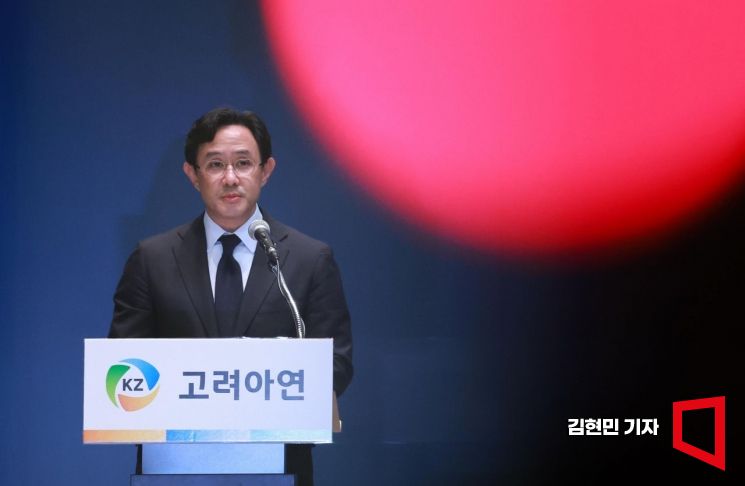 Choi Yoon-beom, Chairman of Korea Zinc, is speaking at a Korea Zinc press conference held on the 13th at the Korea Chamber of Commerce and Industry in Jung-gu, Seoul. On this day, Chairman Choi stated, "I will step down from the position of chairman of the board as soon as possible, and an outside director will take over as chairman of the Korea Zinc board." Photo by Kim Hyun-min
Previously, the Ministry had classified Korea Zinc’s primary technology for secondary battery precursors as both a national core technology and a national advanced strategic technology. The government designates technologies with high technical and economic value in fields such as semiconductors, nuclear power, electrical and electronics, and robotics as national core technologies if their leakage overseas could adversely affect national security and the national economy. Companies holding national core technologies cannot sell these technologies overseas without government approval.
The market views the designation of national core technologies as a constraint on MBK Partners and Youngpoong’s plans to exit their stakes in Korea Zinc. Considering Korea Zinc’s market capitalization of up to 20 trillion KRW, acquisition by domestic companies is realistically difficult, making overseas sale a likely option. However, with the designation as national core technologies restricting sales, a strategic revision is inevitable.
Some suggest that MBK and Youngpoong might attempt a workaround strategy by separately selling business units or assets not subject to national core technology designation. However, if multiple technologies such as secondary batteries, zinc, and antimony are designated as national core technologies, the sales process will inevitably become more complex.
Korea Zinc explained, "Considering the characteristics of antimony, a rare metal essential for defense and advanced technology industries, and China’s strategic resource policy on antimony, the overseas leakage of this technology would not only hinder South Korea’s economic growth but also shake the foundation of its industries. We believe that domestic production of antimony through Korea Zinc’s technology can play a key role in national security."
© The Asia Business Daily(www.asiae.co.kr). All rights reserved.
![Clutching a Stolen Dior Bag, Saying "I Hate Being Poor but Real"... The Grotesque Con of a "Human Knockoff" [Slate]](https://cwcontent.asiae.co.kr/asiaresize/183/2026021902243444107_1771435474.jpg)
















