Ministry of Health and Welfare Establishes 'Winter Welfare Crisis Household Identification and Support Measures'
The government will inspect 400,000 people showing signs of welfare crises to identify blind spots in welfare during the winter season.
On the 21st, the Ministry of Health and Welfare announced at the National Policy-Related Ministers' Meeting that it has established the "Winter Welfare Crisis Household Identification and Support Measures" to help vulnerable groups have a warm winter. The measures include utilizing 47 types of information that can detect crisis signs such as power or water cutoffs, overdue health insurance premiums, and unpaid communication bills, enabling local governments to directly inspect about 400,000 welfare crisis households.
Starting this year, to provide rapid support to crisis households, the use of artificial intelligence (AI) for initial consultations will be expanded nationwide. Support for heating costs for vulnerable households will also be strengthened. For basic livelihood security recipients, the energy voucher amount provided to cold-sensitive groups such as the elderly and infants will be increased by 10,000 KRW from the previous year to 314,000 KRW annually. The usage period has also been extended by one month, from last October through May of next year.
Additionally, from this month for five months, 69,000 senior centers nationwide will receive 400,000 KRW per month for heating costs. Social welfare facilities supported by national funds, totaling 7,000 locations, will receive between 300,000 and 1,000,000 KRW monthly depending on their size. When cold wave or heavy snow warnings are issued, the welfare status of 550,000 vulnerable elderly people will be checked via phone calls or visits, and emergency safety devices will be installed in 266,000 households including elderly living alone.
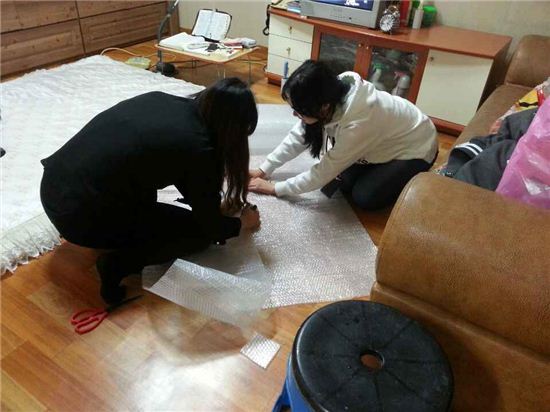 Community leaders are carrying out welfare support activities for low-income residents. Photo by Asia Economy DB
To prevent income gaps during winter, 70,000 jobs for the elderly and 2,000 jobs for people with disabilities will be expanded and selected early within this year. Emergency support housing will be provided for up to six months to households facing housing crises due to disasters, and the thresholds for policy financial products such as small livelihood loans and Sunshine Loan Youth will be lowered to support the economic independence of financially vulnerable groups.
© The Asia Business Daily(www.asiae.co.kr). All rights reserved.

















