2024 Sustainability Global Summit Opening Address
Joo Hyung-hwan, Vice Chairman of the Low Fertility and Aging Society Committee (LoFAS), announced on the 21st that a "Response Plan for an Aging Society," focusing on continuous employment and old-age income security, medical care, nursing, caregiving, and elderly-friendly housing and industries, will be prepared by early next year. He also stated that expanding childbirth credits during the national pension reform process will be considered.
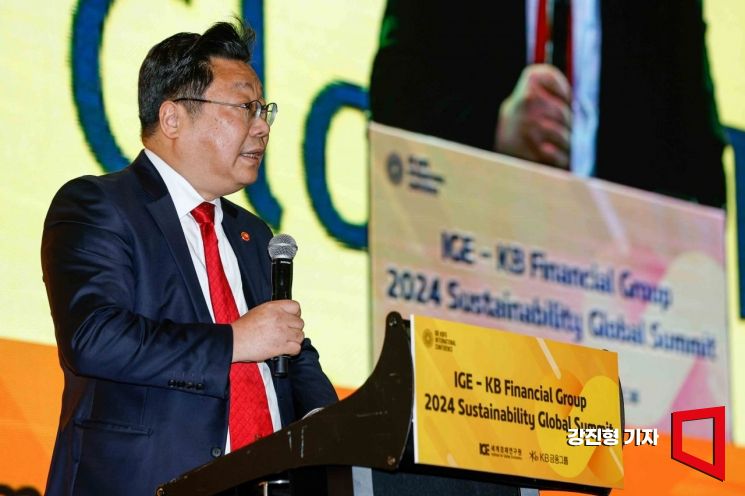 Joo Hyung-hwan, Vice Chairman of the Low Birthrate and Aging Society Committee, is delivering a congratulatory speech at the 'IGE-KB Financial Group, 2024 Sustainability Global Summit' held on the 21st at the Conrad Hotel in Yeouido, Seoul. Photo by Kang Jin-hyung
On the same day, Vice Chairman Joo attended the "2024 Sustainability Global Summit," jointly hosted by the World Economy Research Institute and KB Financial Group at the Conrad Hotel in Yeouido, Seoul, and said, "Low birthrate is a product of structural problems," adding, "There is a lack of good jobs, and those few good jobs are concentrated in the metropolitan area, requiring entry into good schools to obtain them, which has led to a sharp increase in private education expenses due to entrance exam competition."
He continued, "As the population concentrates in the metropolitan area, housing prices rise, and physical and mental competitive pressures intensify, making marriage and childbirth even more difficult," emphasizing the point.
On the same day, Vice Chairman Joo also mentioned responses to the super-aged society alongside low birthrate measures. He stated, "In the process of preparing measures, it is necessary to consider the heterogeneity in education, income, assets, and health levels between early elderly (ages 65?74) and late elderly (75 and older), the differing conditions such as aging speed, jobs, and living infrastructure by region, and the emergence of new policy tools such as smart caregiving using Fourth Industrial Revolution technologies like artificial intelligence (AI), Internet of Things (IoT), and robotics, as well as customized medical care."
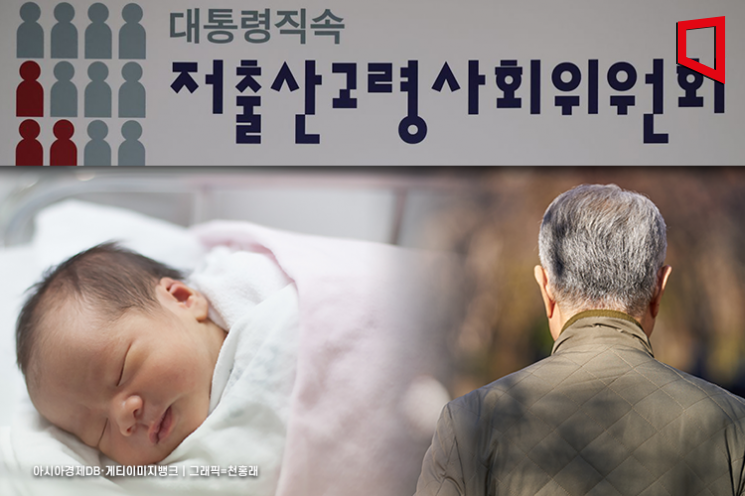
He added, "Based on this, we will prepare a 'Response Plan for an Aging Society' by early next year, focusing on continuous employment and old-age income security, medical care, nursing, caregiving, elderly-friendly housing and industries, and social participation," and stated, "We will also consider expanding childbirth credits linked to overcoming ultra-low birthrate during the national pension reform process."
He emphasized that since the trend of declining working-age population will continue for the time being, efforts to adapt must also be made simultaneously. He said, "We need to encourage active economic participation from various groups such as youth, women in their 30s and 40s, and the elderly, and supplement the decline in the working-age population by increasing the utilization of foreign labor through immigration policy reforms," adding, "We will also promote efforts to restructure the industrial structure centered on advanced industries through bold deregulation, expansion of R&D and education investment, and integration of Fourth Industrial Revolution technologies such as AI to enhance overall economic productivity."
He also emphasized cooperation between Korea and Japan. He said, "Since the trends of low birthrate and aging are global phenomena, more practical solutions can be found by sharing experiences and cases and cooperating beyond individual national responses."
© The Asia Business Daily(www.asiae.co.kr). All rights reserved.
![Clutching a Stolen Dior Bag, Saying "I Hate Being Poor but Real"... The Grotesque Con of a "Human Knockoff" [Slate]](https://cwcontent.asiae.co.kr/asiaresize/183/2026021902243444107_1771435474.jpg)

















