Government to Implement 'Winter Safety Management Measures'
This winter, the government has prepared safety management measures to respond to accidents such as heavy snowfall, cold waves, and fires. The plan is to monitor snowfall conditions in real-time through control systems and manage them in real-time through communication with local governments.
On the 21st, the Ministry of the Interior and Safety announced that it will promote the 'Winter Safety Management Measures' jointly with related agencies to ensure that the public can spend a safe and warm winter.
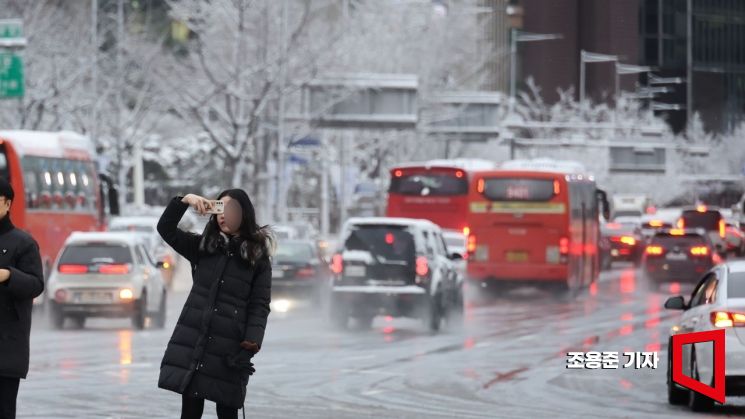 On February 22 last year, a citizen heading to work at the Gwanghwamun intersection in Seoul captures the snow-covered urban landscape on their mobile phone. Photo by Jo Yong-jun
The government has designated the period from December 15 this year to March 15 next year as the 'Winter Natural Disaster Countermeasure Period' and will maintain a constant readiness system for hazardous weather. The snowfall observation network has been expanded from 559 to 625, and the number of local government CCTV monitoring cameras has increased from 540,000 to about 600,000, expanding snow removal infrastructure. In disaster-prone areas, regular and ad-hoc safety inspections are conducted once a month.
Disaster information is shared in real-time through communication channels among central and regional governments, local governments, and eup/myeon/dong offices, as well as village chiefs and community leaders. Vice heads of local governments focus all efforts on on-site situation management. 'Village Snow Removal Teams' consisting of community leaders such as village chiefs are operated, and cooperation systems among public, private, and military sectors are activated to collaborate on snow removal.
To prevent about 400 cases of cold-related illnesses annually, protection for vulnerable groups such as the elderly, homeless, and outdoor workers is strengthened. This includes ▲ safety checks for vulnerable elderly through life support workers ▲ 24-hour emergency shelters operation ▲ operation of cold wave shelters and mobile worker shelters to closely manage cold wave vulnerable groups.
Heating cost support of 400,000 KRW per month for senior centers has been expanded to include 'unregistered senior centers,' and the energy voucher support amount has been increased by 10,000 KRW. Each region also identifies crisis households and supports winter fuel costs until March.
Fire safety management measures that may arise from increased use of heating devices are also being promoted. Facilities with a high risk of large fires, such as jjimjilbangs, nursing homes, and battery manufacturing plants, are intensively managed. Traditional markets strengthen safety inspections and nighttime patrols led by voluntary fire brigades.
In case of a surge in fire reports, the number of 119 emergency call reception desks will be increased from 334 to 837. Special fire duty will be carried out during vulnerable periods such as Christmas and the year-end and New Year holidays.
Lee Han-kyung, Director of the Disaster and Safety Management Headquarters at the Ministry of the Interior and Safety, said, "We will carefully monitor whether the government measures prepared this time are properly functioning on the ground so that the public can spend a safe and warm winter."
© The Asia Business Daily(www.asiae.co.kr). All rights reserved.

















