Medical Group Action Central Disaster and Safety Countermeasures Headquarters Meeting
Improvement of Public Health Doctors and Military Medical Officers Dispatch System
To fill the medical gap caused by conflicts between the government and medical professionals, personnel working in island regions and vulnerable areas are excluded from being dispatched when public health doctors or military doctors are sent.
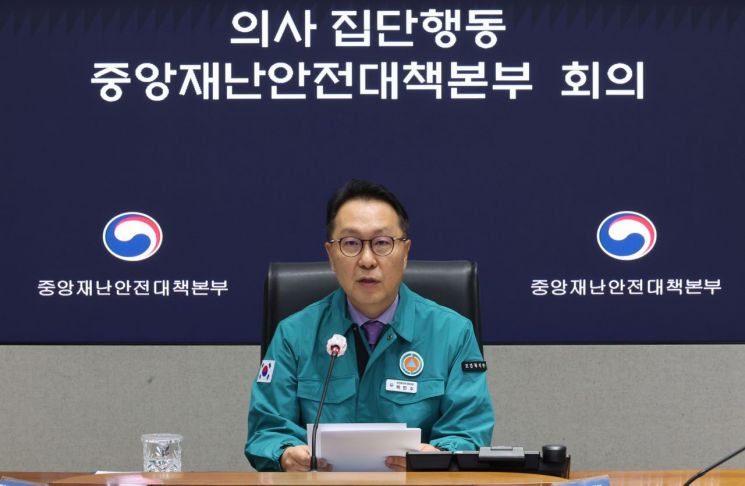 Park Min-su, the 1st Chief Coordinator of the Central Disaster and Safety Countermeasures Headquarters (Vice Minister of Health and Welfare), is speaking at the Central Disaster and Safety Countermeasures Headquarters meeting on doctors' collective action held at the Government Seoul Office in Jongno-gu, Seoul on the 21st. Photo by Yonhap News
Park Min-su, the 1st General Coordinator of the Central Disaster and Safety Countermeasures Headquarters (CDSCH) for the collective action of doctors (Vice Minister of Health and Welfare), chaired the CDSCH meeting at the Government Seoul Office on the 21st and announced improvement measures for the public health doctor and military doctor dispatch system.
Coordinator Park explained, "Despite the difficulties in the medical field, public health doctors and military doctors are playing an important role in maintaining the emergency medical system. Through this reform, public health doctors will be excluded from dispatch to non-contiguous islands (12 cities/counties, 42 islands) and triple vulnerable areas for childbirth, emergency, and pediatrics (22 counties). Dispatch within the same province will be the principle so that they can support patient care in a more familiar environment."
Coordinator Park also said, "For military doctors, a preliminary assignment procedure at least one week in advance and a procedure for medical institutions to directly request the dispatch of military doctors will be introduced. Through this, military doctors will be assigned after sufficient prior consultation, and medical institutions will be able to receive military doctors from their own institutions to contribute to patient care."
The government's ongoing 'Support Project for the Structural Transformation of Tertiary Hospitals' saw 11 additional institutions, including Seoul National University Hospital, added in the 4th selection evaluation on the 15th, bringing the total to 42 institutions participating, which is about 90% of all 47 tertiary hospitals.
Coordinator Park emphasized, "We are advancing medical reform tasks one by one so that citizens can receive necessary medical services regardless of the region they live in. Through structural transformation, tertiary hospitals will focus on severe, emergency, and rare diseases and provide higher quality medical care by diagnosing patients more quickly and sufficiently."
Along with this, the government urged that during the winter season, to prepare for the spread of respiratory diseases such as COVID-19 and influenza, seniors aged 65 and over, residents of infection-vulnerable facilities, pregnant women, and children must receive vaccinations. The government also repeatedly requested that other medical organizations, such as the Medical Association and resident doctors, participate in the ruling and opposition party government-medical council with an open mind, as dialogue for medical normalization continues.
© The Asia Business Daily(www.asiae.co.kr). All rights reserved.

















