Martial Arts, Complaining About Productivity Decline Due to '52-Hour Workweek'
Lee "Positions Differ... Debate and Ease If Necessary"
Lee Jae-myung, leader of the Democratic Party of Korea, heard about the difficulties faced by the trade industry during a meeting with the Korea International Trade Association (KITA) chairpersons. Lee specifically mentioned the sharply divided issues of the 52-hour workweek and the Safe Freight Rate System, stating that "we need to consider them carefully."
On the 20th, at the 'Democratic Party-Korea International Trade Association Livelihood Economy Meeting for Economic Revitalization' held at the National Assembly, Lee opened by saying, "The development of South Korea into the world's 10th largest economy is thanks to exports," adding, "(However) the recent export environment has worsened, narrowing our external economic territory." He continued, "As a politician and as the Democratic Party, I will listen candidly to what role we can play and try to find the maximum possible actions."
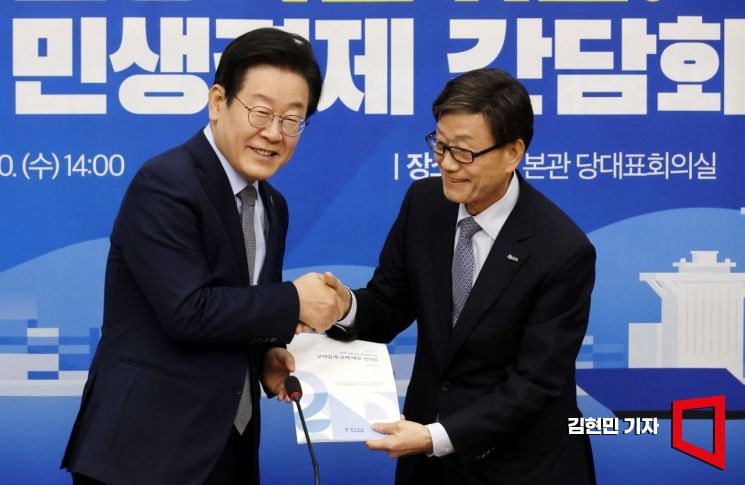 Lee Jae-myung, leader of the Democratic Party of Korea, is receiving a petition on trade industry regulations and difficulties from Yoon Jin-sik, chairman of the Korea International Trade Association, at the National Assembly on the 20th. Photo by Kim Hyun-min
Yoon Jin-sik, chairman of KITA, handed over a proposal containing the trade industry's difficulties to Lee. Cho Sang-hyun from KITA's International Trade and Commerce Research Institute explained the proposal, analyzing that "the trade balance is expected to recover its stable surplus trend." However, he also reported, "After the U.S. presidential election, checks on China have intensified, so while South Korea may gain some indirect benefits, overall, the trade waves are expected to rise due to U.S. protectionism."
The specific proposals from the trade industry included ▲comprehensive measures to address the decline in the working-age population ▲introduction of negative regulations on new technologies ▲strengthening protection against industrial technology leakage ▲reconsideration of the reintroduction of the Safe Freight Rate System ▲clarification of regulations under the Serious Accident Punishment Act. Negative regulation refers to a regulatory approach where all actions are permitted unless explicitly prohibited by law, minimizing restrictions and often applied to innovative growth technologies. Lee responded positively, saying, "Introducing negative regulations in the fields of new technologies and new industries seems truly necessary."
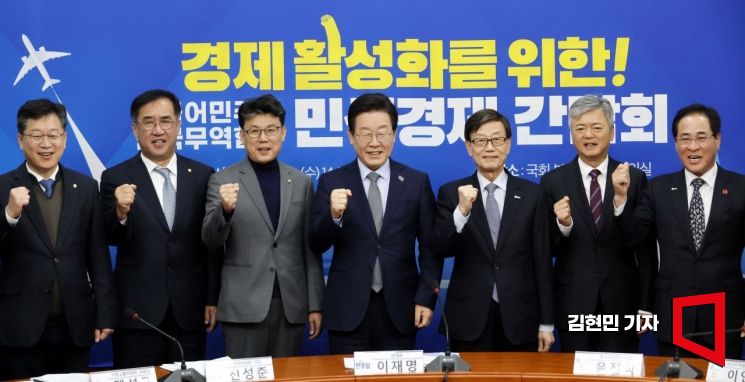 Lee Jae-myung, leader of the Democratic Party of Korea, is taking a commemorative photo before holding a meeting with Yoon Jin-sik, chairman of the Korea International Trade Association, at the National Assembly on the 20th. Photo by Kim Hyun-min
Regarding KITA's proposals to ease the 52-hour workweek and to reconsider the Safe Freight Rate System, Lee showed a reserved stance. KITA explained, "With the 52-hour workweek imposing only time limits, competitiveness is falling compared to the U.S. and Japan," adding, "In the U.S. and Japan, exceptions exist such as not applying the 52-hour workweek to white-collar workers earning over 100 million won annually." Lee responded, "If it is practically necessary, it should be strictly limited and additionally allowed," but also said, "Since the labor side has a different stance, we need to debate this precisely."
On reconsidering the Safe Freight Rate System, Lee stated, "The party is pushing for its reintroduction, but there are differing claims about the basic facts, so I don't know which is objectively correct." The Safe Freight Rate System is a system that effectively guarantees a minimum wage to workers in the freight transport industry. It was temporarily operated from 2020 to 2022.
© The Asia Business Daily(www.asiae.co.kr). All rights reserved.


















