Major PEFs Including IMM, Glenwood, EQT, and Apalma Focus on Environmental Businesses Such as Recycling and Water Treatment
Major domestic private equity firms (PEFs) are focusing on acquiring companies related to the environment, such as waste and water treatment. This is interpreted as a shift towards investing in infrastructure-type businesses rather than highly volatile consumer goods amid uncertain domestic economic conditions.
According to the investment banking (IB) industry on the 21st, Glenwood Private Equity (Glenwood PE) recently signed a stock purchase agreement (SPA) to acquire three water treatment companies under the Bubang Group.
The companies Glenwood PE is acquiring include Techross Environmental Services, Bugok Environmental, and the Chinese subsidiary of Techross Water & Energy. While competitors like Ecobit focus mainly on public water treatment operation and maintenance (O&M) businesses, Techross Environmental Services operates comprehensively in both public and private sectors.
Environmental companies are regulated industries with good cash flow and high future value. Businesses such as plastic waste recycling and urban mining, which extracts metal resources from industrial waste, are considered promising future industries.
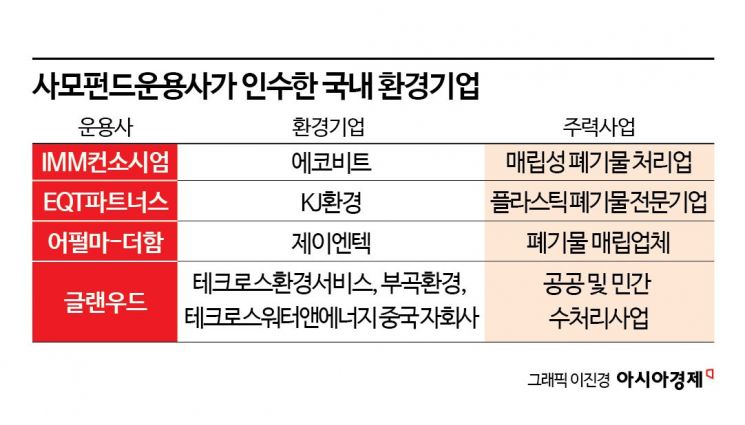
In addition to this year’s Bubang Group water treatment companies, several other environmental companies have welcomed PEF operators as new owners. Earlier, the IMM consortium (IMM Private Equity, IMM Investment, IMM Credit & Solution) acquired Ecobit for 2.07 trillion KRW. Ecobit is a waste disposal company and the leading player in the domestic landfill market. TY Holdings, the holding company of the Taeyoung Group, and PEF operator KKR each held half of the shares before it entered the M&A market during Taeyoung Group’s restructuring process.
Global private equity firm EQT Partners acquired KJ Environment, a plastic waste specialist, for 1 trillion KRW in the second half of this year. The Apalma Capital and The Ham Partners consortium acquired waste landfill operator JNTec for about 500 billion KRW. A senior PEF industry official said, "It is difficult to invest in consumer goods with high volatility in an uncertain economic environment," adding, "Looking for stable infrastructure investments leads us to environmental companies."
The waste industry has high entry barriers as government approval is required. With global efforts underway to address climate change and environmental pollution, this sector is expected to grow and is positive in terms of profitability. Domestic waste companies are small-scale and scattered nationwide, making it ideal to implement a 'bolt-on' strategy by consolidating similar companies to create synergy.
Some large corporations have invested trillion-won scale funds in the waste industry ahead of PEFs. SK Group acquired waste company EMC Holdings (now SK Ecoplant) for 1 trillion KRW in 2020 and has expanded its business by consecutively acquiring medical waste and electronic waste companies. GS Group entered the waste-related industry by acquiring global water treatment company Inima (now GS Inima) in 2011, led by GS Construction. In 2019, it also entered the secondary battery recycling industry through its subsidiary Enerma.
© The Asia Business Daily(www.asiae.co.kr). All rights reserved.
!["The Woman Who Threw Herself into the Water Clutching a Stolen Dior Bag"...A Grotesque Success Story That Shakes the Korean Psyche [Slate]](https://cwcontent.asiae.co.kr/asiaresize/183/2026021902243444107_1771435474.jpg)
















