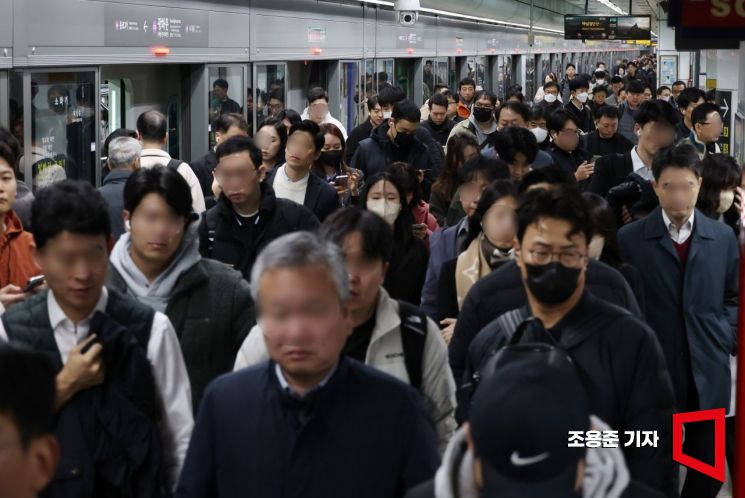
 On the 20th, when the Seoul Metro Workers' Union operating lines 1 to 8 of the Seoul subway began a legal strike, Gwanghwamun Station on Line 5 was crowded with commuters. The Seoul Metro Workers' Union will go on strike starting from the 6th of next month if dialogue is refused. Photo by Jo Yong-jun
Following the National Railroad Workers' Union, the Seoul Metro Union began its 'lawful strike (work-to-rule)' on the 20th. Although there was some confusion during the morning commute in Seoul, the feared massive disruption did not occur overall.
At some stations, trains ran slower than usual or stopped en route. While some commuters were unable to arrive on time due to train delays, most hurried to get to work punctually. However, many citizens are concerned about the evening commute if the lawful strike continues. A 'lawful strike' is a type of work-to-rule action, where employees act strictly according to labor laws such as the Labor Standards Act, refuse overtime or holiday work, leave work on time, or collectively use vacation days recognized by collective agreements or employment rules, thereby reducing work efficiency.
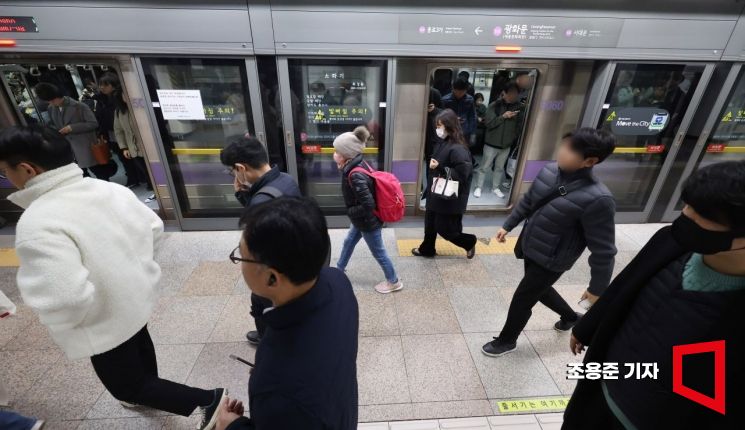 On the 20th, when the Seoul Metro Workers' Union operating lines 1 to 8 of the Seoul subway began a compliance strike, citizens were using the subway at Gwanghwamun Station on Line 5 in Seoul. The Seoul Metro Workers' Union will go on strike starting from the 6th of next month if dialogue is refused. Photo by Jo Yong-jun
According to Korea Railroad Corporation, as of 8 a.m. that day, among 288 metropolitan area trains operating on subway lines 1, 3, and 4, the Suin-Bundang Line, and the Gyeongui-Jungang Line, 8 trains were delayed by more than 20 minutes. Following the previous day, delays on metropolitan subway lines and the Gyeongui-Jungang Line were prominent. A Seoul Metro official, which operates subway lines 1 through 8, told Yonhap News Agency, "As of 8 a.m., the on-time arrival rate for metropolitan area trains was 100%, and there were no cases of delays exceeding 20 minutes." Sindorim Station, usually crowded with people, was busier than usual. Amid hurried transfers, an announcement apologized for train delays of 10 to 20 minutes. True to the lawful strike, some trains kept their doors open for about a minute after all passengers had boarded before departing. There were also trains with signs reading 'Achieve a workplace without surveillance and punishment' attached to the driver's cabin window.
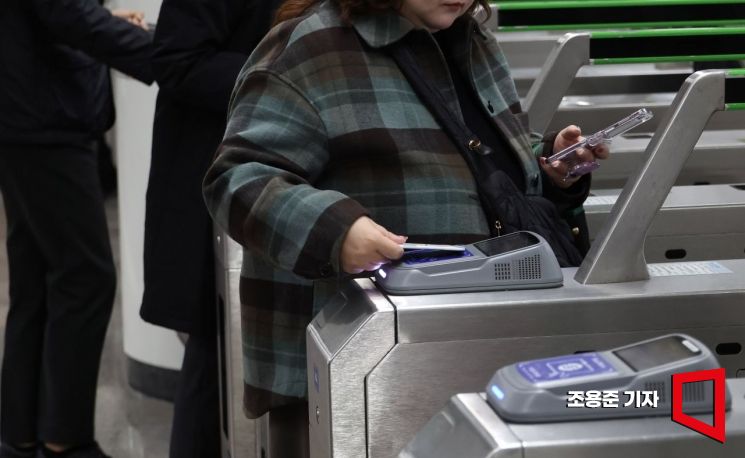 On the 20th, when the Seoul Metro Workers' Union operating lines 1 to 8 of the Seoul subway started a compliance strike, citizens were using the subway at Gwanghwamun Station on Line 5 in Seoul. The Seoul Metro Workers' Union will go on strike starting from the 6th of next month if dialogue is refused. Photo by Jo Yong-jun
Citizens expressed concerns that inconveniences could increase if the strike intensifies. A commuter met at Gwanghwamun Station on Line 5 said, "I didn't know what a lawful strike was, so I hurried to work today no matter what," but added, "If people crowd during the evening commute, delays could be longer than 10 to 20 minutes." Another citizen said, "If the lawful strike continues like this, a real strike in December will cause significant inconvenience to citizens ahead of the year-end and New Year holidays."
© The Asia Business Daily(www.asiae.co.kr). All rights reserved.



















