Establishment and Implementation of Comprehensive Management Plan
Targeting Major Rivers and Parks Including Gyeongancheon
Yongin City in Gyeonggi Province will begin intensive removal of invasive plant species spreading across major rivers and parks within the city starting next year.
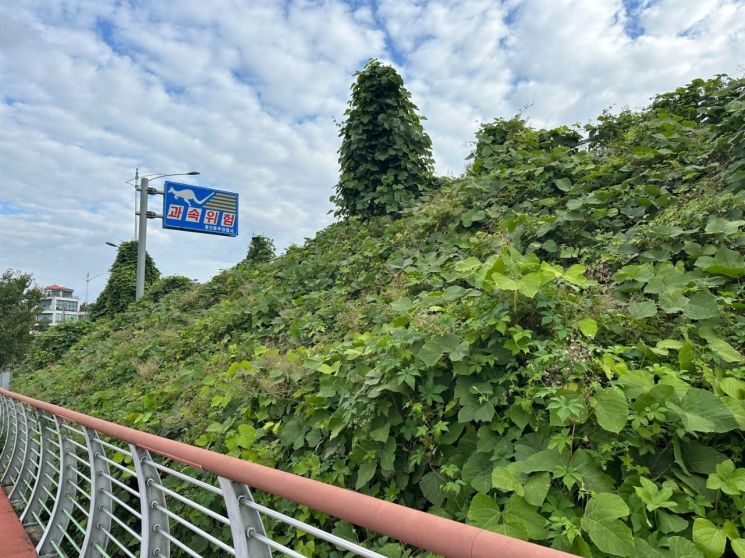 Invasive wild plants clustered along the walking trails of Giheung Lake Park in Yongin. The Yongin City government has established a comprehensive plan to begin intensive removal of invasive wild plants spreading along riversides and park areas starting next year. Provided by Yongin City
On the 20th, Yongin City announced that it has established a "Comprehensive Management Plan for Invasive Wild Plants" to remove invasive wild plants disrupting the ecosystem and restore native plants to create a healthy ecosystem.
The plan includes a joint response by relevant departments to systematically remove wild plants thriving along three major rivers?Gyeongan Stream, Singal Stream, and Tancheon?as well as surrounding roadsides and parks starting next year.
The city identified the habitat status of invasive wild plants based on the "Status Survey Report on Distribution of Invasive Species in the Metropolitan Area" and designated the period from May to September as the intensive management period to focus on removing invasive plants. The management targets include three priority species?Ambrosia artemisiifolia (common ragweed), Dioscorea polystachya (Chinese yam), and Erechtites hieraciifolius (fireweed)?along with 15 other invasive plant species. Ambrosia artemisiifolia causes pollen allergies, while Dioscorea polystachya and Erechtites hieraciifolius hinder the germination and growth of surrounding plants, causing significant damage.
The city will first have the management department directly remove invasive plants on public land and recommend removal to private landowners. In particular, for major habitats such as Gyeongan Stream and Tancheon covering 169,825 square meters, the city plans to actively remove invasive plants using private organizations and professional contractors.
To expand citizen participation, biodiversity education will be conducted through the Suji Environmental Education Center and related materials on invasive plants will be posted on the city’s website.
A city official stated, "Harmful alien species have strong reproductive abilities and threaten the ecosystem to the extent of damaging native plant habitats. The city will systematically remove invasive wild plants to restore a healthy ecosystem."
This year, the city conducted invasive wild plant removal operations over 175,588 square meters along major rivers such as Gyeongan Stream and Singal Stream.
© The Asia Business Daily(www.asiae.co.kr). All rights reserved.
![Clutching a Stolen Dior Bag, Saying "I Hate Being Poor but Real"... The Grotesque Con of a "Human Knockoff" [Slate]](https://cwcontent.asiae.co.kr/asiaresize/183/2026021902243444107_1771435474.jpg)











