Legislative Research Office 'Analysis of the 22nd National Assembly Election'
Sharp Decline in Support Rate Among 2030 Males Compared to Presidential Election
An analysis revealed that the withdrawal of support for the People Power Party by young men in their 20s and 30s was a major cause of the party's defeat in the 22nd general election. Meanwhile, the support for the Democratic Party among young women in their 20s and 30s appeared to have strengthened further.
According to the "22nd National Assembly Election Analysis" report released on the 20th by the National Assembly Research Service, unlike the last presidential election, the voting tendencies of young men in their 20s and 30s changed dramatically in this general election. Based on broadcast exit poll data, the proportion of men in their 20s who supported the People Power Party candidate (President Yoon Seok-yeol) was 22 percentage points higher than those who supported the Democratic Party candidate (Representative Lee Jae-myung) in the last presidential election. However, in this April's general election, this proportion dropped to just 2 percentage points. Similarly, men in their 30s supported the People Power Party by 10 percentage points more than the Democratic Party in the last presidential election, but this figure fell to 2 percentage points in the general election. Within just two years, support for the People Power Party among young men sharply weakened.
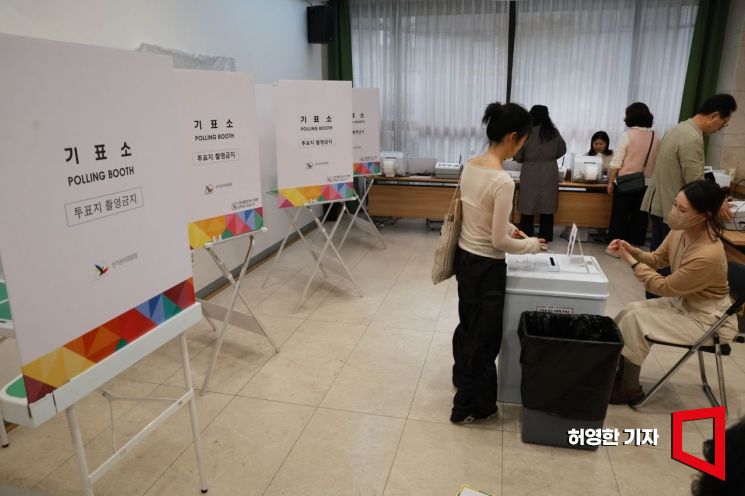 On the afternoon of the 11th, the first day of early voting for the Seoul Metropolitan Office of Education Superintendent and other by-elections, voters are casting their ballots at an early voting station in Jung-gu, Seoul. Photo by Huh Younghan younghan@
The Research Service stated, "The significant decline in relative support for the People Power Party among young men likely had a considerable impact on the election results."
During the last presidential election, the People Power Party campaigned under the ‘Generation Encirclement Theory’ promoted by former leader Lee Jun-seok (currently a member of the Reform New Party). However, after the election, as Lee was effectively ousted from the party leadership and eventually left the party, the generational coalition is presumed to have weakened.
Conversely, young women have consistently shown strong support for the Democratic Party, and this tendency intensified in the recent general election compared to the presidential election. Among women in their 20s, the gap between those who voted for the Democratic Party and those who voted for the People Power Party increased from 24 percentage points in the last presidential election to 45 percentage points in this general election. For women in their 30s, this gap widened from 6 percentage points to 23 percentage points.
Notably, female voter turnout has been increasing. According to the National Election Commission's analysis, voter turnout among women in their 20s to 40s surpassed that of men in the same age groups.
The Research Service analyzed, "Due to the defection of 2030 men from the People Power Party, the gender divide within the youth demographic weakened. Combined with the president's low approval ratings and retrospective voting tendencies, this contributed to the opposition party securing a majority of the seats."
© The Asia Business Daily(www.asiae.co.kr). All rights reserved.

















