A platform capable of mass-producing organoids has been developed. Organoids are also referred to as mini-organs or organ-like structures. The mass production of organoids is expected to lead to expanded applications in the clinical and pharmaceutical industries, acting as a catalyst for animal alternative testing methods (FDA Modernization Act 2.0) and regenerative therapy development.
The National Research Foundation of Korea announced on the 20th that a research team led by Professor Dong-Sung Kim from POSTECH and Professor Tae-Eun Park from Ulsan National Institute of Science and Technology (UNIST) developed a platform capable of uniformly mass-producing organoids.
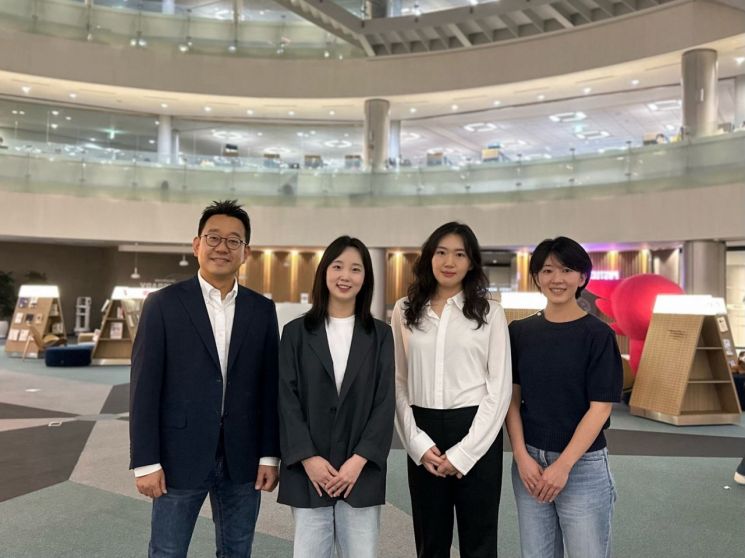 (From left) Professor Kim Dong-sung of POSTECH, Researcher Kim Do-hee, Researcher Lim Hyun-ji of UNIST, Professor Park Tae-eun. Provided by the National Research Foundation of Korea
Organoids are three-dimensional cellular structures that perform functions similar to actual organs and are gaining attention in the fields of human organ development, disease modeling, and regenerative therapy research.
However, current organoid production technologies have limitations. It is difficult to reproducibly produce mature organoids, and maintaining uniform quality and functionality of cultured organoids is challenging.
These issues limit the practical use of organoids in clinical trial validation and new drug development processes. Above all, the existing difficulty in mass-producing organoids has resulted in failing to meet industrial demands.
To address these problems, the joint research team developed a platform called UniMat (Uniform and mature organoid culture platform) that can mass-produce uniform and mature organoids.
UniMat consists of nanofibers with a diameter of 500 nm, about 1/200 the thickness of a human hair. It is a three-dimensional permeable membrane made through a thermoforming process. The three-dimensional permeable membrane provides structural constraints for uniform organoid formation, ensuring consistent size and structure of the organoids.
Additionally, its highly permeable properties allow efficient delivery of nutrients and differentiation factors during the culture process, playing a crucial role in enhancing organoid maturity.
The joint research team successfully produced kidney organoids with nephron structures and blood vessels similar to those of humans from human induced pluripotent stem cells (iPSCs) using UniMat, achieving consistent quality and dramatically improving production efficiency. They also established a polycystic kidney disease model and confirmed the potential for standardized organoid-based disease modeling and drug evaluation.
Induced pluripotent stem cells are stem cells reprogrammed from adult cells to regain differentiation potential and can differentiate into various cell types.
The joint research team expects that this research achievement will accelerate organoid-based research and development, which requires high reproducibility and reliability, and contribute to the development of recently spotlighted animal alternative testing methods.
In particular, by simultaneously solving the issues of organoid quality assurance and mass production with UniMat, it is evaluated that a foundation has been laid for the practical use of organoids in clinical and pharmaceutical industries.
Meanwhile, this research was conducted with support from the Ministry of Science and ICT and the National Research Foundation of Korea through the Bio·Medical Technology Development Project, Mid-Career Researcher Program, and Excellent Young Researcher Program. The research paper was also published online on the 31st of last month in the international journal Nature Communications.
© The Asia Business Daily(www.asiae.co.kr). All rights reserved.

















