Next Month's Commissioning... SM-6 Installation Planned for Sejong Daewang-Class
A naval vessel capable of intercepting North Korea's ballistic missiles is being developed. Until now, our naval ships could only detect North Korea's ballistic missiles, leading to controversy as "ships without fists."
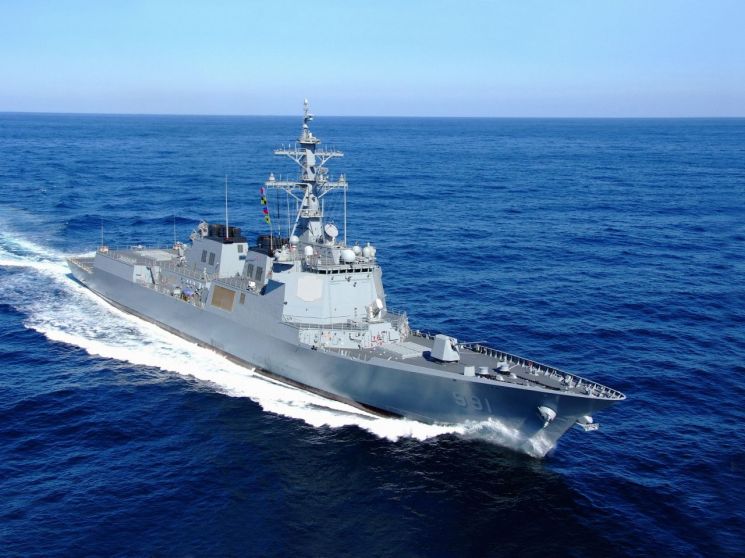
According to the military on the 20th, the Jeongjo Daewang-class destroyer will be delivered to the Navy on the 27th. Since its launching in July 2022, the Defense Acquisition Program Administration and the shipbuilder HD Hyundai Heavy Industries have conducted sea trials and basic performance verification procedures. The Navy, which will receive the Jeongjo Daewang-class destroyer, plans to hold a commissioning ceremony in early next month to announce the ship's arrival, followed by about a year of extensive testing in all areas including crew boarding and armament to proceed with its operational deployment.
The Jeongjo Daewang-class destroyer has a light displacement of 8,200 tons, making it the largest among the Navy's destroyers, while its maximum speed reaches 30 knots (approximately 55 km/h). Most importantly, unlike existing Navy Aegis destroyers that could only 'detect and track' ballistic missiles, the Jeongjo Daewang-class can 'detect, track, and intercept,' which is its most significant distinction.
The core is the SM-3 naval surface-to-air missile. The previous Sejong Daewang-class destroyers were equipped with SM-2 naval surface-to-air missiles. Although the Sejong Daewang-class also features the Aegis combat system and radar with a detection range of about 1,000 km, the SM-2 missile can only attack aircraft and cruise missiles flying below approximately 24 km altitude. Ballistic missiles can be monitored but not intercepted.
The SM-3 missile to be installed on the Jeongjo Daewang-class destroyer is a 'game changer' in this operational environment. The government decided to purchase the SM-3 at the Defense Acquisition Program Promotion Committee in April. The military is reportedly considering purchasing the SM-3 Block I, which has a maximum interception altitude of about 500 km, and the Korea Institute for Defense Analyses (KIDA) is currently conducting a feasibility study.
Some versions of the SM-3 (Block IIA) have an interception altitude exceeding 1,000 km and are capable of intercepting intercontinental ballistic missiles (ICBMs). This led to some controversy over whether to introduce the SM-3. Critics argued that North Korea would only launch short-range ballistic missiles with low flight altitudes toward South Korea, making it unnecessary, or that it might be integrated into the U.S. missile defense (MD) system. However, counterarguments gained traction, noting that if North Korea mobilizes all its forces, there is no guarantee it would not launch medium-range or longer missiles at high angles toward the South, and that it is less plausible to conduct ICBM interception aimed at the U.S. mainland from the Korean Peninsula.
The military expects that the introduction of the SM-3 will enable 'theatre defense' on the Korean Peninsula. This means there will be opportunities to intercept North Korean ballistic missiles anywhere in the operational waters around the peninsula and at higher altitudes. The ballistic missile trajectory is divided into the boost phase immediately after launch, the midcourse phase during high-altitude flight, and the terminal phase as it descends toward the target.
Currently, the Korean Air and Missile Defense (KAMD) system consists of ground-based Patriot, THAAD, and Cheongung (M-SAM) systems that defend against enemy ballistic missiles during the terminal phase. The SM-3 provides interception opportunities not only in the terminal phase but also in the midcourse phase, thereby securing additional chances to perform the highly challenging task of missile interception. The Jeongjo Daewang-class destroyer will also be equipped with the SM-6 missile, which can defend against ballistic missiles in the terminal phase. Following the operational deployment of the Jeongjo Daewang-class and the introduction of the SM-3, the military is considering equipping the Sejong Daewang-class destroyers with the SM-6 as well, to create a more layered and robust ballistic missile defense network.
A military official said, "The operational deployment of the Jeongjo Daewang-class destroyer signifies a revolutionary enhancement of deterrence against North Korea through strengthening the missile defense network."
© The Asia Business Daily(www.asiae.co.kr). All rights reserved.

















