Small Drones Capable of Long-Distance Transport
Concerns Over Mass Supply to Taiwanese Military in Emergencies
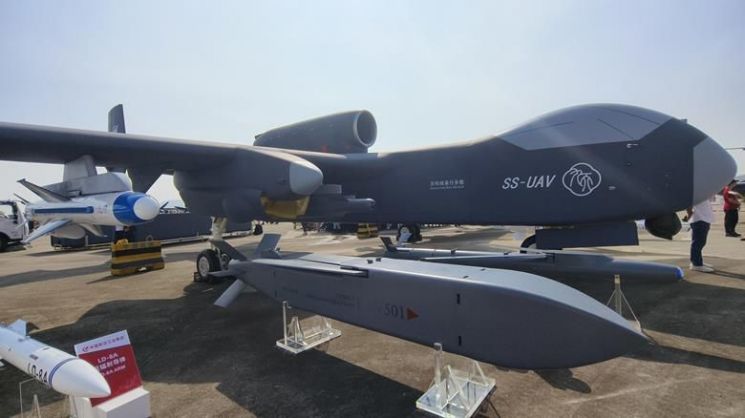 The SS-UAV Jettank drone unveiled at the airshow held in Zhuhai, Guangdong Province, China, from the 12th to the 17th of this month. It can carry missiles and drones weighing up to 6 tons internally. Photo by China CCTV
The world, including the United States, is showing keen interest in the threatening capabilities of China's new unmanned aerial vehicle (drone) 'SS-UAV Jetank,' recently unveiled at the Zhuhai Airshow. China's new weapon is known to be capable of transporting thousands of small drones over long distances. If China deploys this drone in actual combat, it could launch a massive drone swarm in the Taiwan Strait area, where military tensions are already high. The Taiwanese government is preparing for China's mass drone offensive by continuously purchasing drones from the United States and expanding production facilities within Taiwan.
Capable of carrying thousands of drones over long distances... advantageous for mass drone offensives
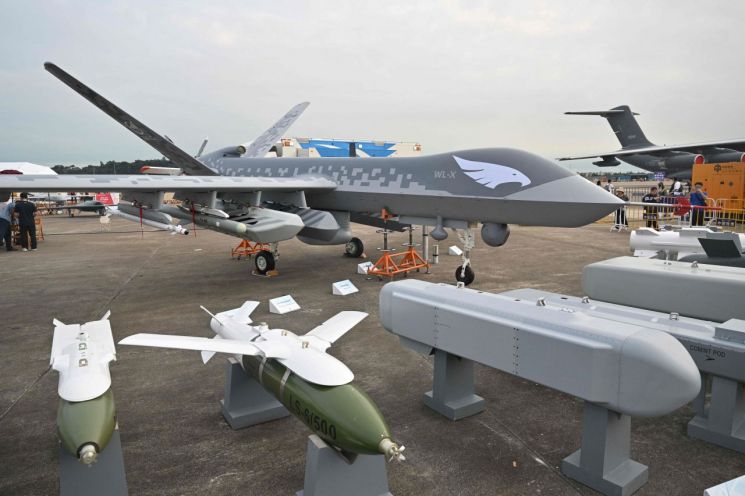 Images of the Winglong-X (WL-X) unmanned aerial vehicle (drone) and various weapons displayed at the airshow held from the 12th to the 17th of this month in Zhuhai, Guangdong Province, China. Photo by AFP Yonhap News
At the airshow held from the 12th to the 17th of this month in Zhuhai, Guangdong Province, China's new drone Jetank was unveiled for the first time. With a wingspan of 25 meters, it is classified as a large drone. China's state-run Global Times described the Jetank as "unlike other common drones used for reconnaissance, bombing, or suicide missions, it can carry small drones internally," adding that "the maximum payload capacity reaches up to 6 tons (t)."
Drones are generally categorized into ultra-small drones weighing less than 250 grams (g), small drones weighing 2 to 25 kilograms (kg), medium drones ranging from 25 kg to 150 kg, and large drones weighing over 150 kg. In the case of the Jetank, if the entire 6-ton payload capacity is filled with small drones, it is estimated that it can carry thousands of small drones. Because of this, both inside and outside China, it is referred to as a "drone carrier," akin to an aircraft carrier for drones.
According to the manufacturer, Aviation Industry Corporation of China (AVIC), this drone can be used not only for reconnaissance and general attacks but also for airborne operations. By switching payloads, it can transport not only drones but also various weapons and supplies. It can also be equipped with laser-guided bombs, glide bombs, anti-ship missiles, and air-to-air missiles, enabling it to provide fire support in aerial operations.
Chinese military aviation expert Fu Chenxiao explained to Global Times, "This drone can transport weapons and equipment comparable to the payload of a bomber over long distances and can deploy small drone swarms using artificial intelligence (AI) for various operations."
Taiwan is purchasing US suicide drones but... "Millions more needed"
If China's drone carrier is deployed in actual combat, Taiwan is expected to face greater military pressure. In an emergency, if China transports large-scale drone squadrons from the mainland and launches a mass drone offensive in the Taiwan Strait area, it will be difficult to respond effectively.
Initially, the United States and Taiwan planned a so-called "hellscape" operation, deploying thousands of bombing drones in the Taiwan Strait to block access to Taiwan's mainland in preparation for a Chinese invasion. However, gathering the necessary drones has proven difficult. DJI, which controls 70% of the global drone market, also dominates the supply chain for key drone components, making it challenging to expand drone production facilities within Taiwan.
In June, the Taiwanese government announced it would purchase 1,000 drones, including suicide and multipurpose drones, from the US government. Separately, it is preparing to establish a large-scale drone production base within Taiwan. The plan is to have around 1,700 drones by the end of the year, but considering China's massive production capacity, this is expected to be far from sufficient. The Institute for the Study of War (ISA) pointed out, "To have the capability to counter China, Taiwan would need to deploy at least several million drones to the front lines in a short period."
Moreover, considering the modern warfare environment where drone usage on the front lines has significantly increased, a fleet of around 1,700 drones could be quickly depleted. The UK's Royal United Services Institute (RUSI) estimated that the Ukrainian military, engaged in conflict with Russia, consumes about 10,000 drones per month alone.
© The Asia Business Daily(www.asiae.co.kr). All rights reserved.
![Clutching a Stolen Dior Bag, Saying "I Hate Being Poor but Real"... The Grotesque Con of a "Human Knockoff" [Slate]](https://cwcontent.asiae.co.kr/asiaresize/183/2026021902243444107_1771435474.jpg)


















