Construction of Green Energy Cities, Resolving Energy Welfare Blind Spots
Secured 70 Million KRW Budget... Accelerating Energy Happy City
Yeongju City received the Grand Prize at the '2024 Gyeongsangbuk-do Energy Awards Ceremony' held on the 19th at the Seonbi World Convention Hall.
Hosted by Gyeongbuk Province and organized by the Korea Energy Agency, the Energy Awards evaluate 22 cities and counties within the province based on eight criteria: △renewable energy distribution projects △discovery of energy policies and system improvements △energy-saving inspections and crackdowns △safety inspections of renewable energy facilities △resident participation and contribution to provincial policy achievements, among others, selecting outstanding achievements in the energy sector.
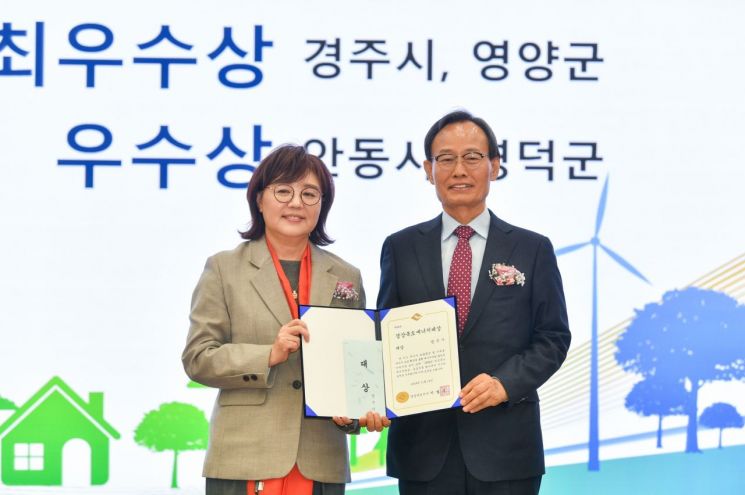 Yeongju City is receiving the Gyeongbuk Province Energy Award and taking a commemorative photo. (From the left, Yang Geum-hee, Deputy Governor for Economy of Gyeongbuk Province, Park Nam-seo, Mayor of Yeongju City)
The city was recognized for its achievements in building a green energy city through the expansion of renewable energy infrastructure and addressing energy welfare blind spots, receiving the Grand Prize along with securing a project fund of 70 million KRW.
The city achieved the notable accomplishment of being selected for the Renewable Energy Convergence Support Project for three consecutive years. From 2022 in the northern region (Punggi-eup, Sunheung, Dansan, Buseok, Anjeong), 2023 in the southern region (Bonghyeon, Isan, Pyeongeun, Munsu, Jangsu), and 2024 in the downtown area (9 districts), a total project cost of 10.9 billion KRW (5.8 billion KRW national and provincial funds, 3.4 billion KRW city funds, 1.7 billion KRW self-contribution) was invested to complete the installation of 1,314 solar power sites, 83 solar thermal sites, and 94 geothermal sites. This is expected to reduce approximately 1 billion KRW annually in electricity bills and heating fuel costs for individual homes and others.
Additionally, to eliminate energy welfare blind spots between urban and rural areas, a total of 9.3 billion KRW has been invested in projects including △LPG pipeline network construction at the village level in rural areas without city gas supply (2.1 billion KRW) △city gas supply project for 323 households in the downtown area (1 billion KRW) △energy-saving projects such as replacement of outdated electrical facilities (streetlights) (1 billion KRW) △energy welfare projects for vulnerable groups (5.2 billion KRW), accelerating the realization of a carbon-neutral green city and an energy-happy city.
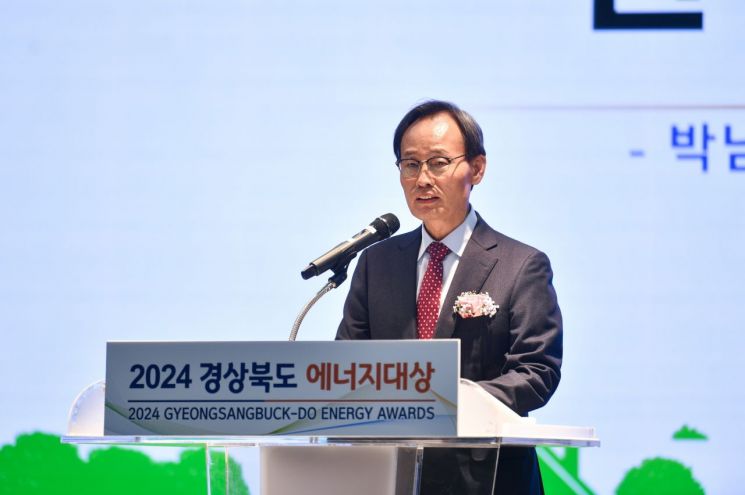
Mayor Park Nam-seo stated, “We will continuously expand energy welfare benefits that citizens can feel and systematically promote energy sector projects to contribute to job creation and revitalization of the local economy,” adding, “We will do our best to establish Yeongju as a sustainable green energy city.”
© The Asia Business Daily(www.asiae.co.kr). All rights reserved.
![Clutching a Stolen Dior Bag, Saying "I Hate Being Poor but Real"... The Grotesque Con of a "Human Knockoff" [Slate]](https://cwcontent.asiae.co.kr/asiaresize/183/2026021902243444107_1771435474.jpg)

















