"Need to Establish Heat Maps for Efficient Use of Unutilized Heat"
Discussion on Defining and Expanding the Role of Collective Energy in the National Assembly
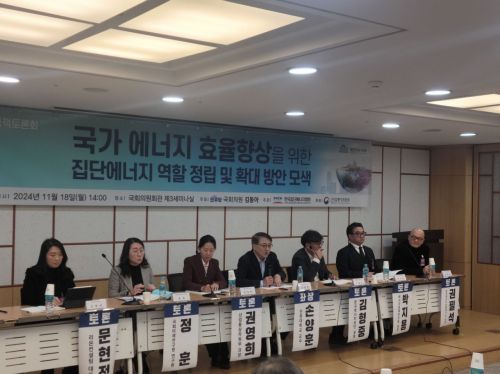 At the policy discussion titled "Establishing and Expanding the Role of Collective Energy for National Energy Efficiency Improvement" held on November 18 at the National Assembly Members' Office Building in Yeouido, Seoul, the panelists are speaking. (2024.11.18) Photo by Kang Hee-jong
There have been calls for a legal system and government organization dedicated to thermal energy, which accounts for half of the final energy consumption. There are also demands to establish a heat map that can efficiently utilize unused heat.
At the policy forum titled "Establishing and Expanding the Role of Collective Energy for National Energy Efficiency Improvement" held on the 18th at the National Assembly Members' Office Building in Yeouido, Seoul, Professor Cho Hong-jong of Dankook University, who presented the keynote speech, said, "Thermal energy accounts for 50% of Korea's final energy consumption," and added, "A dedicated governance capable of presenting a long-term roadmap for heat supply is necessary." Professor Cho also stated, "Utilizing unused heat to improve efficiency is the most important carbon neutrality measure," and added, "Ultimately, it should be approached with the concept of a smart city through a comprehensive infrastructure plan covering electricity, heat, telecommunications, roads, and hydrogen."
According to the International Energy Agency (IEA)'s 'Renewables 2023' report, heat accounts for 48%, electricity 21%, and transportation 27% of domestic final energy consumption. Until now, domestic energy strategies have been centered on electricity. The transportation sector has also focused on electrification, such as electric vehicles. In contrast, strategies for thermal energy have only been reflected in some areas like combined heat and power plants and collective energy, without comprehensive measures. There is almost no national strategy on how to decarbonize approximately 15 million gas boilers currently installed domestically. Combined heat and power plants refer to a form of power generation that uses waste heat left over from electricity generation for district heating.
The alternatives proposed by participants at the forum included the utilization of heat maps and the expansion of support for combined heat and power plants. Professor Cho explained, "The European Union (EU) has established heat maps for 14 countries," and added, "London is conducting a project that connects district heating into a network to supply heat."
Another presenter, Professor Yoo Seung-hoon of Seoul National University of Science and Technology, said, "The United States interprets renewable energy broadly and recognizes combined heat and power as a means to fulfill renewable energy supply obligations," and suggested, "Korea should also discuss support measures such as providing the Power Industry Infrastructure Fund for collective energy combined heat and power, tax reductions like individual consumption tax cuts, including combined heat and power electricity in Korea Electric Power Corporation's Energy Efficiency Resource Standard (EERS), free allocation of emission permits, and recognizing it as a means to fulfill zero energy building obligations."
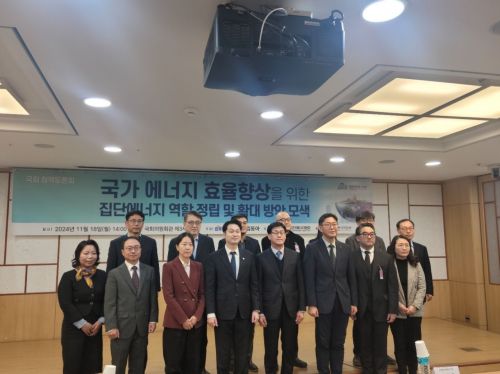 At the policy discussion on "Establishing and Expanding the Role of District Energy for National Energy Efficiency Improvement" held on November 18 at the National Assembly Members' Office Building in Yeouido, Seoul, key participants are taking a commemorative photo. (2024.11.18) Photo by Kang Hee-jong
Participants at the forum also demanded comprehensive measures and strategy formulation for thermal energy. Kim Hyun-jung, Director of the Korea Energy Agency, said, "Domestic energy systems and policies have been developed focusing on electricity, contrasting with active renewable energy dissemination policies in the electricity and transportation sectors," and emphasized, "There is a need to establish thermal energy governance." He proposed, "New systems such as certification and trading systems for renewable heat, waste heat, and low-carbon heat should be introduced to develop heat-centered carbon neutrality implementation measures."
Park Ji-yong, Director of the Korea Energy Economics Institute, said, "In Europe, as a measure for carbon neutrality in heat energy consumption, which accounts for 50% of final energy consumption, efforts are being made to expand collective energy and switch to clean heat sources," and added, "To link with other energy systems such as electricity and gas and to promote business transformation, it is necessary to establish governance that systematically and continuously manages mid- to long-term plans and policies for thermal energy."
Jung Hoon, Researcher at the National Assembly Futures Institute, said, "Among domestic laws related to thermal energy, there is no law defining the concept and scope of thermal energy, and energy policies are being established centered on the electricity sector without a decarbonization strategy for the heat sector," and suggested, "It is necessary to add a definition clause for thermal energy in related energy laws to establish the types and concepts of thermal energy and to prepare a legal basis to build a statistical system necessary for thermal energy strategy formulation."
Kwon Pil-seok, Director of the Green Energy Strategy Institute, said, "In the case of building thermal energy, decarbonization must be achieved by electrifying or replacing 15 million boilers with district heating, but it is not easy due to many stakeholders," and added, "There is a need to move away from policies focused on combined heat and power plants and consider heat networks that can utilize unused heat."
Moon Hyun-jung, CEO of Raon Consulting, said, "Individual heating with city gas (when applying boiler grade 1) emits 134% more greenhouse gases annually compared to district heating," and emphasized, "Collective energy should be recognized as a carbon reduction technology and clearly assigned a bridging role in transitioning from fossil fuels to renewable energy."
Kwon Young-hee, Director of the New Industry Distributed Energy Division at the Ministry of Trade, Industry and Energy, said, "Recognition of the role of collective energy as a decarbonization means and flexible resource is being strengthened," and added, "The government will strive for concrete measures such as expanding collective energy dissemination and providing benefits through the establishment of the 6th Basic Plan for Collective Energy and the Special Act on Distributed Energy Activation."
Meanwhile, the event was hosted by Assemblyman Kim Dong-a of the Democratic Party of Korea, organized by the Korea Collective Energy Association, and supported by the Ministry of Trade, Industry and Energy. The chair of the forum was Professor Son Yang-hoon of Incheon National University.
© The Asia Business Daily(www.asiae.co.kr). All rights reserved.


















