20 Years of Semi-Public Transportation System, Financial Support Improvement Forum
"Funding Cuts Cannot Be the Goal of the System"
"Policy Goals Such as Company Management Efficiency Are Also Needed"
As the semi-public operation system for Seoul city buses marks its 20th year, there are calls to focus bus policy discussions on 'service enhancement' rather than budget cuts.
According to Seoul city officials on the 19th, at the 'Improvement Plan for Seoul City Bus Financial Support System' forum hosted by the Korean Society of Transportation the previous day, Im Sam-jin, President of the Korea Environment Survey and Evaluation Institute, who presented at the event, emphasized, "Reducing financial support cannot be the goal of system improvement." Im stated, "It is more important to develop buses that match the status of global cities and serve as 'sustainable transportation' during the climate emergency."
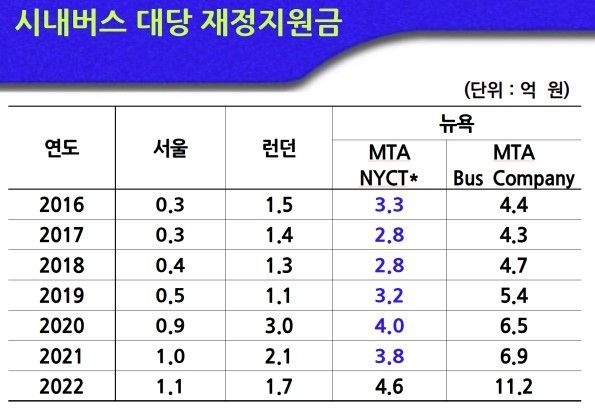 Seoul, London, and New York City Bus Financial Support per Vehicle. Analysis Data by Im Sam-jin, President of the Korea Environment Survey and Evaluation Institute
According to Im's analysis, the financial support provided to city buses to cover deficits of bus companies in New York was about 11 times higher than that of Seoul. In 2022, the financial support per Seoul city bus was 110 million KRW, while London provided 170 million KRW, and New York provided 460 million KRW (MTA NYCT) and 1.12 billion KRW (MTA Bus Company). Based on this, Im said, "Seoul's financial support is very low compared to global cities like New York and London," adding, "Seoul's transport share is much higher, so there is room to increase support when considering rational transportation investment."
The need for active financial support from the central government was also mentioned. Im said, "Regardless of the method, a financial support system for city buses by the central government must be established and transparently disclosed," emphasizing, "Especially in crisis response, the state's responsibility must be clear." Kim Se-ho, former Vice Minister of Land, Infrastructure and Transport, who gave the keynote speech, said, "The best climate change response is the bus," and added, "Both central and local governments must prioritize clear climate change responses in supporting public transportation."
Calls for "Structural Reform" Including Bus Companies' 'Moral Hazard'
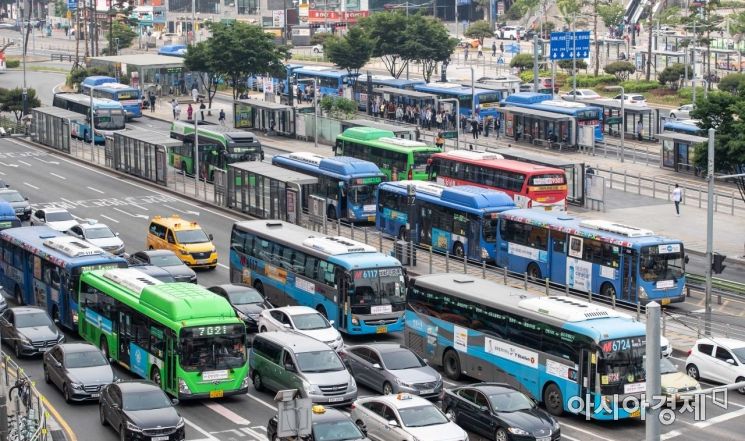 Buses are operating at the Seoul Station Bus Transfer Center in Jung-gu, Seoul. Photo by Kang Jin-hyung
However, there is also a strong argument that structural issues such as moral hazard among companies under the semi-public operation system must be addressed. Kang In-cheol, Director of Seoul City's Bus Policy Division, explained, "If we see the transportation industry, businesspeople, and managers as a collective, pursuing private interests is their nature. Policies or systems that go against human nature are unlikely to succeed," adding, "Changing the post-settlement system to a pre-determined system was part of that effort."
Last month on the 22nd, the city announced an innovation plan for the semi-public operation system, deciding to change the financial support method for bus companies accordingly. The 'post-settlement system,' which fully compensated deficits after settlement, will be replaced by a 'pre-determined system' where total revenue and total costs for the next year are set in advance, and only the difference is supported, encouraging companies to voluntarily reduce costs. Kang said, "Of course, our policy goal is not to reduce finances. The saved costs will be used to improve services," adding, "If the system changes, the cost structure itself will change, and then the amount or scale of financial support will also be adjusted."
Jeong Hee-yong, an official from the Ministry of Land, Infrastructure and Transport, also said, "The semi-public operation system inherently leads to moral hazard by operators and poor management by supervisory authorities," adding, "Although several local governments operate systems such as differential profit payments to address operators' moral hazard, these measures are insufficient, so operators lack sufficient motivation for management efficiency to improve services." The Ministry is studying improvement plans for the semi-public operation system with various local governments.
Hwang Ki-yeon, a KAIST visiting professor who chaired the session, interpreted the current situation from the perspective of an 'emergency.' He said, "The issue of moral hazard in subsidies has always been discussed, but now is a time to approach the new and very difficult environment faced by public transportation from a different perspective."
© The Asia Business Daily(www.asiae.co.kr). All rights reserved.
![Clutching a Stolen Dior Bag, Saying "I Hate Being Poor but Real"... The Grotesque Con of a "Human Knockoff" [Slate]](https://cwcontent.asiae.co.kr/asiaresize/183/2026021902243444107_1771435474.jpg)

















