Military to Increase Basic Pay for Junior Officers
Targeting 6.6% Increase in Basic Pay
Efforts to Recognize All 'Overtime at Guard Units'
The Ministry of National Defense is pushing to raise the basic salary of junior officers to over 2 million won per month, following an increase in soldiers' pay. The income of junior officers has been controversial as it was compared to the monthly income of a sergeant, which is 2 million won.
On the 18th, the Ministry of National Defense summarized the achievements in the defense sector so far and announced future plans to mark the midpoint of the Yoon Seok-yeol administration's term. First, next year, the basic salary of junior officers such as sergeants and second lieutenants will be increased by about 6.6%, aiming to exceed 2 million won per month for sergeants. The increase rate for junior officers' basic salary is expected to reach 6% this year as well, which is double that of general public officials, showing a strong will to continue raising it.
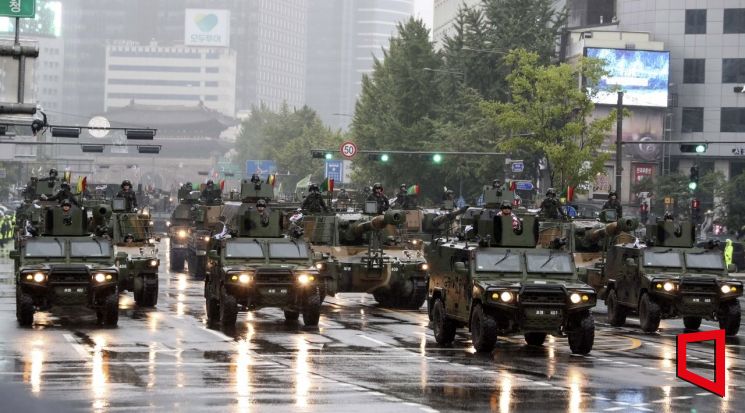 Mechanized unit soldiers are marching in a parade at last year's 75th Armed Forces Day celebration. Photo by Joint Press Corps
Additionally, the Ministry of National Defense is also promoting a plan to recognize all overtime hours actually worked from next year for frontline outposts (GP), general outposts (GOP), air defense units, and naval vessels, where overtime can reach an average of 180 to 230 hours. Currently, only up to 100 hours are recognized regardless of actual work.
A Ministry of National Defense official predicted, "For junior officers working in border units, reflecting actual working hours will significantly increase various allowances linked to the basic salary, resulting in an average monthly increase of over 1 million won."
Furthermore, the Ministry plans to secure 105,000 rooms for officers' accommodations by the end of the year, which is 92% of the required amount, and about 114,000 rooms by 2026, fulfilling 100% of the demand. The policy aims to enable 'one room per person' usage.
Moreover, the Ministry of National Defense emphasized that the readiness against North Korea has been further strengthened under the Yoon Seok-yeol administration. The deployment of U.S. strategic assets, which was nonexistent from January 2018 to May 2022, has been conducted more than 30 times up to November this year. Both frequency and intensity have increased. Also, with the suspension of the September 19 inter-Korean military agreement, operations and training in the contact area have normalized, conducting 18 brigade-level or higher outdoor maneuver exercises and 22 artillery and naval firing drills.
The Ministry stated, "(Due to the September 19 agreement) northwest island units incurred inland rotation training needs, wasting about 14 billion won of defense budget," adding, "Since the suspension of the agreement, the military has ensured the operation conditions of combined U.S.-ROK surveillance and reconnaissance assets and normalized operations and training in the contact area to deter North Korean provocations."
The military currently has two reconnaissance satellites to monitor North Korea's nuclear and missile activities 24/7, and plans to launch the third satellite from the U.S. Vandenberg Air Force Base in the third week of next month.
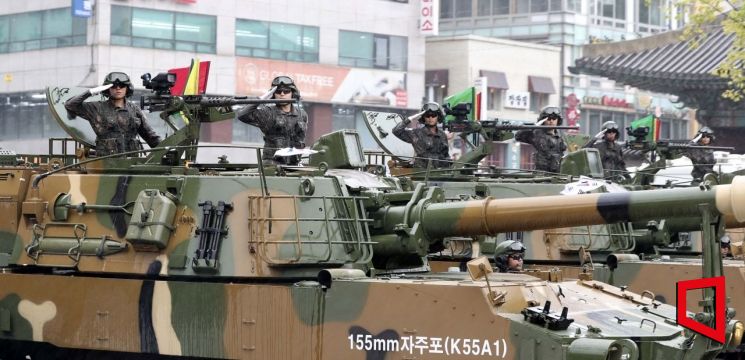 Mechanized unit soldiers are marching in a parade at last year's 75th Armed Forces Day celebration. Photo by Joint Press Corps
Amid the decrease in military manpower, the budget for manned-unmanned combined combat systems, which is gaining attention, will continue to expand. Next year's budget for this sector is planned at 306.9 billion won, which is three times the 101.6 billion won allocated in 2022. The mission scope of unmanned combat systems, which was previously focused on surveillance and reconnaissance, will be expanded to include strike and threat elimination. To this end, small suicide drones and explosive detection and disposal robots will be introduced. In particular, from next year, AI-based manned-unmanned combined border units will be pilot-operated at the frontline. This will include aerial reconnaissance and strike systems, GP unmanned operational bases, multi-legged robots, and multipurpose unmanned vehicles.
Strengthening of the Korean-style three-axis system will also continue. At last month's Armed Forces Day event, plans were announced to increase the warhead weight and quantity of the high-power missile 'Hyunmoo-5.' The Hyunmoo-5, which was mounted on a 9-axle transporter erector launcher (TEL) with an 8-ton warhead, can be further enlarged. The long-range surface-to-air guided missile (L-SAM) is expected to complete development within this month, and preparations for mass production are underway.
© The Asia Business Daily(www.asiae.co.kr). All rights reserved.
![Clutching a Stolen Dior Bag, Saying "I Hate Being Poor but Real"... The Grotesque Con of a "Human Knockoff" [Slate]](https://cwcontent.asiae.co.kr/asiaresize/183/2026021902243444107_1771435474.jpg)

















