Hankyung Association 'Entrepreneurship and Korea's Economic Leap in the AI Revolution Era' Seminar
Hankyung Research Institute "1%P Increase in Startup Failure Regret Lowers Per Capita GDP by 0.06%"
An analysis has shown that as the number of aspiring entrepreneurs increases, the gross domestic product (GDP) per capita also rises. It calls for policy support that expands entrepreneurial opportunities and establishes social safety nets in case of entrepreneurial failure.
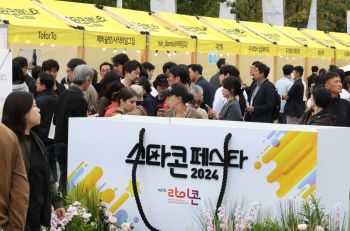 Citizens visiting the 'Starcon Festa 2024,' held from the 28th to the 31st of last month at the Playground in Gwanghwamun Square, Seoul, organized by the Korea Economic Association, KB Financial Group, and the Ministry of SMEs and Startups, are browsing excellent products from small business owners. The event is a public-private partnership project aimed at discovering star small business owners with entrepreneurial spirit and creative ideas and nurturing them into global large corporations. Photo by Jo Yongjun
On the 18th, Lee Gyuseok, Senior Research Fellow at the Korea Economic Research Institute, presented this analysis at a seminar titled "Entrepreneurship in the Age of Artificial Intelligence (AI) Revolution and the Rebound of the Korean Economy," hosted by the Korea Economic Association at the FKI Tower in Yeouido, Yeongdeungpo-gu, Seoul.
Lee stated that according to a survey of OECD member countries, when the proportion of people aged 18 to 64 seeking entrepreneurial opportunities increases by 1 percentage point, GDP per capita rises by approximately 0.27%.
Conversely, if the proportion of people who answered that they could not start a business increases by 1 percentage point, GDP per capita was analyzed to decrease by about 0.06%. Furthermore, when the quality index of government-supported entrepreneurship programs (out of 5 points) increases by 1 point, GDP per capita was found to increase by 4.81%.
Lee emphasized, "Government policy support such as entrepreneurial opportunities and entrepreneurship programs is necessary," adding, "To alleviate the fear of failure, it is essential to establish an inclusive system and simultaneously promote the construction of social safety nets."
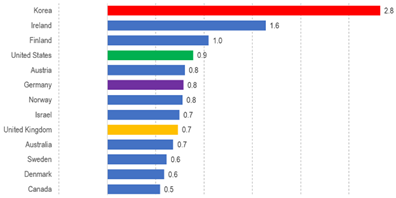 Average Annual Growth Rate of Total Factor Productivity in Major OECD Countries from 1990 to 2021. Provided by the Korea Economic Association
Experts also suggested that Korea’s economy must grow by enhancing productivity through technological innovation. Jeon Youngmin, CEO of Lotte Ventures, stressed the importance of ensuring that Korea’s economic growth does not stall through technological innovation. He explained that since Korea’s total factor productivity is higher than that of major countries such as the United States, the United Kingdom, and Germany, technological innovation represents a new growth paradigm for the Korean economy.
Looking at the average annual growth rate of total factor productivity in major OECD countries from 1990 to 2021 over 32 years, Korea’s rate was 2.8%, higher than Ireland (1.6%), the United States (0.9%), Germany (0.8%), the United Kingdom (0.7%), Australia (0.7%), and Canada (0.5%).
Jeon stated, "To prepare for demand reduction, it is necessary to maximize total factor productivity to strengthen export competitiveness and implement an open immigration policy considering the declining working population."
There was also an opinion that Korea should fully leverage its abundant advanced industrial infrastructure. Since Korea possesses a value chain including generative artificial intelligence (AI), cloud, data centers, semiconductors, and computing infrastructure, it is urged to actively utilize these assets.
Yoon Sangdoo, Head of Naver Cloud AI Lab, said, "Based on the experience of 'Sovereign AI,' where a nation or company builds independent AI capabilities using its own infrastructure and data, new business opportunities must be created," adding, "To achieve this, the government, telecom companies, large corporations, startups, and AI semiconductor companies must form a 'one team' to enhance competitiveness."
There was also a call to actively utilize AI in the new drug development process. Nine Seong, CEO of AI drug development company Tinaclon, said, "Among 1,355 new drug approvals submitted to the U.S. Food and Drug Administration (FDA) from 1980 to 2022, Korean pharmaceutical and bio companies accounted for only 4 cases (0.3%)," adding, "Actively applying AI in the drug development process will significantly enhance Korea’s pharmaceutical and bio capabilities."
In his keynote speech, Lee Geun, Distinguished Professor at Seoul National University, said, "In the AI revolution era, a 'K-entrepreneurship' model where the government, large corporations, and SMEs collaborate is needed," advising, "The key is to spread a virtuous cycle structure like Silicon Valley in the U.S., where companies founded by talents from large corporations are acquired by large corporations."
Kim Changbeom, Executive Vice Chairman of the Korea Economic Association, emphasized in his opening remarks, "In the AI revolution era, entrepreneurship acts as a core factor determining national competitiveness," and stressed, "It is necessary to seek ways to boost entrepreneurship for the rebound of the Korean economy."
© The Asia Business Daily(www.asiae.co.kr). All rights reserved.
![Clutching a Stolen Dior Bag, Saying "I Hate Being Poor but Real"... The Grotesque Con of a "Human Knockoff" [Slate]](https://cwcontent.asiae.co.kr/asiaresize/183/2026021902243444107_1771435474.jpg)

















