5.2% Increase Compared to Last Year, Continuing the 1 Trillion Won Budget Era for 2 Consecutive Years... Proactively Preventing Budget Waste Through Bold Expenditure Restructuring and Strategic Resource Allocation
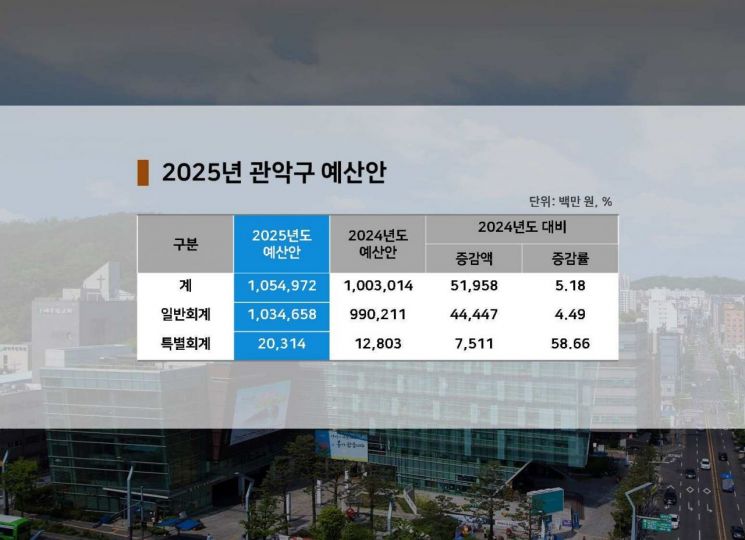
Gwanak-gu (District Mayor Park Jun-hee) will continue the era of a 1 trillion won main budget for the second consecutive year.
The district has prepared a total budget of 1.055 trillion won for 2025, a 5.2% increase compared to this year’s 1.03 trillion won, and submitted it to the Gwanak-gu Council.
Amid ongoing economic recession, high inflation, and difficulties in securing tax revenue, the outlook for next year’s income is also bleak. The district has chosen ‘selection and concentration.’ The main focus is on strategic resource allocation by proactively blocking budget waste through bold expenditure restructuring.
To this end, the district plans to focus on five major goals: ▲ Gwanak, a healing and garden city where residents are happy ▲ Strengthening customized welfare by life cycle ▲ Fostering an innovative economic city ▲ Creating a robust and safe living environment ▲ A city shining with education and culture, aiming for efficient and sound financial management in 2025.
First, 14.7 billion won has been allocated to create ‘Gwanak, a healing and garden city where residents are happy.’ This includes ▲ planting flowers along streets (300 million won) ▲ creating a leftover green garden on Nangok-ro (800 million won) ▲ repairing and maintaining the gateball court in Gwanaksan Park (100 million won) ▲ operating forest leisure programs (68 million won) ▲ operating the Gwanaksan water playground (180 million won) ▲ running forest experience programs for toddlers (300 million won), among others. These efforts will lead the way in building a garden city where residents can escape daily life and heal in nature through diverse natural infrastructure and leisure programs.
To strengthen ‘customized welfare by life cycle,’ the district has allocated 690.7 billion won, accounting for 65.5% of the total budget. The plan is to respond to various welfare demands arising from changing population structures and focus on forming a customized welfare network by life cycle.
In particular, the budget includes ▲ increasing allowances for national veterans and establishing welfare allowances for spouses (3.57 billion won) ▲ supporting postpartum care expenses (1.1 billion won) ▲ providing Kangchung Kangchung growth and childcare support funds (970 million won) ▲ supporting daycare center operations (7 billion won) ▲ operating a single-person household support center (160 million won) ▲ operating the Gwanak 50 Plus Center (350 million won) ▲ constructing the Gwanak Cultural Welfare Town (1 billion won) ▲ constructing the Senior Comprehensive Welfare Town (4.4 billion won) ▲ operating the Dementia Relief Center (1.1 billion won), among others. These efforts aim to make Gwanak a city where it is good to have and raise children and where seniors live happily and healthily.
A total of 12.5 billion won will be invested in the economy and job sectors, which will serve as the foundation for ‘fostering an innovative economic city.’ This includes ▲ providing public jobs (3 billion won) ▲ establishing the Gwanak Job Happiness Corporation (300 million won) ▲ establishing the Gwanak Small and Medium Venture Promotion Agency (770 million won) ▲ local brand commercial district development project (Sarosugil) (200 million won) ▲ issuing exclusive gift certificates for Gwanak Love and public delivery apps (2.4 billion won), among others. Next year, the district plans to catch two rabbits at once: leap forward as a venture startup hub and recover the difficult livelihood economy amid prolonged economic recession.
A total of 45.1 billion won has been allocated to ‘creating a robust and safe living environment’ where residents feel secure. First, the construction of public parking lots at Sangdo Neighborhood Park (4.8 billion won) and Moraenae Park (2.8 billion won) will address the long-standing issue of parking shortages in residential areas. Safety in daily life will also be ensured through road and facility repairs, heatwave and cold wave countermeasures, expansion and dredging of sewage facilities, and the establishment of a disaster management fund.
A total of 45.8 billion won is planned to be invested in ‘a city shining with education and culture.’ In particular, the education expense subsidy project to realize customized educational welfare has been increased by 2 billion won from 8 billion won this year to 10 billion won. The budget also includes ▲ support for eco-friendly school meals (5.4 billion won) ▲ hosting the lifelong learning festival (72 million won) ▲ lifelong education voucher support project (300 million won) ▲ operation of Sillim-dong Three-Room (360 million won) ▲ youth job linkage and employment support (800 million won) ▲ cultural city creation project (670 million won), among others. The district plans to generously support these to enhance residents’ satisfaction with education and culture.
The 2025 budget proposal will be finalized on December 18 after review by the Gwanak-gu Council.
District Mayor Park Jun-hee said, “Since next year’s budget was prepared with difficulty under tough tax revenue conditions, we will carefully manage policies necessary for residents and quickly implement policies that residents can feel and empathize with.”
© The Asia Business Daily(www.asiae.co.kr). All rights reserved.
![Clutching a Stolen Dior Bag, Saying "I Hate Being Poor but Real"... The Grotesque Con of a "Human Knockoff" [Slate]](https://cwcontent.asiae.co.kr/asiaresize/183/2026021902243444107_1771435474.jpg)

















