Munkwangyeon 'Leisure Consumption Status and Challenges in Population Declining Areas' Report
40% of Total Consumption Expenditure in Population Declining Areas by 'Non-Residents'
Among the 229 cities, counties, and districts nationwide, more than half?122 areas?are classified as at risk of extinction. A study has found that attracting resident populations and expanding leisure consumption through the expansion of cultural and tourism facilities have a significant effect on revitalizing the local economy in population-declining areas.
According to the report "Leisure Consumption Status and Challenges in Population-Declining Areas" released on the 17th by the Korea Culture and Tourism Institute, visitors to these areas, i.e., the ‘resident population,’ account for half of the total consumption in all population-declining regions nationwide.
In particular, leisure consumption such as travel, culture, and sports showed that non-residents' consumption (52.5%) was 5 percentage points higher than that of residents (47.5%), suggesting that plans to revitalize the local economy through the use of related facilities should be developed.
The institute analyzed personal consumption data (Shinhan Card) over the past three years (2022 to the first quarter of 2024) for 89 basic local governments experiencing population decline nationwide. To understand the structure of total consumption expenditure in population-declining areas, consumption was divided into non-leisure and leisure categories, and leisure types were classified as ‘travel,’ ‘dining out,’ ‘culture,’ and ‘sports’ for analysis.
Although the consumption share of non-residents was in the 40% range overall, non-residents’ leisure consumption expenditure was 52.5%, exceeding that of residents. In population-declining areas, non-residents showed a higher consumption share in travel and sports-related sectors. The well-known travel consumption share was overwhelmingly high at 82.1%, followed by sports at 56.7%.
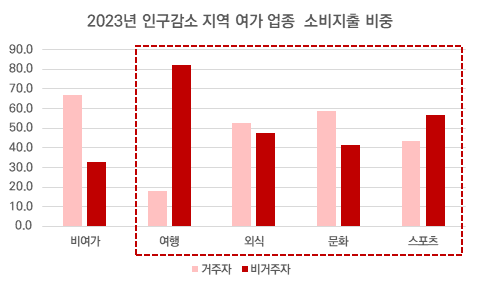 2023 Population Decline Area Leisure Industry Consumption Expenditure Share Graph. [Table = Korea Culture and Tourism Institute]
As consumption by non-residents visiting for travel and sports purposes becomes more active, efforts to increase the staying population and secure the ‘resident population’ are necessary. The ‘resident population’ is a new population concept that includes people who stay in the area and enhance the region’s actual vitality.
The institute explained, "Compared to general areas, population-declining regions see a significant impact on total regional consumption from spending by visiting non-residents, indicating their key role in revitalizing these areas."
For example, Yanggu-gun in Gangwon Province has worked to increase the staying population by hosting large-scale sports competitions and training camps at the national and provincial levels. Similarly, Boeun-gun in Chungbuk and Yecheon-gun in Gyeongbuk have expanded their resident populations by attracting domestic and international sports events and festivals.
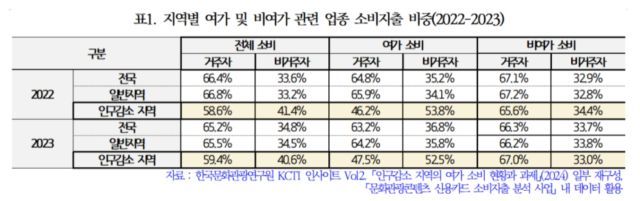 Proportion of Consumer Spending on Leisure and Non-Leisure Related Industries by Region, 2022-2023. [Table = Korea Culture and Tourism Institute]
Song Cheol-jae, head of the Data Analysis Team at the Korea Culture and Tourism Institute, said, "By utilizing card data that can accurately capture actual consumption expenditure, we identified the consumption expenditure structure in population-declining areas and confirmed the importance of attracting the resident population. If surveys on resident population statistics become more active in the future, it will be necessary to prepare specific measures to revitalize leisure consumption through additional analysis."
Kim Se-won, president of the Korea Culture and Tourism Institute, stated, "The resident population is a new population concept that includes people who stay in the area and enhance the region’s actual vitality. The institute’s data-based diagnosis and policy recommendations for population-declining areas, linked to this new population concept, can be widely utilized in establishing various regional revitalization policies in the future."
The full report on this project can be accessed through the institute’s website.
© The Asia Business Daily(www.asiae.co.kr). All rights reserved.
![Clutching a Stolen Dior Bag, Saying "I Hate Being Poor but Real"... The Grotesque Con of a "Human Knockoff" [Slate]](https://cwcontent.asiae.co.kr/asiaresize/183/2026021902243444107_1771435474.jpg)


















