Ministry of National Defense Allocates Approximately 3 Billion KRW for Drug Test Kits
Opposition "Concerns Over Human Rights Violations" vs Ruling Party "Necessary for Combat Readiness"
The government, ruling party, and opposition clashed over the budget for drug testing targeting soldiers at the National Assembly's National Defense Committee (NDC). The Ministry of National Defense plans to conduct random drug tests on 30% of soldiers. The opposition argued that this might be an excessive alignment with the government's 'war on drugs' policy and called for a reduction in the scale.
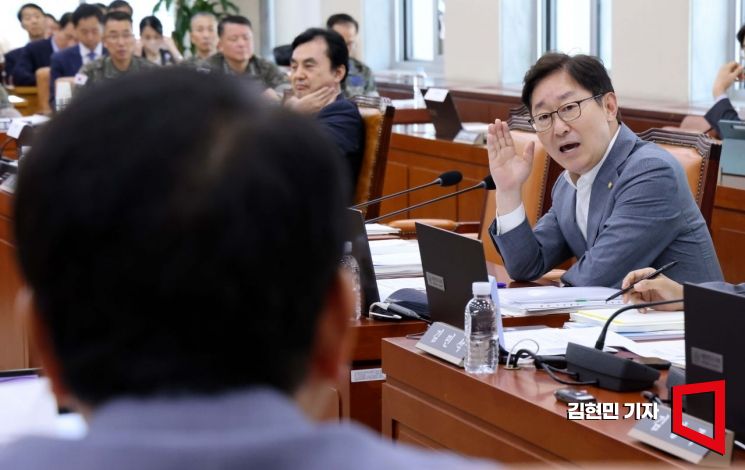 Park Beom-gye, a member of the Democratic Party of Korea, is making a procedural statement at the National Defense Committee plenary meeting held at the National Assembly on the 27th. Photo by Kim Hyun-min kimhyun81@
On the 13th, the NDC Budget and Accounts Examination Subcommittee reviewed the budget for the Ministry of National Defense's medical supplies procurement project for the next year. The key issue was the drug testing kits. The budget for the medical supplies procurement project next year is about 103.3 billion KRW, a decrease of 7.9 billion KRW compared to this year, but approximately 3.024 billion KRW was newly allocated for the drug testing kits project. According to the revised "Enforcement Decree of the Act on the Status and Service of Soldiers" amended in July, the Ministry of National Defense plans to conduct random drug tests on 30% of soldiers currently in service.
Democratic Party lawmakers expressed skepticism about the necessity of the related project. They claimed it was merely a 'show' budget allocation for the current government focusing on drug crackdowns. Democratic Party lawmakers Chu Mi-ae, Ahn Kyu-baek, Park Beom-gye, and Hwang Hee questioned, "Why was the random testing standard set at 30%?" and "Since the Military Manpower Administration already conducts drug tests on conscripts, why is there a need for duplication?"
There were also concerns about human rights violations. It was argued that not only soldiers but also men in their 20s could be stigmatized as suspected drug users. According to the Ministry of Food and Drug Safety's 'Drug-related Disciplinary Status Data,' only 30 soldiers have been disciplined for drug-related issues from 2020 to July this year, raising questions about the necessity of expanding the scope.
The government and ruling party countered that the drug testing kit budget is necessary from the perspective of military combat readiness. Kang Seon-young, a former general and member of the People Power Party, reportedly said, "Since soldiers handle weapons, large-scale drug testing is necessary." The Ministry of National Defense claimed, "The U.S. military also conducts drug tests on soldiers."
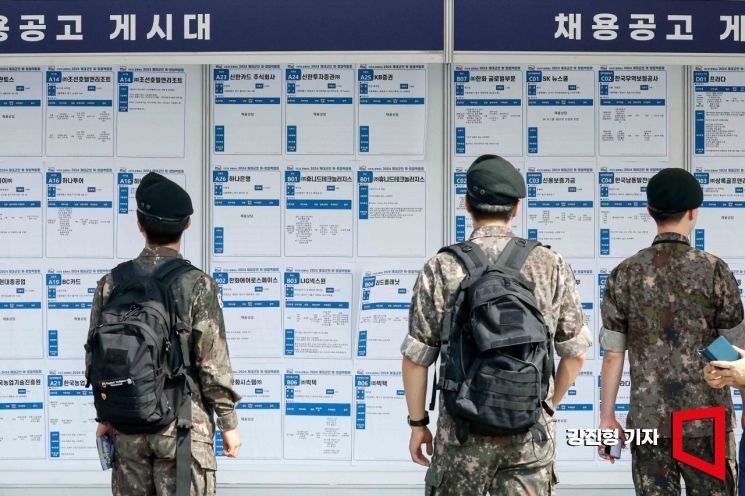 On the 10th, participants are looking at the job posting board at the '2024 Veterans Employment and Startup Expo' held at the Peace Plaza of the War Memorial of Korea in Yongsan-gu, Seoul. Photo by Jinhyung Kang aymsdream@
The National Assembly Budget Office also pointed out this issue in its '2025 Budget Proposal Committee Analysis.' It stated, "There is an aspect of excessive allocation in the quantity and unit price of the testing kits purchased, so the budget scale should be adjusted to an appropriate level." The unit price for drug testing kits, which the Ministry of National Defense bid for in May this year, was 8,845 KRW, but the unit price was set at 12,000 KRW in next year's budget.
After a fierce debate between the ruling and opposition parties, no conclusion was reached regarding the drug testing kit budget. The opposition plans to cut the budget to an appropriate level. Lawmaker Ahn said, "This does not mean we are downplaying the drug problem. However, setting the standard at 30% is excessive," adding, "If it is a random inspection, I think about 10% would be sufficient."
© The Asia Business Daily(www.asiae.co.kr). All rights reserved.
![Clutching a Stolen Dior Bag, Saying "I Hate Being Poor but Real"... The Grotesque Con of a "Human Knockoff" [Slate]](https://cwcontent.asiae.co.kr/asiaresize/183/2026021902243444107_1771435474.jpg)

















