Gang Involved in Smuggling Over 1,800 Exotic Species Caught
Buying at 300,000 Won and Selling at 4 Million Won
Smuggling Hidden in Underwear and Cigarette Packs
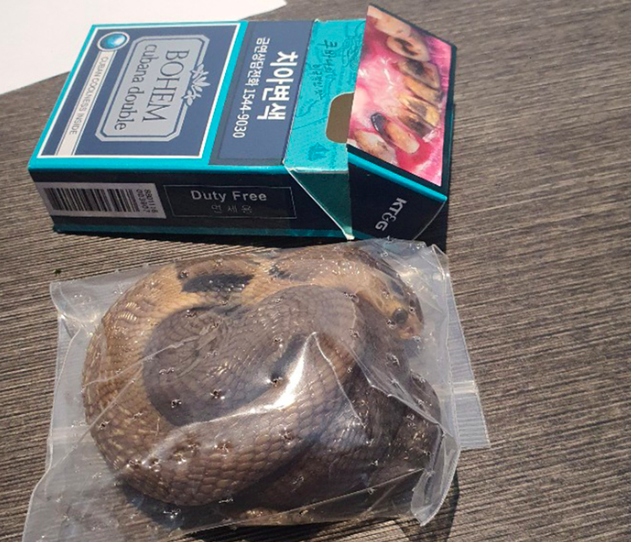
A group smuggling lizards, turtles, scorpions, and other creatures hidden in underwear and cigarette packs at Incheon Airport has been caught, leading to analyses that South Korea is no longer a safe zone for smuggling.
On the 14th, the Korea Customs Service at Incheon Airport announced that from May to October, they conducted a "special crackdown on smuggling of exotic species," and sent 14 people suspected of smuggling 1,865 lizards, turtles, scorpions, and other animals to the prosecution without detention for violating customs laws. The smuggled creatures are valued at 1.9 billion KRW.
Among the exotic species seized by customs were rare species worth tens of millions to hundreds of millions of KRW, including the Komodo dragon and emerald tree boa, which are internationally endangered species (CITES Appendix I). The Komodo dragon, native to Komodo Island in Indonesia, is a rare species with an estimated global population of fewer than 5,000 individuals. Customs stated that there is no official record of its import into South Korea, and this is the first time smuggling has been detected.
According to customs, the suspects smuggled these exotic species dozens of times from July 2022 to May this year while entering from countries such as Thailand and Indonesia, hiding them in underwear, cup noodle containers, and cigarette packs. Two main perpetrators were found to have recruited acquaintances as couriers by luring them with free overseas trips to avoid customs inspections.
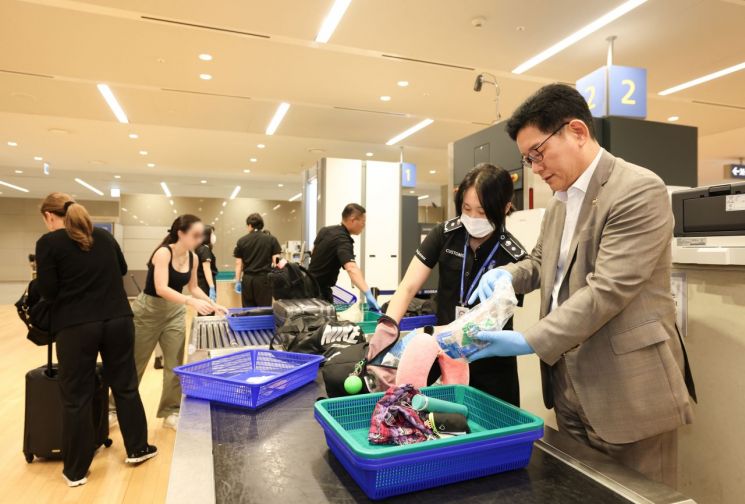 Koh Kwang-hyo, Commissioner of the Korea Customs Service, is personally inspecting the luggage of travelers arriving from Mexico in the early morning hours at Incheon International Airport in Jung-gu, Incheon on August 7. Photo by Yonhap News
They made huge profits by selling internationally endangered animals that cannot be traded legally through online cafes and specialized reptile shops. In the case of the CITES Appendix I Burmese star tortoise, it was purchased in Thailand for about 300,000 KRW and sold domestically for 4 million KRW, a 12-fold increase.
An official from Incheon Airport Customs said, "Smuggling of exotic species, including internationally endangered species, is a serious crime that disrupts the domestic ecosystem and threatens public safety," adding, "We will continue to actively block illegal importation of exotic species at border checkpoints." Meanwhile, the seized wild animals are currently being protected at the National Institute of Ecology, which has the relevant facilities and personnel.
Earlier, in March last year, when elephant ivory smuggling was rampant in Vietnam, authorities stepped up crackdowns. At that time, the local media 'VN Express' reported, "Authorities in Hai Phong, a northern port city, discovered 7 tons of elephant ivory in a container shipped from Angola, Africa."
The container, which passed through Singapore, was declared to customs as carrying peanuts. In February of the same year, the coast guard and customs also seized 500 kg of elephant ivory at Hai Phong port. The ivory was confirmed to have been shipped from Nigeria.
© The Asia Business Daily(www.asiae.co.kr). All rights reserved.


















