US Followed by NIS Confirm 'North Korean Military Combat Participation'
North Korea Crosses Red Line... Government Reviews Step-by-Step Response
'Values' Biden or 'Peace' Trump, a Dilemma
Following the United States, our government has also confirmed that North Korean troops deployed to Russia have begun participating in combat. It is inevitable that lethal weapon support for Ukraine will be considered. This is in accordance with the 'step-by-step response measures' previously announced by the government. However, it remains uncertain what decision the government will make between the Biden administration in the U.S., which strongly supports Ukraine, and the incoming Trump administration, which aims to end the war quickly.
The National Intelligence Service (NIS) stated on the 13th, a day earlier, that "North Korean troops deployed to Russia have moved to the Kursk region over the past two weeks and completed their battlefield deployment," adding, "It is assessed that they are already participating in combat." An NIS official added, "We are collecting and analyzing additional related intelligence and information."
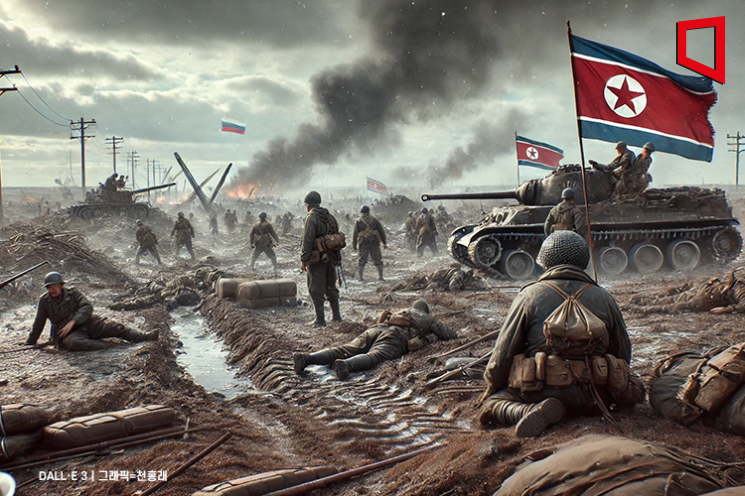
Earlier, the U.S. State Department had first confirmed the 'combat participation' fact. Vedant Patel, Deputy Spokesperson of the U.S. State Department, said at a briefing on the 12th (local time), "We can confirm that (North Korean troops) have begun engaging in combat operations alongside Russian forces." Until then, the Ministry of National Defense and Ministry of Foreign Affairs of our country had only stated that they were "watching closely with the possibility in mind," but intelligence authorities have now confirmed it as fact.
Until now, our government viewed the actual combat participation of North Korean troops, i.e., deployment to the battlefield, as a kind of 'red line.'
President Yoon Suk-yeol stated at a press conference on the 7th, "If (North Korean troops) gain experience in modern warfare, it could pose a fatal threat to our security, so we will change the support method step-by-step depending on the degree of North Korean involvement." Earlier, at a joint press conference following the Korea-Poland summit on the 24th of last month, when asked about this, he said, "As a general principle, we had the principle of not directly supplying lethal weapons to Ukraine, but we can consider it more flexibly depending on North Korean activities."
Since the government has officially acknowledged the combat deployment of North Korean troops, consideration of 'weapon support' is inevitable. The government is focusing on providing defensive weapons first. Air defense systems such as Cheongung I, which can intercept fighter jets, Cheongung II, which can intercept ballistic missiles, and jamming drones requested by Ukraine are being discussed. These missile systems can also be converted for offensive use. Due to the prolonged war, the U.S. is running low on 155mm artillery shell stockpiles, so there is also talk of us providing shells indirectly.
The variable is 'Trump.' Donald Trump, whose election was confirmed on the 6th, has repeatedly stated his intention to 'end the war.' Unlike the Biden administration, which prioritizes alliances and values, the Trump administration, based on 'America First,' is likely to judge that U.S. support for Ukraine is excessive.
In this case, our government will have no choice but to consider whether to align with the current U.S. administration or to act with the next administration in mind. If Korea hastily supports lethal weapons to Ukraine and then the Trump administration intervenes in January next year to push for a quick end to the war, it could find itself in a difficult situation.
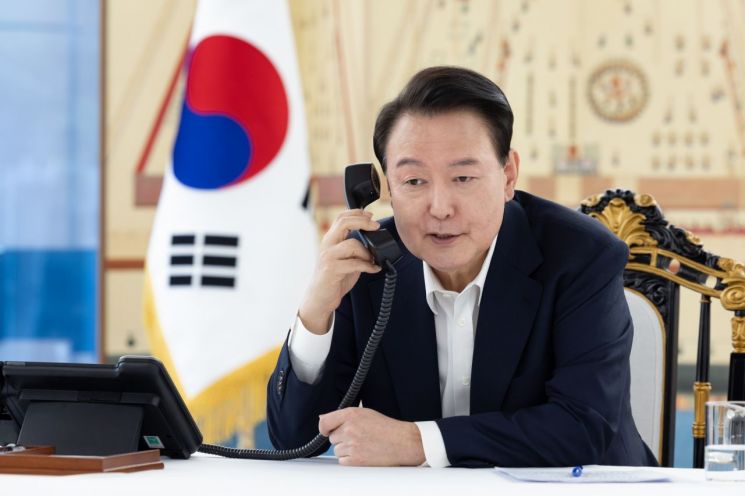 President Yoon Suk-yeol is having a phone call with President-elect Donald Trump of the United States at the presidential residence in Hannam-dong, Seoul, on the 7th. Photo by the Presidential Office, Yonhap News Agency
However, many also question whether the Trump administration's policy emphasizing 'ending the war' will be realized immediately. There are criticisms that it may be a kind of 'campaign rhetoric' to attract votes during the election period. It is also analyzed that policy coordination according to the current administration's stance during the transition process will have an impact.
A senior official from the Ministry of Foreign Affairs said at a meeting with reporters on the 12th, "Trump has shown his will to end the war, saying he would end it within 24 hours," but added, "War does not end unilaterally by one country's decision; there is an opponent and interests among the parties involved." He further noted, "There can be a significant difference between political remarks during the election campaign and actual policy."
Considering our national interests, many believe that we should act taking into account the intentions of the new administration, which will affect Korea-U.S. relations for the next four years. Above all, lethal weapon support for Ukraine is like our 'last stronghold,' as the North-South confrontation on the Korean Peninsula could be reproduced as a 'proxy war' in Europe.
Unlike the firm stance the government has taken against the deployment of North Korean troops, it is maintaining a cautious position regarding weapon support. Prime Minister Han Duck-soo said at a meeting with reporters the day before, "It is not desirable for Korea to act alone," adding, "It is a task to be advanced through sufficient consultation with the international community, especially our close ally, the United States." Regarding changes in the direction of support for Ukraine, he drew a line, saying, "Nothing has been decided."
© The Asia Business Daily(www.asiae.co.kr). All rights reserved.


















