Ministry of Economy and Finance, November Fiscal Trends
Managed Fiscal Balance Deficit Ranks Third Largest Ever
As of September this year, the national budget deficit recorded 91.5 trillion won, an increase of 20.9 trillion won compared to the same period last year. This is due to a decrease in corporate tax revenue caused by worsening corporate performance, while government spending continues to grow.

According to the "Monthly Fiscal Trends November Issue" published by the Ministry of Economy and Finance on the 14th, total revenue from January to September this year was 439.4 trillion won, an increase of 3.1 trillion won compared to the same period last year. The increase in total revenue was due to a rise in fund income and non-tax revenue. Non-tax revenue increased by 1.6 trillion won to 22.4 trillion won, influenced by the repayment of loans to small and medium-sized enterprises during the recent COVID-19 period. Fund income increased by 12.8 trillion won to 161.6 trillion won, due to an increase in social security fund income.
On the other hand, national tax revenue was 255.3 trillion won, down 11.3 trillion won from the same period last year. Although value-added tax and income tax increased by 5.7 trillion won and 0.4 trillion won respectively due to an increase in payment performance, corporate tax revenue sharply declined by 17.4 trillion won due to worsening corporate performance.
Total expenditure also recorded 492.3 trillion won as of the cumulative total in September, the second highest level ever following 536 trillion won in 2022. Total expenditure increased by 24.8 trillion won compared to the same period last year.
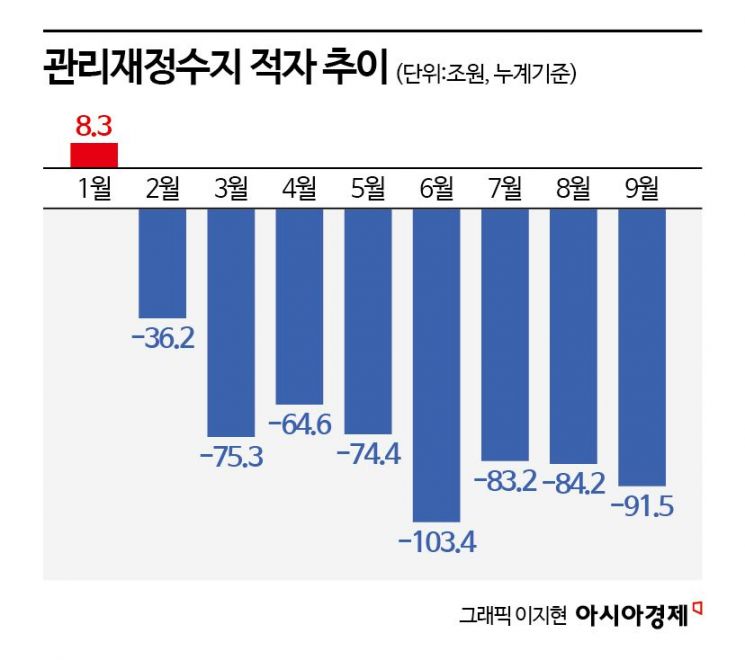
Despite the deterioration in tax revenue, government spending increased, resulting in an integrated fiscal balance deficit of 52.9 trillion won, which is the difference between total revenue and total expenditure. After deducting the four major social security funds such as the National Pension from the integrated fiscal balance to show the government's actual fiscal condition, the management fiscal balance showed a deficit of 91.5 trillion won. This is the third largest deficit on a cumulative basis for September since the monthly management fiscal balance statistics began in 2014. The deficit widened by 20.9 trillion won compared to the same period last year.
The accumulated central government debt as of September was 1,148.6 trillion won, a decrease of 18.7 trillion won from the end of the previous month. The issuance volume of treasury bonds in October was 9.9 trillion won, and the issuance volume from January to October was 148.5 trillion won. The procurement interest rate in October was maintained at 2.93%, the same level as the previous month (2.93%), and the bid rate rose to 337% from 318% in the previous month.
The Ministry of Economy and Finance explained, "Despite the Bank of Korea's interest rate cut in October, the treasury bond interest rate rose compared to the previous month due to factors such as the pre-reflection of expectations for monetary policy easing, escalating tensions in the Middle East, and growing concerns about fiscal and tariff policies ahead of the U.S. presidential election."
© The Asia Business Daily(www.asiae.co.kr). All rights reserved.
![Clutching a Stolen Dior Bag, Saying "I Hate Being Poor but Real"... The Grotesque Con of a "Human Knockoff" [Slate]](https://cwcontent.asiae.co.kr/asiaresize/183/2026021902243444107_1771435474.jpg)












