Additional Personnel by Phone 30 Minutes Before the Day
No-Show, Practical Compensation Measures Needed
Recently, self-employed business owners have been complaining about financial losses caused by no-shows, and now a self-employed person from a restaurant in Gwangalli, Busan, has voiced their grievance over no-show damages. On the 12th, a post titled "No-show. Worst case: 20 tables, 90 people. Approximate damage amount 3 million won" was uploaded on the self-employed community 'Apeunikka Sajangida' (Because It Hurts, I'm a Boss). The author, Mr. A, lamented that he suffered significant financial losses due to no-shows at his restaurant during the Busan Fireworks Festival held on the 9th.
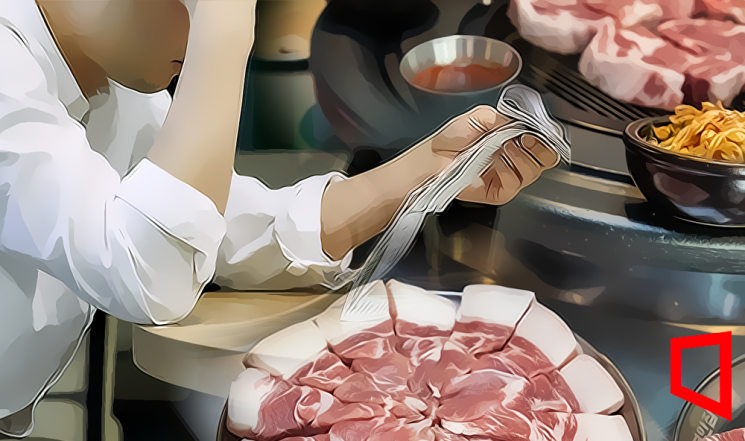 Recently, self-employed business owners have been complaining about financial losses caused by no-shows, and now a self-employed person from a restaurant in Gwangalli, Busan, has voiced their grievance about suffering from no-show damages. Asia Economy
Mr. A explained, "I communicated with the reservation party several times over a few days, conducted a prior inspection, and continuously checked. I even have recorded phone conversations. The hall manager checked the number of people and tables once more with the reserver the day before the event." He added, "(The customer) said they would order the 120,000 won package. There was also mention that the number of people might increase the next day. (The reserver) personally came to write down their affiliation and reservation date. On the day of the event, 30 minutes before the reservation time, they called to add more people, so we prepared accordingly." However, despite the reservation time arriving, the customers did not show up. Mr. A said, "When I called, they said they confused us with another place. Does that make any sense?" He expressed frustration, saying, "We prepared about 20 tables and 90 servings, and assigned 4 additional staff members. The no-show reservation damage alone is about 3 million won."
He continued, "They acted as if I didn’t exist and held their event at another restaurant, even conducting a prize draw there. They don’t answer calls. When I called and mentioned my restaurant’s name, they kept denying it. They even blocked my number. When I called from another number, they answered but said 'We never made a reservation' and blocked me again," he reported. Mr. A described the situation as "frustrating" and said, "The amount is larger than expected, and because of the no-show group, many customers who came that day couldn’t be served. What should I do?" seeking advice.
Netizens responded to the story with comments such as "You should require a deposit for reservations," "Even if you publicize it, if it’s a private gathering or group and not a public organization, compensation is difficult. Filing a civil lawsuit won’t even cover the litigation costs for no-shows," and "It’s unfortunate that the damage amount is so large." One netizen advised, "Sending a certified letter before filing a complaint usually gets an immediate response. Be sure to secure recorded calls and any evidence you can prove. You must accurately estimate the losses. If the group is not a private gathering but a business, corporation, or institution, communicate the situation through official channels rather than just the person in charge."
Previously, as damages from no-shows increased among self-employed business owners, the Korea Fair Trade Commission established a penalty regulation for the food service industry in the consumer dispute resolution standards in 2018 to prevent such damages. According to the regulation, customers can cancel their reservation if they do so more than one hour before the reserved time, but if they cancel within one hour, the deposit paid in advance is non-refundable. However, since the deposit is only about 10% of the order amount and the regulation is a recommendation that cannot be enforced, there are criticisms about its ineffectiveness.
Meanwhile, no-shows are also analyzed to be related to the phenomenon called 'call phobia.' Call phobia refers to symptoms where people mainly feel difficulty and fear in phone calls, commonly experienced by younger generations accustomed to SNS like KakaoTalk and those with introverted personalities. People with call phobia find phone calls themselves burdensome, and the act of calling to cancel an appointment is a heavy burden, so instead of dealing with the situation, they choose to avoid and hide. In this way, with no clear regulations to punish no-shows, voices are growing to establish clear punitive provisions for malicious and planned no-shows.
© The Asia Business Daily(www.asiae.co.kr). All rights reserved.

















