Government and Ruling Party Virtually Nullify Commercial Act Revision
Approach Based on Individual Provisions for Mergers and Physical Division under Capital Market Act Revision... Focus on Protecting Common Shareholders
Amid the government and ruling party's de facto abandonment of the amendment to the Commercial Act that would expand the duty of loyalty from 'companies' to 'shareholders,' the opposition party plans to adopt the related amendment as its party stance on the 14th. Given that the opposition party holds a majority of seats in the National Assembly, it is highly likely that they will push forward the amendment to the Commercial Act unilaterally, considering the votes of 14 million individual investors. The business community has expressed concerns, warning that the side effects, such as a surge in lawsuits, could weaken companies' competitiveness.
Opposition Party to Adopt Commercial Act Amendment as Party Stance on the 14th
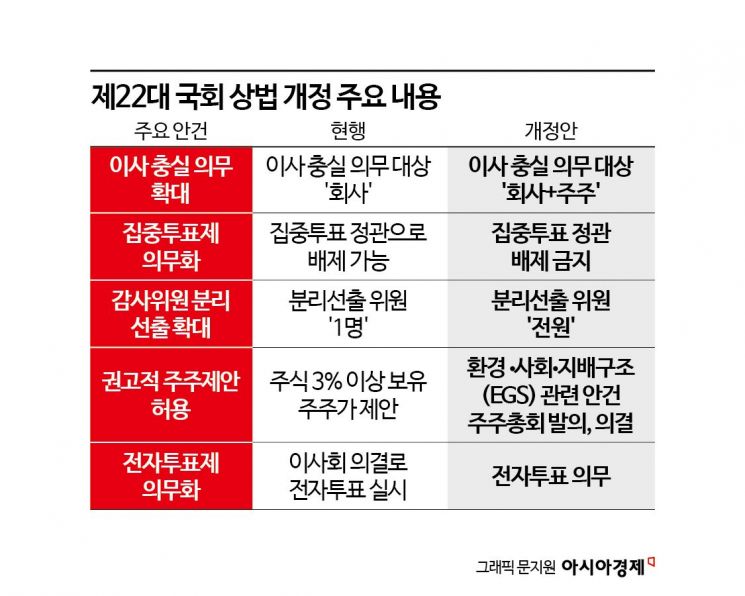
According to the National Assembly and the financial investment industry on the 14th, the Democratic Party plans to hold a party caucus at 10:30 a.m. that day to adopt the amendment to the Commercial Act related to expanding the duty of loyalty of directors as its party stance. A member of the Democratic Party's Stock Market Revitalization Task Force (TF) said in a phone interview with Asia Economy the previous day that regarding the subsequent handling of the bill in the standing committee, "Since there are significant concerns from the business community, we believe that further public discussion procedures are necessary," adding, "We will continue to spread the necessity of amending the Commercial Act."
The opposition party is aiming to amend the Commercial Act within the year, centered around Lee Jae-myung, leader of the Democratic Party. Lee Jae-myung is scheduled to attend the event "Donghak Ants Meeting," hosted by Democratic Party lawmakers Park Jumin and Lee Eon-ju on the 20th. This event is a forum where small shareholders will participate and express their opinions regarding the recently controversial amendment to the Commercial Act.
The Democratic Party's Stock Market Revitalization Task Force (TF), which is promoting the amendment, has also been preparing behind the scenes in line with Lee's activities, holding a meeting on the 12th to gather opinions from small investors. On the 8th, they held a forum titled "Discussion on the Duty of Loyalty of Directors and Institutional Improvement Measures for Proportional Protection of Shareholders' Interests," where they heard opinions from academia and the business community regarding the amendment.
The Democratic Party, the major opposition party, may push the amendment to the Commercial Act unilaterally despite opposition from the People Power Party. According to the National Assembly's bill information system, the Democratic Party has currently proposed 21 amendments to the Commercial Act. On the 1st and 8th of this month, lawmakers Jeong Tae-ho and Lee Eon-ju, members of the National Assembly's Legislation and Judiciary Committee (Law Committee), proposed amendments to the Commercial Act. The Law Committee, which oversees the Commercial Act, is chaired by Democratic Party lawmaker Jeong Cheong-rae, and Democratic Party members outnumber others. The amendment to the Commercial Act will be finalized after passing through the Law Committee's subcommittee, full committee, and plenary session.
Government and Ruling Party Shift to Amending the Capital Markets Act
On the other hand, the government and ruling party have shifted to pursuing only amendments to the Act on Capital Markets and Financial Investment Business (Capital Markets Act) within the year. Kim Sang-hoon, a member of the Policy Committee of the People Power Party and the Political Affairs Committee, recently revealed in a media interview that through confidential party-government meetings, they discussed directions for amending the Capital Markets Act to protect general shareholders.
Alongside the amendment to the Commercial Act, the idea of prioritizing listed companies through special provisions in the Capital Markets Act was mentioned during the opinion-gathering process but was not adopted as the final plan. The government and ruling party are currently considering only an approach based on individual provisions applicable to special situations such as physical division and mergers. This includes reflecting the actual value based on external evaluations instead of the current stock price standard when determining merger ratios between listed affiliates, and mandating disclosure of corporate value evaluation results. This is interpreted as a targeted approach in response to growing dissatisfaction among small shareholders regarding the merger price calculation method, as seen in recent cases like the Doosan Robotics and Doosan Bobcat merger.
A representative from Kim Sang-hoon's office said, "During previous party-government consultations, there was discussion about including measures to protect shareholders during mergers or physical divisions," adding, "We will strive to pass the lawmaker's bill as soon as possible, but further consideration is needed on what additional content to propose."
The Financial Services Commission, the main government agency responsible for the Capital Markets Act, also plans to prepare a government proposal soon and submit it to the National Assembly. Financial Services Commission Chairman Kim Byung-hwan stated at the National Assembly Political Affairs Committee plenary session on the 12th that regarding the amendment to the Commercial Act, "(The government) will prepare at least guidelines to facilitate legislative discussions."
The government's and ruling party's decision is believed to have been influenced by opposition from the Ministry of Justice and concerns from the business community. Koo Sang-yeop, Director of the Legal Affairs Office at the Ministry of Justice, said in a briefing after the fourth public livelihood forum in January, "Even if the amendment to the duty of loyalty of directors is enacted, it will remain an abstract and declarative provision." This statement came just 15 days after President Yoon Suk-yeol hinted at amending the Commercial Act at the Korea Exchange opening ceremony earlier this year. The business community has been concerned that global activist funds and others might increasingly file lawsuits against directors for breach of duty of loyalty, using it as a pretext for breach of trust charges.
A business community official said, "Looking at the amendment to the Commercial Act proposed by the Democratic Party, which includes expanding the duty of loyalty of directors, separate election of audit committee members, and cumulative voting, when these systems are actually introduced, it will be influential shareholders like hedge funds or pension funds, not ordinary small shareholders, who will utilize them," adding, "If the goal is truly to protect individual investors, a more effective measure would be to restrict the deliberate calculation of merger ratios favorable to controlling shareholders during divisions."
On the other hand, Lee Sang-hoon, a professor at Kyungpook National University Law School, criticized, "Adding provisions on a case-by-case basis is a 'rule-based approach,' while expanding the duty of loyalty of directors is a 'principle-based approach.' If you take a rule-based approach, it becomes a post hoc remedy where people can escape when problems arise, so the idea is to improve the principle (Commercial Act), but the current approach has limitations."
© The Asia Business Daily(www.asiae.co.kr). All rights reserved.

















