Yoon Seok-yeol Government's Health and Welfare Achievements and Plans Announced
Normalization of Medical Delivery System through Tertiary Hospital Structural Transformation
Pension Reform Discussions Intensify... Full Efforts to Boost Birth Rate
The government reiterated its commitment to complete healthcare reforms, including expanding medical school quotas and establishing public policy fees, to strengthen essential and regional healthcare next year. To expand competent medical personnel, a 'Medical Workforce Supply and Demand Estimation and Adjustment Discussion Organization' will be established, and efforts to transform tertiary general hospitals focusing on severe diseases will be accelerated.
The Ministry of Health and Welfare announced major achievements and future plans in the health and welfare sector on the 14th at the Government Seoul Office, marking the midpoint of the Yoon Seok-yeol administration.
First, the Ministry will reform the payment system by introducing public policy fees to guarantee regional and essential healthcare, investing 1.2 trillion KRW this year and 10 trillion KRW by 2028 in essential medical services such as severe and emergency care. Medical schools, which have increased their intake for the first time in 27 years, will admit a total of 4,578 freshmen in 2025. To achieve a rational and acceptable estimation of medical personnel, a workforce supply and demand estimation committee will also be formed; however, since the medical community has not yet expressed willingness to participate, the process will begin with the nursing workforce supply and demand estimation committee.
To transform tertiary general hospitals focusing on severe treatment, the government plans to prepare and implement the second phase of healthcare reform by the end of the year, which includes fostering regional secondary hospitals that the public and medical community can agree on, innovating primary care, establishing cooperative systems, and restructuring indemnity insurance. To support this, more than 30 trillion KRW will be invested over the next five years, including 10 trillion KRW in government funds and 20 trillion KRW in health insurance.
In response to the trends of low birth rates, delayed marriage, and increased infertility, support for healthy pregnancy and childbirth will continue. For infertility treatments, which impose a significant economic burden, the number of supported procedures per childbirth will be expanded to 25, and the out-of-pocket rate for those aged 45 and older will be reduced to 30%. Income and age criteria for local government infertility treatment support programs have also been abolished. Starting next year, support will be provided for the costs of freezing and preserving reproductive cells to preserve fertility, essential fertility tests for men and women of reproductive age, and health insurance coverage will be expanded to include non-reimbursed drugs necessary for infertility treatments.
The single pension reform plan, prepared for the first time in 21 years, includes raising the national pension contribution rate from the current 9% to 13% and increasing the nominal income replacement rate from 40% to about 42%. The national pension fund's investment return rate, which was -8.22% in 2022, improved significantly to 13.59% last year. The government plans to actively participate in parliamentary discussions to ensure smooth progress of pension reform and will expand the scope and duration of contribution support to eliminate blind spots in enrollment.
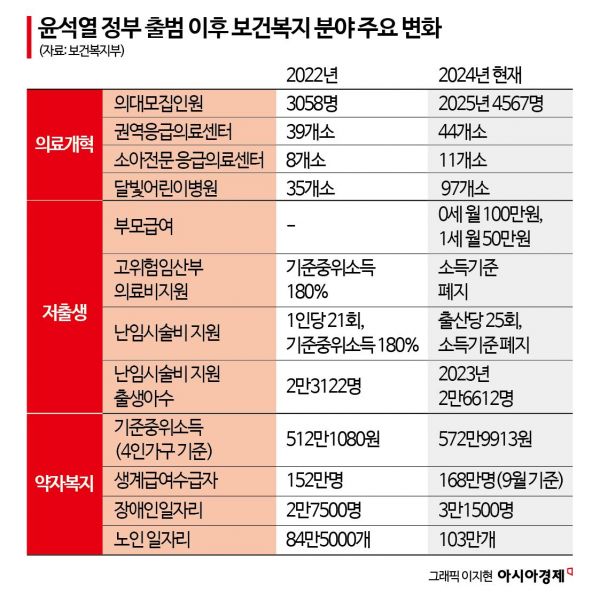
Socially vulnerable groups such as low-income households, persons with disabilities, and the elderly will be protected more broadly. The median income standard was raised to a record high of 5.47% in 2023, 6.09% in 2024, and 6.42% in 2025, and the livelihood benefit eligibility criteria were adjusted upward (from 30% to 32%) for the first time in seven years, lowering the welfare threshold and raising the minimum living guarantee level. As a result, the number of livelihood benefit recipients increased significantly from 1.52 million in 2022 to 1.68 million in 2024. The Yoon administration plans to raise the livelihood benefit eligibility criteria to 35% of the median income during its term. The government-created elderly jobs surpassed 1 million last year and will increase to 1.1 million next year. Through the birth notification system and protected childbirth system, 567 pregnant women in crisis have been supported so far, with 33 applying for protected childbirth.
Additionally, the Ministry of Health and Welfare will introduce a challenge- and mission-oriented research and development (R&D) system such as a Korean-style ARPA-H to foster the next-generation bio and digital health industries and will invest in new-concept R&D to secure top-tier technologies.
© The Asia Business Daily(www.asiae.co.kr). All rights reserved.
!["The Woman Who Threw Herself into the Water Clutching a Stolen Dior Bag"...A Grotesque Success Story That Shakes the Korean Psyche [Slate]](https://cwcontent.asiae.co.kr/asiaresize/183/2026021902243444107_1771435474.jpg)

















