Set Location Revealed Last December with Embargo Imposed
Strict Security Even on Non-Shooting Days "Special Orders Received"
Scripts Delivered via Programs That Prevent Printing and Emailing
CEO Kim Ji-yeon "Everyone Seemed to Act While Watching My Cues"
'Squid Game' Season 2 will be released on the 26th of next month. Related information has been reported through the media since the 11th. This includes interviews with director Hwang Dong-hyuk and the set design. None of the coverage was based on recent reporting. In fact, the set was revealed to the media on December 7th of last year. The interview took place on August 1st. All reports were tightly controlled.
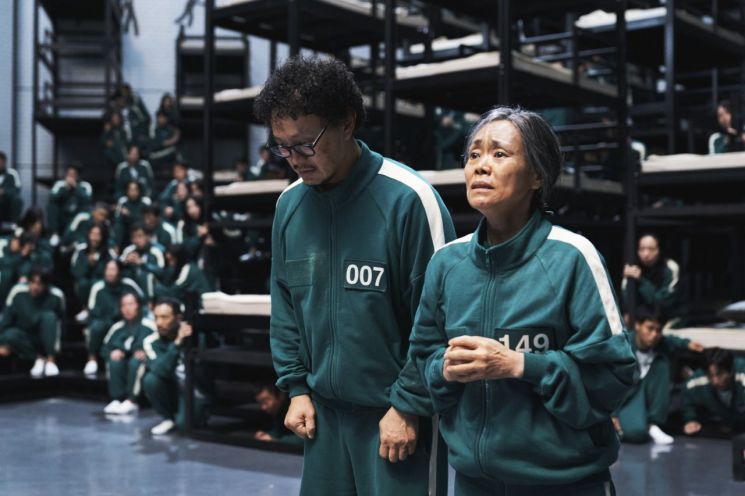
In the former case, it took a full 11 months for the article to be published. This was due to an embargo. Netflix strongly demanded confidentiality in advance. They even required a pledge not to disclose anything seen or heard on the set. Those who refused were denied entry. Stickers to prevent filming with mobile phone cameras were applied, and the location of the set was not disclosed. Only reporters who took a large bus from Gwanghwamun, Seoul, were allowed to enter.
The studio cube in Yuseong-gu, Daejeon Metropolitan City, where the set is located, had strict security even when 'Squid Game' was not filming. When visited in April, even looking around the entrance area was not permitted. Jo Hyun-rae, then director of the Korea Creative Content Agency, which operates Studio Cube, was not allowed to enter. A security official explained, "The production team had gone down to Changwon for outdoor filming," and "There was a special order that the set must not be revealed even a little."
The entire production process was kept secret because Season 1 of 'Squid Game' achieved huge global success. It is the most-watched content in Netflix history. It is estimated to have generated an economic effect of over 900 million dollars (1.2669 trillion won). Due to the high interest in the sequel, all leaks were thoroughly blocked. In particular, the set is a highly symbolic place that allows one to gauge the message director Hwang Dong-hyuk wants to convey. When the set was revealed in December last year, Director Hwang said, "The set visuals express the story we want to tell in Season 2."
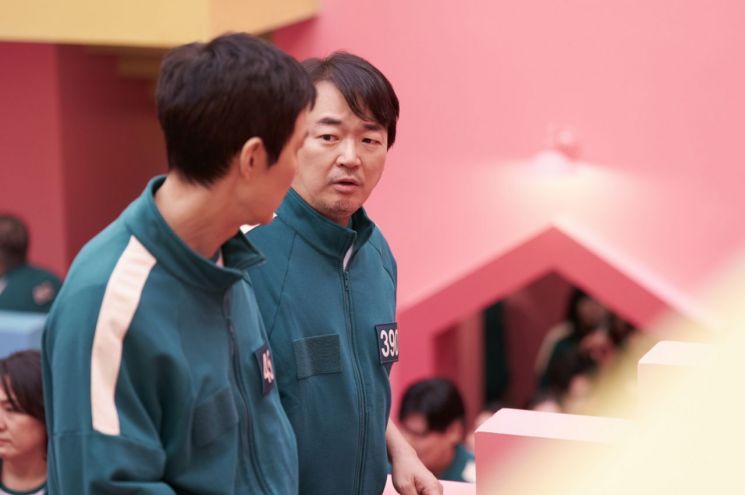
The biggest feature of the new set is the large O and X marks drawn on the floor of the participants' dormitory. Art director Chae Kyung-sun explained, "It represents the beginning of confrontation, such as 'You and I are different,' 'I am right and you are wrong.'" Director Hwang Dong-hyuk also said in an interview last August, "I depicted how groups divided by O and X split, hate each other, confront, and conflict."
"The act of defining each other as opposites, labeling each other as adversaries, and expressing endless hatred has expanded beyond the internet space into everyday life. Watching that, I drew a picture of people labeling each other's chests with O or X, marking coordinates, and antagonizing each other. Through these people in this small society, this small game arena, I wanted to show the whole society's state as 'Isn't it like this now?' and 'Aren't we living like this?' as if it were someone else's story."
Netflix could not show this until one or two months before the main episode release. This was because the set was only rented until early June. Sets such as the bed dormitory and maze stairs had to be dismantled to proceed with other filming. A source explained, "Since art director Chae Kyung-sun, who designed the set, won an Emmy Award, interest in the set itself was high, so the embargo period had to be extended."
Another source said, "Even the cast members had to sign a pledge not to take photos or disclose any content to enter the set." Actors who were not leads did not even receive the full script. They had to memorize and act out only the scenes they were in. If they forgot their lines, they could not look at the script but had to ask the staff, 'What is my line?' It is said that similar methods are used in Hollywood blockbusters to prevent leaks of content in advance.
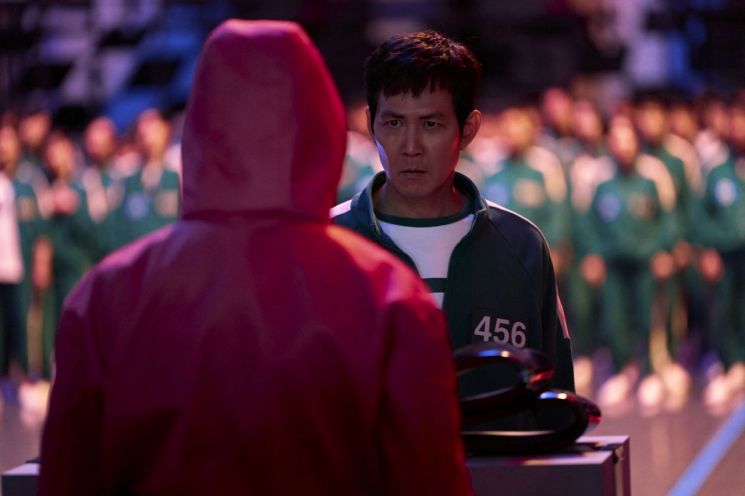
Producer Kim Ji-yeon, CEO of Siren Pictures, revealed, "Even then, we delivered the script in a unique way to prevent leaks." She explained, "Since everyone was interested in what games would appear and what games would be played, we could not deliver the script using conventional methods like watermarks. We used a program that could not be printed or emailed."
As a result, occasional farcical situations occurred on set. Actors who had not memorized their lines struggled because they could not check the script. Kim said, "We heard many complaints, but we had to endure it even if we were cursed." Most actors did not even know who died or survived in the story. So, they secretly exchanged information about their characters' fates. Kim asked to convey her apologies, saying, "I overheard phrases like 'I die, so do you die too?' several times. Everyone seemed to act cautiously."
© The Asia Business Daily(www.asiae.co.kr). All rights reserved.



















