Gumi Plant Production Capacity Expanded from 1500 to 3000t
Aramid Pulp Mainly Used for Automotive Parts
Responding to Demand for Dust-Reducing Brake Pad Materials
Kolon Industries is accelerating its entry into the high value-added product market by increasing the production of aramid pulp.
Kolon Industries announced on the 13th that it has invested approximately 22 billion KRW in its Gumi plant in Gyeongbuk to significantly expand the annual production capacity of aramid pulp from 1,500 tons to 3,000 tons and has begun trial operations. After conducting trial operations through this month, the company plans to start full-scale product delivery from next month.
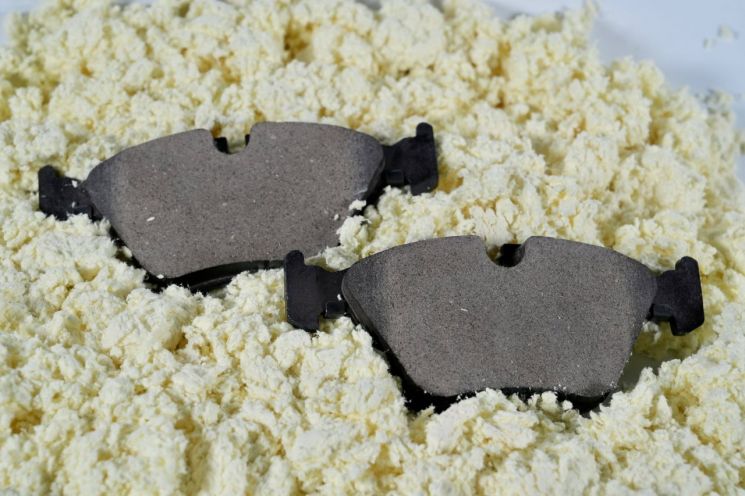 Kolon Industries aramid pulp products and brake pads applied with them. Provided by Kolon Industries
Aramid pulp is a product made by applying physical friction to aramid yarn to create crumb-like particles, mainly used as reinforcement materials in automotive parts such as brake pads, gaskets, and tire rubber.
Aramid yarn is known as a "superfiber" because it is strong enough to stop bullets and possesses heat resistance and abrasion resistance that can withstand temperatures above 500 degrees Celsius and friction. Additionally, it is regarded as a high value-added product due to its complex manufacturing process and high technological entry barriers.
In particular, brake pads using aramid pulp can reduce dust by up to 70% compared to existing products, enabling compliance with the "Euro 7 (European automotive environmental regulation)" that will be enforced from November 2026.
Meanwhile, Kolon Industries increased its aramid yarn production capacity from 7,500 tons to 15,310 tons at the end of last year, establishing the largest production capacity in South Korea.
© The Asia Business Daily(www.asiae.co.kr). All rights reserved.

















