'Squid Game' Season 2 Press Conference
"Using Season 1 Voting More Actively"
"Seong Gi-hun Obsessed with Blind 'Retribution'"
"Young People Joining the Game Feels Natural Now"
"I'm not a horse. I'm a human. So I'm curious. Who are you, and how can you do such things to people? That's why I can't forgive what you do."
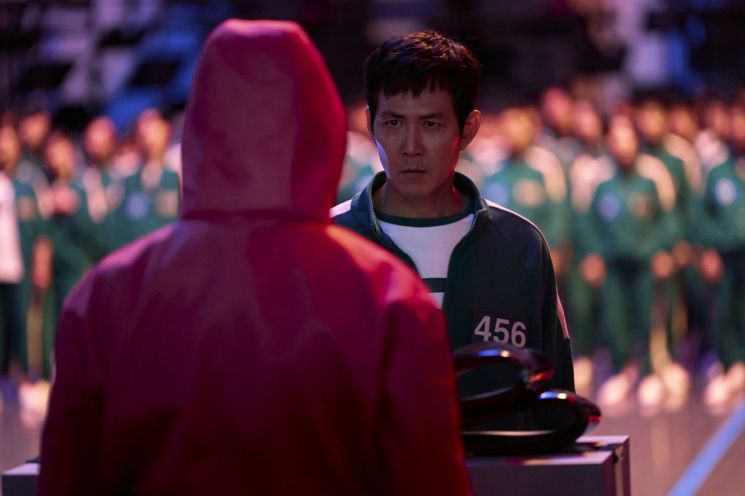
This is the last line left by Seong Gi-hun (Lee Jung-jae) in Season 1 of 'Squid Game.' He decides to jump back into the brutal game that mercilessly kills those who are eliminated. He is no longer a naive and immature middle-aged man. He is a hero trying to save the participants who are being driven toward death.
The changed journey will be revealed on the 26th of next month. Seong Gi-hun will once again wear the teal tracksuit with white stripes and play the game. He plans to use the rule that allows the game to be stopped through voting. However, the organizers are not easy opponents.
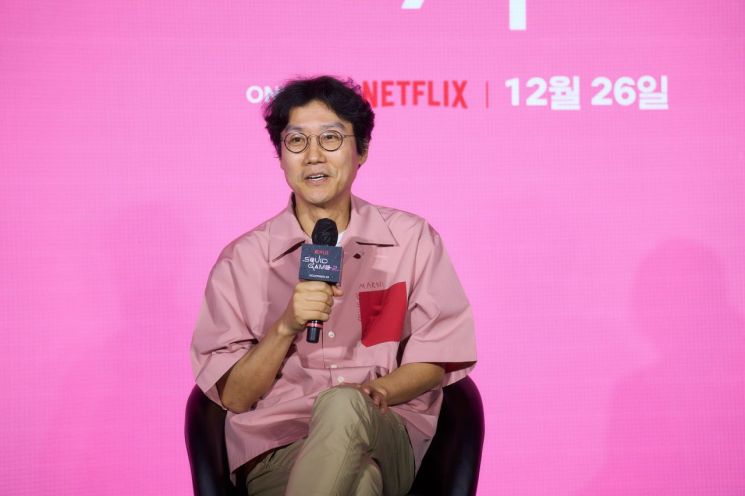
Director Hwang Dong-hyuk stated at the 'Squid Game' Season 2 press conference held at the Four Seasons Hotel Seoul on August 1st, "We made more active use of voting compared to Season 1."
"The organizers use voting much more powerfully and cleverly. Each game includes a voting process, and the surviving participants engage more actively in voting. Those who voted against each other's will?whether to continue or stop?split into two sides, leading to more intense conflict and confrontation."
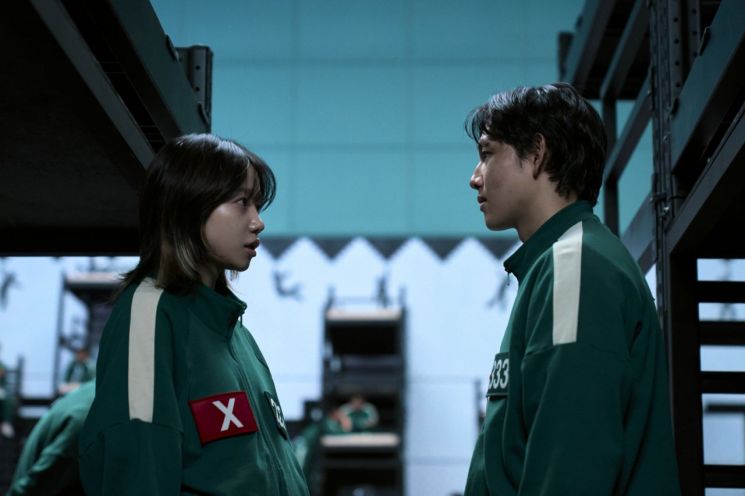
This is an expression metaphorically representing divisions, conflicts, and hatred arising from religion, ideology, background, gender, race, and more, not only in Korea but worldwide. Director Hwang wanted to symbolically depict the increasingly intensified trend. He said, "I portrayed how groups divided into O and X split, hate each other, confront, and conflict."
"The act of defining each other as opposites, labeling each other as opponents, and expressing endless hatred has expanded beyond the internet space into everyday life. Watching that, I depicted people in this small society, this small game arena, labeling each other's chests with O or X, marking coordinates, and antagonizing each other. Through these people, I wanted to show the whole society's state as if it were someone else's story?'Isn't society like this now?' 'Aren't we living like this?'"
Seong Gi-hun stands at the center of the conflict. In Season 1, he was reckless. He acted like a child but would suddenly lose his temper. However, he has deep affection for people and is inherently humane. After winning the prize money of 45.6 billion won, he suffers from psychological pain.
Director Hwang said, "He tries to live happily again with his daughter using the prize money, but he has fundamentally changed already. The red hair symbolizes that," adding, "He is obsessed with the blind purpose of 'must punish.' He will run madly toward that goal."
Lee Jung-jae, who portrayed the character, also said, "For Gi-hun, the mindset that 'those who caused this situation must be punished' was probably the most important."
"Although he is powerless and lacks the strategy to solve problems, I thought his innate human nature of 'this must not happen again' played the biggest role. In fact, the Season 2 script depicted that feeling well. I believe the clear purpose of having to change all this was the biggest driving force behind his transformation from Season 1."
There is no way the game will be stopped as Gi-hun intends. Even in Season 1, among the 201 survivors of the 'Red Light, Green Light' game, 187 jumped back into the game to overcome their unfortunate realities. They are filled with hope to start a new life by winning the prize money and disregard invisible dangers.
The flow of Season 2 is no different. Participants shout "One more round!" at the top of their lungs. Many are young. Director Hwang said, "I used to think that one had to be quite old to be in debt and lose hope enough to participate in 'Squid Game,' but the world has changed," adding, "Sadly and regrettably, over the past few years, I have witnessed many young people in their 20s and 30s becoming eligible to participate."
"Looking at the news, teenagers and people in their 20s lose large sums of money through coins and internet gambling, commit crimes or commit suicide due to debt. With the rampant spread of rental fraud, phishing crimes, identity theft, and many victims, it no longer feels strange for such young people to participate in the game; rather, it has become a realistic story."
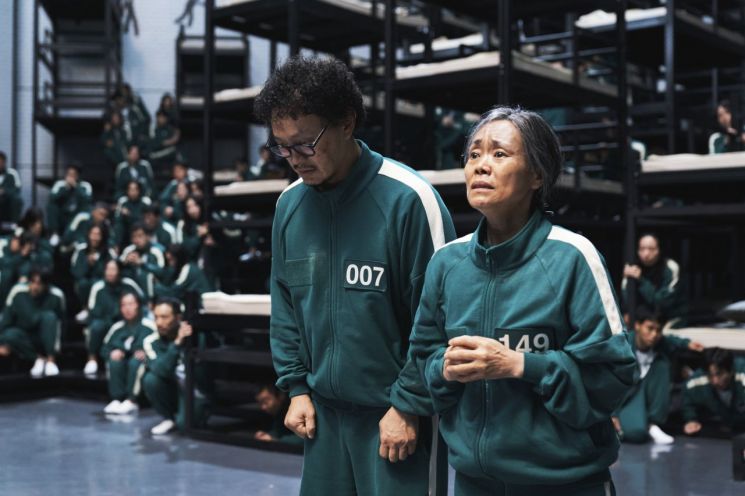
Only the 'Red Light, Green Light' game has been revealed regarding what games the younger participants will play. Director Hwang said, "I pondered for a long time about which games to introduce," adding, "We chose games that not only Koreans but also foreigners can enjoy."
"There were many expectations and hopes for specific games to appear on the internet and around us. But above all, the games had to be simple, with immediate and easily understandable penalties for losers. We carefully arranged many games requiring cooperation. They will be more dramatic than the games in Season 1."
Director Hwang said he immersed himself in one question while embedding joy, anger, sorrow, and pleasure into a series of games. That question is whether humans have the qualities to escape the downward slope tilted toward conflict. He confessed, "I still haven't found the answer."
"'Squid Game' asks us whether we have the power to change a worsening world. Viewers may not find the answer either. But at least the plot gaps can be filled because it is a story about our lives. While filming Season 2, there was a school district in front of an old hotel in Daejeon. At 10 or 11 p.m., students would inevitably come out with exhausted faces and wait for the bus. Seeing them, I wondered, 'Can our country really become a good country?' Is there a future in a society that classifies those who fail to enter good universities or become doctors as dropouts? Can't everyone live a valuable life? Sadly, reality is an endless Squid Game."
© The Asia Business Daily(www.asiae.co.kr). All rights reserved.



















