'De Facto Military Alliance' Pretext for Justifying North Korean Troop Deployment
US Department of Defense: "Additional Deployment? Definitely Possible"
The de facto 'military alliance' between North Korea and Russia is about to come into effect. Since it explicitly states mutual military support, there is also speculation that it could be used as a pretext for additional deployment of North Korean troops.
On the 12th, the Korean Central News Agency reported, "The 'Treaty on Comprehensive Strategic Partnership between the Democratic People's Republic of Korea and the Russian Federation,' signed in Pyongyang, has been ratified by the State Affairs Commission decree," adding, "The head of state signed the decree on the 11th." The 'decree' is a form of legal norm issued by the Standing Committee of the Supreme People's Assembly, possessing legal binding force and authority following the socialist constitution and Supreme People's Assembly decrees.
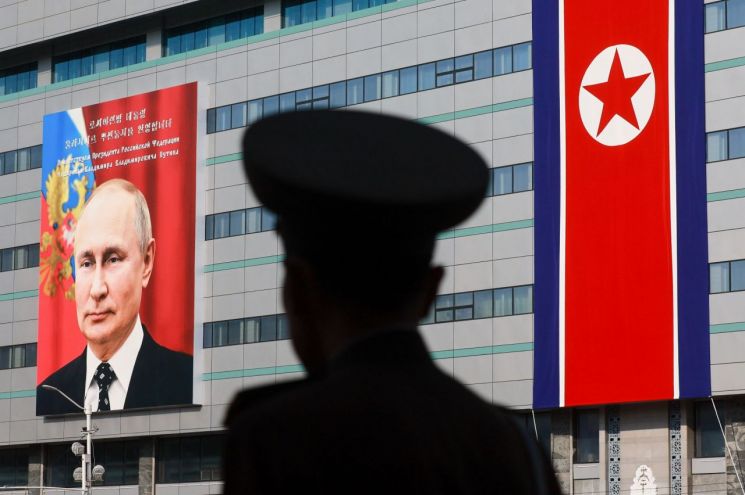 A large banner with a photo and the phrase "Welcome Comrade Vladimir Putin, President of the Russian Federation" is hung on a building near Kim Il-sung Square in Pyongyang ahead of Russian President Vladimir Putin's state visit in June this year. Photo by TASS Yonhap News
Earlier, both chambers of the Russian parliament unanimously approved the treaty ratification bill submitted by Russian President Vladimir Putin, and President Putin gave the final signature on the treaty on the 9th (local time). Until now, there had been no news of North Korea undergoing the Supreme People's Assembly ratification process, but under the North Korean constitution, if the treaty is considered important, it can be ratified by the State Affairs Commission chairman's authority, so it is regarded as dependent on Chairman Kim Jong-un's decision.
With both sides completing the ratification process, once they exchange ratification documents, the treaty will come into effect indefinitely. This treaty is evaluated as effectively reviving the 'automatic military intervention' clause contained in the old Soviet-era North Korea-Soviet friendship treaty. The key is Article 4, which states that "if either party is invaded and enters a state of war, the other shall promptly provide military assistance by all means at its disposal."
Once the treaty takes effect, the possibility opens for North Korean troops to be fully deployed in combat on the Ukraine-Russia front. For example, when satellite images suggesting North Korean troop deployment were released on the 25th of last month, President Putin did not outright deny it but instead recalled the problematic 'Article 4.' At that time, he said, "You are aware that the strategic partnership agreement between us and North Korea has been ratified," adding, "That treaty contains Article 4." This was a strong assertion that there is no problem with North Korean troop deployment as pointed out by South Korea and the West.
Furthermore, it is expected that this will be used to justify troop deployment or as a pretext for additional deployments. Ukrainian President Volodymyr Zelensky claimed the day before that about 50,000 enemy troops were engaged in the Kharkiv region, and that 11,000 North Korean troops had been deployed there. Sabrina Singh, Deputy Spokesperson for the U.S. Department of Defense, stated at a regular briefing on the 7th (local time) that although additional deployments exceeding the estimated "11,000" have not yet occurred, "Could more North Korean troops head to the battlefield? Certainly, that is possible."
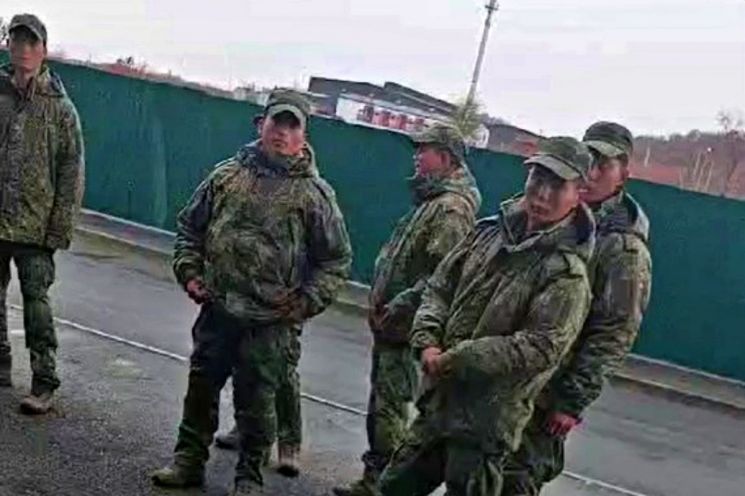 Screenshot of a video presumed to be of North Korean soldiers released by Russian independent media. ASTRA Telegram channel
This treaty raises concerns that it will cause various security instabilities on the Korean Peninsula beyond simple troop deployments. The possibility has increased that Russia's nuclear capabilities could be extended or transferred to North Korea, or that North Korea and Russia might conduct joint military exercises. President Putin has left open the prospect of North Korea-Russia joint exercises by saying, "Why not?"
An official from the Ministry of Unification said, "There is a significant possibility that a ceremony for exchanging ratification documents between high-level North Korean and Russian officials will be held."
© The Asia Business Daily(www.asiae.co.kr). All rights reserved.


















