WMO Report Released
"Exceeds 1.54 Degrees Compared to Pre-Industrial Levels"
The average global temperature from January to September this year temporarily exceeded the warming limit promised by the international community, leading to projections that this year will be the hottest on record.
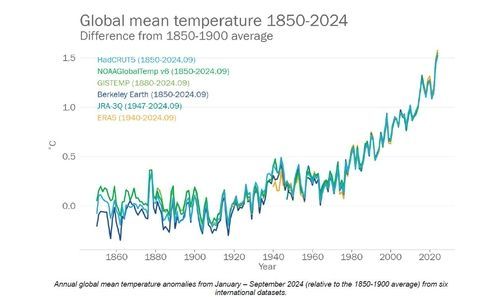
The World Meteorological Organization (WMO) announced on the 11th (local time) that it submitted a report containing this information at the 29th United Nations Climate Change Conference of the Parties (COP29) held in Baku, Azerbaijan.
According to the report, the average global surface temperature from January to September this year was analyzed to be 1.54 degrees Celsius (±0.13 degrees margin of error, hereafter Celsius) higher than the average during the pre-industrial period of 1850?1900. This is higher than last year’s annual average temperature, which was also the 'hottest year' on record.
Considering that the European Union (EU) climate change monitoring agency Copernicus Climate Change Service (C3S) observed last year’s global average temperature to be 14.98 degrees, it is expected that this year’s annual average temperature will exceed 15 degrees.
The international community pledged through the 2015 Paris Agreement on Climate Change to limit the rise in global temperature to 1.5 degrees Celsius above pre-industrial levels. Although there have been instances where the monthly global average temperature exceeded this limit, this year marks the first case where the annual average temperature surpasses it.
However, the WMO diagnosed this as a temporary exceedance of the limit. WMO Secretary-General Petteri Taalas explained, "A temporary exceedance of 1.5 degrees in monthly or annual temperature rise does not mean that the goals of the Paris Agreement have failed. Natural phenomena such as El Ni?o can cause significant fluctuations, and it should not be equated with the long-term temperature goals set over decades by the Paris Agreement."
Based on initial analysis results, the WMO stated that the level of global warming in the long-term trend has likely reached about 1.3 degrees above pre-industrial levels.
Nevertheless, the WMO warned that a major crisis in implementing the Paris Agreement is evident. The organization expressed concern, saying, "Glacier loss, sea level rise, and ocean heat increase are accelerating," and "Extreme weather events worldwide are causing significant economic damage to communities."
Secretary-General Taalas said, "Whether warming stays below or exceeds 1.5 degrees, it increases climate extremes and risks," adding, "There is an urgent need to reduce greenhouse gas emissions and to strengthen monitoring and understanding of the changing climate."
© The Asia Business Daily(www.asiae.co.kr). All rights reserved.
![Clutching a Stolen Dior Bag, Saying "I Hate Being Poor but Real"... The Grotesque Con of a "Human Knockoff" [Slate]](https://cwcontent.asiae.co.kr/asiaresize/183/2026021902243444107_1771435474.jpg)











