Mayor Kang, First to Post Protest Posters on Commute... Passes Baton to 3 Others
Citizen Participation Begins in Earnest... "Carefully Preparing the City of Protest Posters"
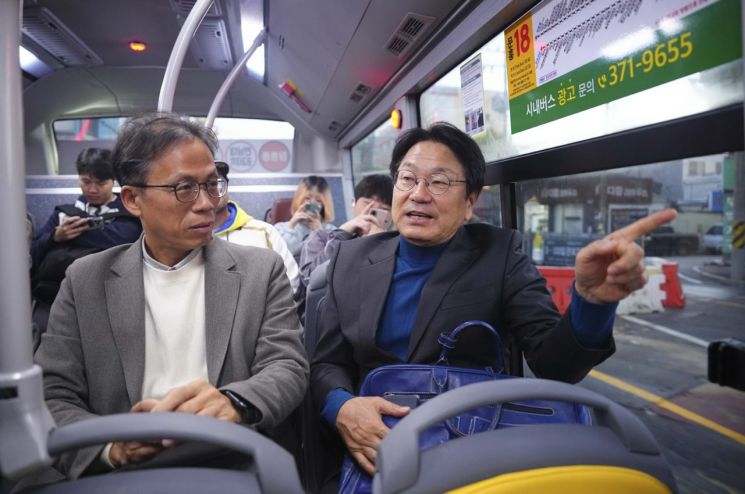 Gwangju Mayor Kang Gi-jung is taking a bus from his home in Munheung-dong, Buk-gu to City Hall on the morning of the 11th, engaging in conversations with citizens to realize the vision of "Gwangju, the City of Public Posters." Photo by Gwangju City
On the 11th, Kang Gi-jung, mayor of Gwangju City, embarked on a "1,250 won public transportation commute" in celebration of "Pedestrian Day." He became the first participant in the city's project to spread public awareness of the Dae·Ja·Bo (public transportation, bicycle, pedestrian-centered) city initiative, called the "Public Transportation Commute Challenge."
On that day, Mayor Kang left his home at 6:30 a.m., took a city bus, transferred at Gyeongshin Girls' High School stop, and arrived at Gwangju City Hall. The trip took a full hour. Although it took more than three times longer than his usual commute, the reason for choosing the city bus was clear. With the imminent opening of Phase 1 of the Gwangju Urban Railway Line 2, the city is designing a new public transportation system linked to it. Mayor Kang aimed to listen to citizens' voices on-site to reflect them in policies and to personally practice the Dae·Ja·Bo city concept.
During his bus commute, Mayor Kang explained the Dae·Ja·Bo city concept to citizens he met and sought their opinions. He also attentively listened to the difficulties faced by citizens commuting via public transportation. Mayor Kang promised, "Since punctuality and connectivity of city buses must be strengthened, we will carefully address any shortcomings."
Gwangju City officially launched the "Dae·Ja·Bo Commute Challenge," a citizen engagement policy for the Dae·Ja·Bo city, with Mayor Kang as the first participant. This challenge is a citizen participation project encouraging commuting by eco-friendly transportation modes such as public transportation, bicycles, and walking instead of private cars. The Gwangju City Council, the Office of Education, public officials, and public institutions are expected to participate. Later, the initiative will expand into a citywide movement aligned with the opening of Urban Railway Line 2.
The challenge proceeds in a relay format, where participants post verification photos on social media (SNS) and recommend the next participant. Through this, Gwangju City plans to encourage active citizen participation and spread consensus on the Dae·Ja·Bo city policy.
Mayor Kang stated, "The Dae·Ja·Bo city will be fully realized with the opening of Phase 1 of Urban Railway Line 2 and a comprehensive transformation of the urban transportation system. Bold policies and citizen participation are essential to achieve Dae·Ja·Bo. The city will engage in discussions with citizens and steadily prepare by increasing public transportation usage experiences."
Meanwhile, Gwangju City is promoting a people-centered transportation system overhaul to respond to the climate crisis and strengthen urban sustainability.
© The Asia Business Daily(www.asiae.co.kr). All rights reserved.

















