'New Energy Outlook: Republic of Korea' Report
Clean power including renewable energy and nuclear accounts for 17%
Solar and wind need to expand 10-fold
To achieve carbon neutrality by 2050, South Korea will need carbon capture and storage (CCS) technology to contribute the most at 41%. Additionally, it is estimated that a total capital investment of $2.7 trillion (approximately 3,762 trillion KRW) will be required.
According to the report "New Energy Outlook: Republic of Korea" published on the 11th by Bloomberg New Energy Finance (NEF), South Korea's achievement of carbon neutrality by 2050 depends on clean power and CCS technology.
Bloomberg NEF identifies the power sector as South Korea's largest source of carbon emissions. The report states that to achieve carbon neutrality by 2050, carbon emissions from the power sector must be reduced by more than two-thirds by 2030.
South Korea has pledged in its Nationally Determined Contribution (NDC) submitted to the United Nations to reduce emissions by 40% by 2030 compared to 2018 levels. This is lower than the 50% reduction proposed in Bloomberg NEF's net-zero scenario. According to Bloomberg NEF's economic transition scenario (a scenario driven by the cost competitiveness of technology, assuming no policy support), South Korea's actual reduction is predicted to be around 18%.
David Kang, Head of Research for Korea and Japan at Bloomberg NEF, stated, "South Korea still has an opportunity to meet its 2030 emission reduction targets. To do so, it is necessary to expand the deployment of renewable energy and electric vehicles over the next five years, while also laying the groundwork to reduce emissions in economic sectors such as industries where reductions are difficult."
The solution proposed by Bloomberg NEF in the report is CCS. In South Korea's carbon neutrality scenario, CCS is expected to account for 41% of total reductions by 2050, playing a key role in emission reduction. This is significantly higher than the global contribution of 14%. Clean power sources such as renewable energy and nuclear power are expected to contribute 17% by 2050, which is much lower than the global share of 45%.
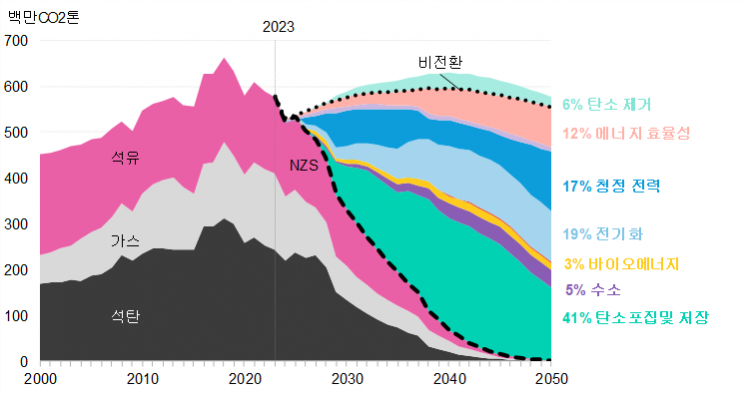 Comparison of South Korea's Net Zero Scenario and Non-Transition Scenario. The 'Non-Transition' scenario is a hypothetical counterfactual scenario that assumes no additional improvements in decarbonization and energy efficiency. It assumes that the future fuel composition in power generation and transportation remains unchanged after 2023 (and after 2027 for maritime transport). For all other sectors, the economic transition scenario is applied as a counterfactual scenario to the Net Zero scenario. 'Clean power' includes renewable energy and nuclear power, while carbon capture and storage, hydrogen, and bioenergy are designated separately in their respective categories. 'Energy efficiency' includes demand-side efficiency improvements and increased recycling in industry.
The large share of CCS in South Korea's carbon neutrality scenario is due to geographical characteristics. Song Seohee, lead author of the report and analyst at Bloomberg NEF's Energy Economics team, explained, "As it becomes increasingly difficult to find land suitable for large-scale renewable energy projects, there is upward pressure on the prices of solar and wind energy," adding, "Therefore, the need for CCS technology to fully decarbonize the power and industrial sectors is growing."
Nevertheless, the report analyzes that to achieve carbon neutrality, South Korea must expand the capacity of solar and wind energy to 304 gigawatts (GW), which is ten times the current capacity. The report also suggests applying CCS technology to about one-third of the domestic coal-fired power plants, which currently total 73 GW, by 2030.
The report further states that South Korea will need to invest $2.7 trillion by 2050 to decarbonize its energy system. This means an annual capital investment of $102 billion (142 trillion KRW), which corresponds to 6% of the country's GDP as of 2023. Last year, South Korea's investment in energy transition was $25 billion (approximately 34 trillion KRW), about one-quarter of this amount. The report points out that a clear and consistent policy framework is necessary to increase investor confidence and expand investments to realize carbon neutrality.
Annaly Seo, a BNEF Korea analyst and co-author of the report, said, "The high investment demand required in the net-zero scenario also represents a significant economic opportunity for South Korea," explaining, "Under this scenario, South Korea will not only reduce emissions but also enhance energy security by reducing fossil fuel imports. Additionally, demand will increase for technologies in which Korean manufacturers have a competitive advantage, such as electric vehicles and batteries."
© The Asia Business Daily(www.asiae.co.kr). All rights reserved.

















