Gyeonggi Province Governor Kim Dong-yeon and the mayors and county heads of the 31 cities and counties in Gyeonggi Province have agreed to promote bipartisan cooperation for a better life for residents, including establishing a joint response system to address the climate crisis.
On the 11th, Gyeonggi Province announced that it held the first governor-mayor/county head meeting of the second half of the 8th local government term at Danwon Hall on the 25th floor of the Gyeonggi Provincial Government Office, attended by Governor Kim Dong-yeon, Suwon Mayor Lee Jae-jun, and other heads of the 31 cities and counties. The meeting was attended by 20 mayors and county heads and 11 deputy mayors and deputy county heads.
At the meeting, Governor Kim Dong-yeon said, "Due to various situations such as the recent U.S. presidential election results, rapidly changing international circumstances, and North Korea’s deployment of troops to Russia, peace is being threatened and people’s livelihoods are becoming very difficult. In this context, the roles of Gyeonggi Province and each city and county feel even more important."
He continued regarding next year’s Gyeonggi Province budget, "We have set the policy direction with an active and expanded budget increased by 7.2%, centered on Humonomics (people-centered economy). We will play an active fiscal role including revitalizing the economy through more opportunities, creating a world where people live with more equal opportunities, and responding to future challenges and the climate crisis."
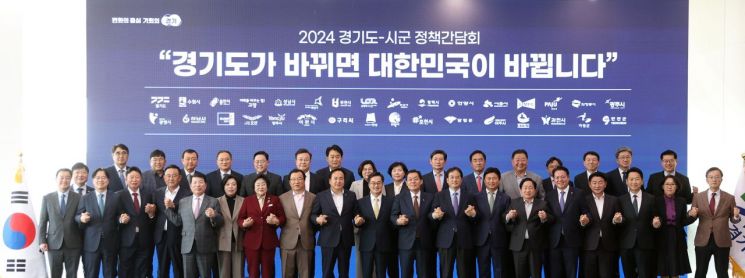 Gyeonggi Province Governor Kim Dong-yeon held the first governor-mayor meeting of the second half of the 8th term on the 11th, attended by heads of 31 cities and counties within the province. Photo by Gyeonggi Provincial Government
He added, "I hope that today’s discussion on responding to the climate crisis will also include discussions on what the 31 cities and counties want to say to the province and the issues they want to solve together."
On this day, the Policy Cooperation Committee set Humonomics as the key task for the second half of the 8th local government term and proceeded based on this with four areas: ▲more economic vitality through human investment and opportunity expansion (Opportunity Economy), ▲providing more equal opportunities through a virtuous cycle economy integrated with care labor and industry (Care Economy), ▲energy transition economy for better opportunities (Climate Economy), and ▲coexistence and cooperation economy through easing border tensions and establishing a peace system (Peace Economy).
Each city and county agreed to explore ways to jointly utilize the Gyeonggi Province Climate Data Platform and climate satellites when establishing climate policies and to cooperate in policy promotion to expand residents’ participation in climate insurance and climate action opportunity income. They also agreed to collaborate in discovering and providing unused public land in cities and counties to create renewable energy power plants and activate climate funds that return development profits to residents.
This meeting was held for the first time in one year and two months since the last one in September of last year, as the first half Policy Cooperation Committee scheduled for June this year was canceled due to the response to the Hwaseong Arisel fire accident. It was the fourth meeting since Governor Kim Dong-yeon took office.
© The Asia Business Daily(www.asiae.co.kr). All rights reserved.

















