In the first round of the Japanese Prime Minister designation election, Shigeru Ishiba, the leader of the ruling Liberal Democratic Party, and Yoshihiko Noda, the leader of the main opposition Constitutional Democratic Party, ranked first and second respectively, leading to a runoff vote.
In the first round of the Prime Minister designation election held on the 11th during the special Diet session in the House of Representatives (lower house) plenary session, out of a total of 465 votes, Prime Minister Ishiba received 221 votes, and Representative Noda received 151 votes.
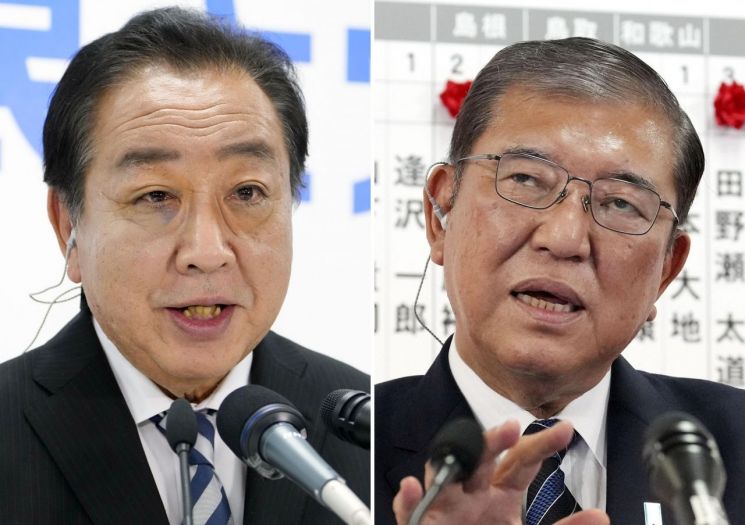 Japanese Prime Minister Shigeru Ishiba (right) and Yoshihiko Noda, leader of the Constitutional Democratic Party Photo by Yonhap News
Since no candidate received a majority, a runoff vote for the Prime Minister designation will be held in the House of Representatives for the first time in 30 years. In the runoff vote, the candidate with the most votes will be designated as Prime Minister regardless of whether they achieve a majority.
Japanese media predict a high possibility of victory for Prime Minister Ishiba, who ranked first in the first round. The second opposition party, Nippon Ishin no Kai, and the third opposition party, the Democratic Party for the People, which hold the casting votes, are expected to cast their votes for their respective party leaders in the runoff. In the runoff vote, any ballots with names other than Ishiba and Noda will be invalid.
The first Ishiba Cabinet resigned en masse at a provisional cabinet meeting that morning. If Prime Minister Ishiba is re-elected, the second Ishiba Cabinet will be launched with key ministers retained.
Prime Minister Ishiba, who took office on October 1, dissolved the House of Representatives early on the 9th of the same month, leading to the House of Representatives election (general election) held on the 27th of last month.
© The Asia Business Daily(www.asiae.co.kr). All rights reserved.
!["The Woman Who Threw Herself into the Water Clutching a Stolen Dior Bag"...A Grotesque Success Story That Shakes the Korean Psyche [Slate]](https://cwcontent.asiae.co.kr/asiaresize/183/2026021902243444107_1771435474.jpg)
















