"Request for Clearer Regulations in Short Selling System Improvements"
Provision of English Guidelines... Customized Consulting Also Available
Value-Up Policy "Not a One-Time Task... A National Challenge"
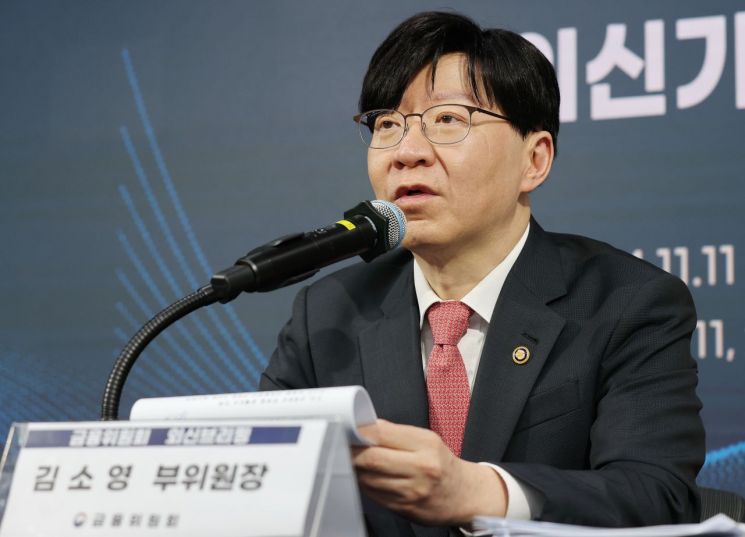
Kim So-young, Vice Chairman of the Financial Services Commission, emphasized on the 11th that "we will do our best to provide continuous explanations and communication (for overseas investors) during the follow-up process of improving the short-selling system."
Vice Chairman Kim So-young stated this at a foreign press briefing held at the Korea Press Center in Seoul in the afternoon, saying, "During the process of promoting improvements to the short-selling system, we received many requests from overseas investors for regulatory clarity."
In June, the Financial Services Commission decided to ban short selling until March 30 of next year to resolve controversies over illegal short selling. In fact, some overseas investment banks (IBs) were caught by financial supervisory authorities for illegal naked short selling in Korea. To prevent naked short selling, the FSC required institutional investors to establish internal balance management systems. The Korea Exchange is building a Centralized Inspection System (NSDS) for more systematic management.
However, among foreign investors, there was criticism that the Korean government's blanket ban on short selling posed a policy risk. Short selling is an investment method where stocks are borrowed and sold in anticipation of a price decline to make a profit. It is also used for risk hedging purposes. After the short-selling ban, Morgan Stanley Capital International (MSCI) downgraded its evaluation of short-selling accessibility in the Korean market from positive (no major issues) to negative (needs improvement).
Vice Chairman Kim So-young explained, "Regarding the core institutional improvement tasks such as building a short-selling IT system, establishing internal control standards, and the verification obligations of securities firms, we presented detailed Korean and English guidelines immediately after announcing the measures." She added, "We organized a joint task force (TF) with related agencies, assigned persons in charge for major investors, and are providing customized consulting."
She continued, "We are striving to enhance overseas investors' understanding of domestic short-selling regulations by providing detailed integrated guidelines on the criteria for judging naked short selling."
She also emphasized the government's corporate value-up policy. The core of the value-up program is for listed companies to disclose corporate value enhancement plans and design their own future vision for value improvement. As of 3 p.m. on November 7, 37 companies have made official disclosures and 31 companies have made preliminary disclosures of corporate value enhancement plans.
Vice Chairman Kim So-young said, "Although the domestic stock market has recently shown somewhat sluggish performance compared to major overseas markets, it is regrettable, but we need to view changes in the capital market (domestic stock market) from a more mid- to long-term perspective." She added, "Capital market advancement and corporate value-up are not one-time events but national tasks that will be pursued steadily and persistently."
Meanwhile, Vice Chairman Kim So-young also mentioned efforts to strengthen sanctions against unfair trading in the capital market, improvements to the system for similar investment advisory businesses such as leading rooms, and achievements in inclusion in the FTSE Russell World Government Bond Index (WGBI) due to efforts to improve accessibility for foreign investors. She also shared news about the full abolition of the financial investment income tax and the introduction of the domestic investment-type Individual Savings Account (ISA). Measures for institutionalizing Alternative Trading Systems (ATS) and unlisted stock platforms were also discussed.
© The Asia Business Daily(www.asiae.co.kr). All rights reserved.
![Clutching a Stolen Dior Bag, Saying "I Hate Being Poor but Real"... The Grotesque Con of a "Human Knockoff" [Slate]](https://cwcontent.asiae.co.kr/asiaresize/183/2026021902243444107_1771435474.jpg)
















