Health Insurance Research Institute Releases 21-Year Follow-Up Results of 8.47 Million People
Higher BMI Increases Disease Risk... "The Basis for 25 as a Standard Is Unclear"
Although a body mass index (BMI) of 25 or higher is classified as 'obese,' a study has found that the risk of death is actually lowest around a BMI of 25. Experts have argued that the obesity threshold should be raised to a BMI of 27 or higher based on these findings.

According to the National Health Insurance Service on the 11th, the Health Insurance Research Institute announced these research results at the Korean Society for Health Education and Health Promotion Autumn Academic Conference held on the 8th. The study was based on a 21-year follow-up of 8.47 million adults who underwent general health checkups in 2002?2003.
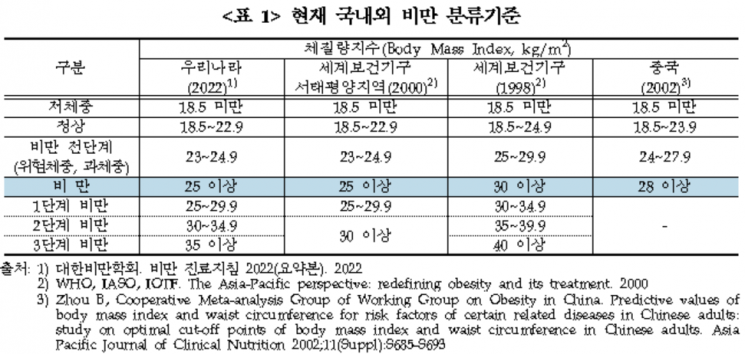
BMI (Body Mass Index) is calculated by dividing body weight (kg) by the square of height (m²) and is the most widely used measure for defining obesity. In South Korea, according to the World Health Organization (WHO) Western Pacific Region standards, a BMI of 18.5?22.9 is classified as 'normal,' 23?24.9 as 'pre-obese (at-risk weight/overweight),' and 25 or higher as 'obese.'
However, when the researchers analyzed the association between BMI and total mortality based on the follow-up data, a 'U'-shaped curve appeared, showing the lowest mortality risk in the BMI 25 range. Excluding deaths within six years from the start of observation, the analysis showed that mortality risk was lowest in the BMI 25 range, while underweight individuals with BMI below 18.5 and those with class 3 obesity with BMI 35 or higher had mortality risks 1.72 times and 1.64 times higher, respectively, compared to the BMI 25 range. Examining the increase in mortality risk above BMI 25, it was confirmed that the risk doubled in the BMI 29 range compared to the previous range.
In analyzing the association between cardiovascular and cerebrovascular diseases?including hypertension, diabetes, and dyslipidemia?and BMI, the researchers explained that the risk of disease occurrence generally increased as BMI rose, making it unclear to specify BMI 25 as the obesity threshold. Specifically, the risk of cardiovascular and cerebrovascular disease was lowest at BMI below 18.5 and gradually increased thereafter, with hypertension and diabetes peaking at BMI 34, dyslipidemia at BMI 33, and cardiovascular and cerebrovascular diseases at BMI 34.
Regarding the increase in disease risk above BMI 25, hypertension, diabetes, and dyslipidemia showed a greater increase at BMI 27, cardiovascular disease at BMI 29, and cerebrovascular disease at BMI 31 compared to the previous ranges.
Professor Oh Sang-woo of Dongguk University Ilsan Hospital explained, "Twenty years ago, the lowest mortality risk was observed at BMI 23, but changes in body shape, lifestyle, and disease patterns resembling Western trends have led to the lowest mortality risk now being observed at BMI 25." He added, "Considering the overall research results, it is judged that raising the current obesity diagnostic criterion to BMI 27 is an appropriate diagnostic standard for Koreans."
Lee Sun-mi, head of the Health Management Research Center at the Health Insurance Research Institute, also stated, "This study is the largest-scale follow-up study based on health insurance big data related to obesity criteria. Considering both the incidence of cardiovascular and cerebrovascular diseases and mortality risk among Korean adults, there is a need to raise the current obesity standard to at least a BMI of 27. China has already applied a BMI of 28 or higher as the obesity criterion."
© The Asia Business Daily(www.asiae.co.kr). All rights reserved.


















