Orange Body with Black Wings Features
Endangered Species with Demanding Habitat Requirements
The red bat, a natural monument and endangered species, has been confirmed in Jeju for the first time in seven years.
On the 11th, Yonhap News reported that the Jeju World Heritage Headquarters identified one red bat hibernating in Kimnyeong Cave, Gujwa-eup, Jeju City, a UNESCO World Natural Heritage site, during regular monitoring last month. Belonging to the family Vespertilionidae, the red bat is about 4 to 6 cm in body length, characterized by a deep orange body and black wings. It is a rare species commonly known to the public as the "golden bat." It was designated as a natural monument in 2005 and is classified as a Class I endangered wild animal and a species of concern by the International Union for Conservation of Nature (IUCN).
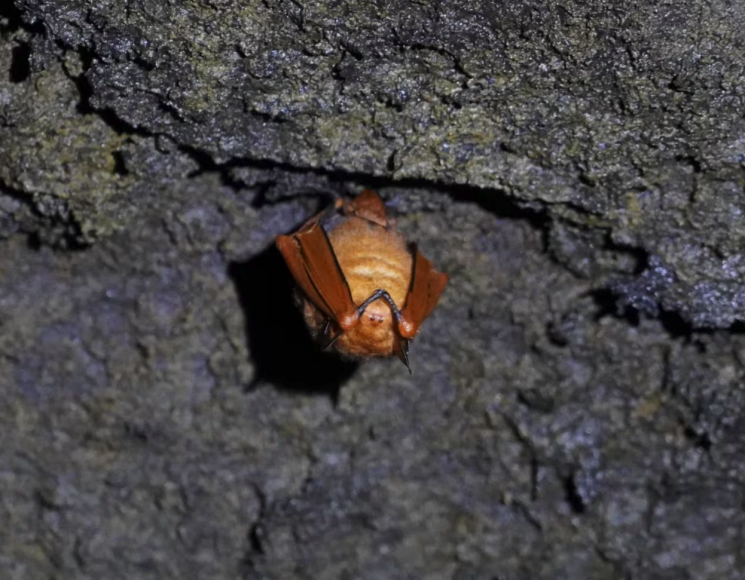 The red bat, a natural monument and endangered species, has been confirmed in Jeju for the first time in seven years. Photo by Jeju World Heritage Headquarters
This is the first confirmation of the red bat in Kimnyeong Cave in seven years since 2017. The World Heritage Headquarters explained that Jeju lava caves are important habitats for this rare species, as their presence was also confirmed in nearby Manjang Cave from 2010 to 2019. The Geomunoreum Lava Tube System, registered as a UNESCO World Natural Heritage site, provides an ideal environment for bats with its forested surroundings and abundant food sources. Additionally, it maintains a constant temperature and high humidity throughout the year, creating optimal conditions for bat hibernation.
The red bat hibernates in deep parts of caves from October to May. It gives birth to one or two pups from late June to early July. As hibernation sites nationwide are decreasing due to forest destruction and mine entrance closures, the ecological value of Jeju lava caves is receiving increased attention. A Jeju official stated, "The discovery of the red bat, which has more demanding habitat requirements compared to other bats, in Kimnyeong Cave suggests that not only the interior of the cave but also Kimnyeong Cave and its surrounding environment are well preserved." He added, "This shows that Jeju lava caves are important habitats for this rare species." Kang Seok-chan, head of the Jeju World Heritage Headquarters, said, "We will conduct continuous monitoring to ensure the safe wintering of the red bat," and added, "We will strive to conserve and manage the Geomunoreum Lava Tube System so that it can function as a stable habitat for diverse species."
© The Asia Business Daily(www.asiae.co.kr). All rights reserved.

















