Lee Strengthens Ties with Business Community Ahead of First Trial Verdict
Pragmatic Approach to Expand Centrist Base
KCCI: "Flexible Working Hours, Rationalized Wage System"
Lee Jae-myung, leader of the Democratic Party of Korea, said on the 11th, "Growth is welfare. I believe growth is development."
On the same day, Lee met with Sohn Kyung-shik, chairman of the Korea Employers Federation (KEF), at the KEF headquarters located in Mapo-gu, Seoul, and made these remarks. Lee explained, "When I talk about livelihood issues, it means making the people better off, and the core is corporate activity," adding, "Companies must create jobs to generate national wealth." He emphasized, "Corporate activity must be at the center, and the state should encourage and smoothly support corporate activities," stressing the need to find solutions for coexistence and innovation despite difficult economic conditions.
This visit to KEF came just a week after Lee attended the 'SK AI Summit 2024' at COEX in Gangnam-gu on the 4th and met with Chey Tae-won, chairman of SK Group. Chairman Chey was re-elected as the 25th president of the Korea Chamber of Commerce and Industry in March this year and has been serving as a leader of economic organizations for four years since 2021.
The background to Lee’s recent increase in engagement with the business community lies in the Democratic Party’s strengthening of a pragmatic line aimed at 'expanding the centrist base.' While party leader Park Chan-dae and the leadership focus on aggressive opposition against the Yoon Suk-yeol administration, Lee is pursuing a 'two-track strategy' by advancing 'Meoksa-nism' policies in the economy and livelihood sectors. This reflects the judgment that strengthening cooperation and communication with the business community beyond political figures is essential to secure firm support from the centrist electorate. A Democratic Party official said in a phone interview regarding the meeting, "It will be a meaningful occasion to jointly seek solutions for coexistence and innovation amid difficult external economic conditions."
Lee’s 'rightward shift' is prominent in the second-term system. Earlier on the 4th, the party decided to abolish the financial investment income tax as its official stance. Initially, the Democratic Party planned to implement the financial investment tax scheduled to start next year as planned, but Lee’s intention for 'economic recovery' is known to have influenced the last-minute decision to abolish it. Three days later, on the 7th, the party also launched the 'National Economic Advisory Council,' an economic policy think tank emphasizing a 'pro-business' stance.
Some view Lee’s increased contact with business figures as related to upcoming judicial risks. Lee faces first trial verdicts on charges of 'violation of the Public Official Election Act' on the 15th and 'subornation of perjury' on the 25th. Since the court rulings could deal a direct blow to his future presidential ambitions, this is interpreted as part of a public opinion campaign to strengthen a centrist, conservative, and pragmatic line before the verdicts.
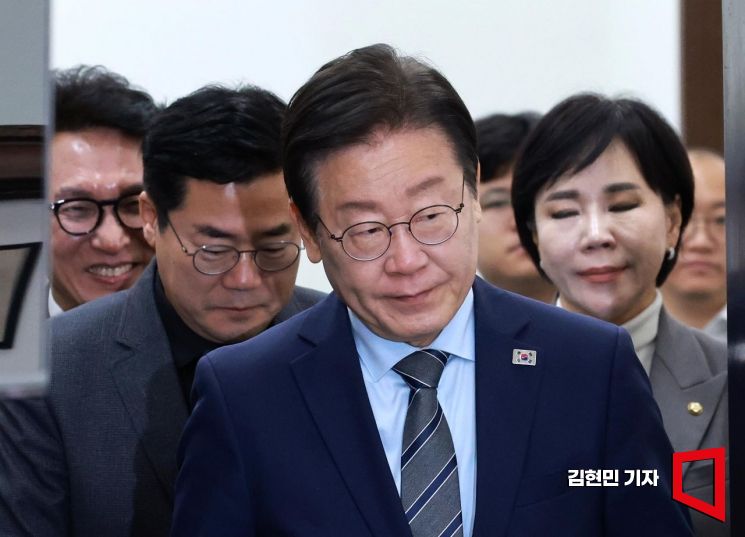 Lee Jae-myung, leader of the Democratic Party of Korea, is attending the Supreme Council meeting held at the National Assembly on the 8th. Photo by Kim Hyun-min
Meanwhile, KEF requested Lee to resolve inefficient labor regulations during the meeting. Chairman Sohn Kyung-shik said, "Accumulated inefficient regulations in our labor market are lowering corporate competitiveness and restricting investment," demanding labor market flexibility and advancement of labor-management relations, while expressing concerns about related bills currently submitted to the National Assembly.
KEF proposed the need to enhance flexibility in the rigid labor market by introducing flexible working hours and rationalizing wage systems. They advocated changing the calculation unit for overtime work and improving flexible work systems to achieve flexible working hours. They also added that the procedure for changing employment rules should be improved to restructure the wage system based on job and performance.
Regarding the proposed reduction of working hours submitted to the National Assembly, KEF conveyed concerns that corporate competitiveness could decline due to low productivity compared to major countries. They also worried that extending the statutory retirement age could deepen the dual structure of the labor market and cause intergenerational conflicts over jobs.
KEF demanded improvements in labor-management relations, arguing that companies lack sufficient means to respond compared to the rights granted to labor unions. They claimed the need to prohibit workplace occupation, allow replacement labor during union strikes, and improve the unfair labor practices system.
Additionally, KEF urged tax reforms such as inheritance tax and corporate tax adjustments and support for advanced industries like semiconductors to revitalize investment. They also expressed concerns that the recent amendment to the Commercial Act, which expands the duty of directors to act faithfully, would add burdens to corporate management.
© The Asia Business Daily(www.asiae.co.kr). All rights reserved.
![Clutching a Stolen Dior Bag, Saying "I Hate Being Poor but Real"... The Grotesque Con of a "Human Knockoff" [Slate]](https://cwcontent.asiae.co.kr/asiaresize/183/2026021902243444107_1771435474.jpg)
















