Priority Investment in Projects That Can Be Completed Within This Year Among Key Tasks of the 8th Elected Administration
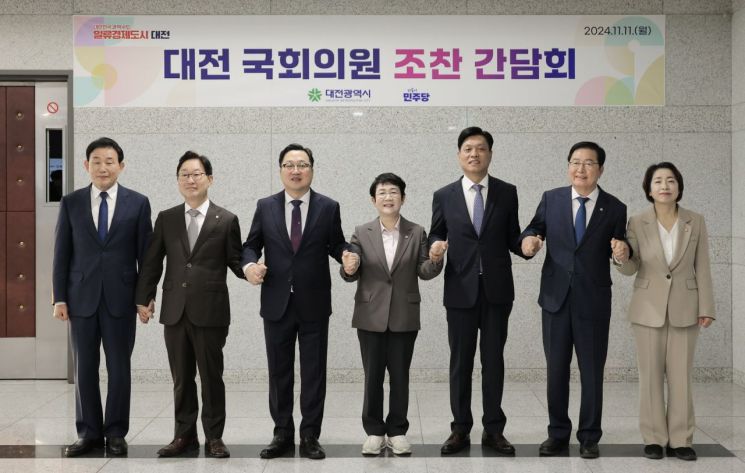 Lee Jangwoo, mayor of Daejeon, held a breakfast meeting on the 11th at the Korea Railroad Corporation conference room with National Assembly members Park Junghyun, Park Beomgye, Cho Seungrye, Jang Jongtae, Park Yonggap, and Hwang Jeonga to secure national funding for the next year. / Daejeon City
Daejeon City announced that it has submitted its budget proposal for next year to the city council, totaling 6.6771 trillion won, an increase of 144.1 billion won compared to last year.
The general account stands at 5.547 trillion won and the special account at 1.1301 trillion won, representing increases of 1.5% (79.3 billion won) and 6.1% (64.8 billion won) respectively from last year.
The city allocated funds to projects nearing completion, including 28.1 billion won for the creation of the Baseball Dream Park, 14.1 billion won for the Pyeongchon Industrial Complex, 4.2 billion won for the Second Daejeon Literature Center, and 2.4 billion won for the Social Economy Innovation Town.
Additionally, to ensure the smooth progress of long-awaited civic projects, the city allocated 97.8 billion won for the construction of Urban Railway Line 2, 18.7 billion won for the Yuseong Complex Terminal, and 3 billion won for the trackless tram project. To prepare for heavy rainfall, 10 billion won was set aside for the maintenance of sediment in the three major rivers.
Furthermore, to support self-employed individuals and small business owners struggling with high interest rates and inflation, the city allocated 41 billion won for ultra-low interest loans, 3.4 billion won for rent support for micro-business owners, 1.6 billion won for joint delivery services in traditional markets, 1 billion won for card payment communication fees for small businesses, and 4.5 billion won for modernization of traditional market and shopping district facilities.
To overcome generational conflicts caused by low birth rates and an aging population, the city assigned 54.1 billion won for Daejeon-style childcare allowances, 131.9 billion won for infant care fees, 6.5 billion won for operational expenses per class in daycare centers, 1.5 billion won for additional support for three-year-old Nuri care fees, and 22.4 billion won for child care support.
Youth support initiatives include 13.8 billion won for marriage incentives for young couples, 12.9 billion won for temporary youth rent support, and 1.9 billion won for youth housing deposit interest support.
For senior citizens, the city allocated 20.4 billion won for free public transportation, 107.6 billion won for senior employment programs, 598.1 billion won for basic pensions, and 3.1 billion won for food expenses at senior centers.
In the field of science and technology, focusing on six strategic industries (aerospace, bio-health, nano-semiconductors, defense, quantum, and robotics), the city allocated a total of 66.2 billion won, including 3 billion won for the establishment of a bio-startup center, 4.7 billion won for the defense industry innovation cluster and the robot drone center, and 1 billion won for system semiconductor technology support.
To respond to the ongoing increase in expenditure demand, the city plans to issue 170 billion won in local bonds, a 29% (70 billion won) decrease from this year.
The budget proposal for next year is expected to be finalized on December 13 after review and approval by the city council.
Meanwhile, on the 11th, Daejeon Mayor Lee Jangwoo held a breakfast meeting with local National Assembly members at the Korea Railroad Corporation conference room to discuss strategies for securing next year's national budget.
As the National Assembly begins its review of next year's budget, Mayor Lee requested joint efforts to secure funding for 21 major projects, including the construction of Urban Railway Line 2 tram and the establishment of urban railway LTE-R.
Mayor Lee stated, "Given the government's fiscal austerity policy and the decrease in national tax revenue, securing national funds is expected to be challenging. We will focus our efforts on securing national funds for citizens through close cooperation with local lawmakers."
Park Junghyun, chairperson of the Daejeon City branch of the Democratic Party of Korea, said, "The city of Daejeon and its seven National Assembly members share the common goal of developing Daejeon. To achieve this, budget support is essential. The more difficult the situation, the more bipartisan cooperation is needed. We will strive to secure increased funding and livelihood budgets as requested by the city."
© The Asia Business Daily(www.asiae.co.kr). All rights reserved.

















