KCCI, Report on "Logistics Supply Chain Changes and Implications in Trump's Second Term" on the 11th
There are claims that the eco-friendly logistics infrastructure project targeting all U.S. ports is likely to be withdrawn following the second term of the Trump administration. In particular, it is analyzed that concentrated investments are expected to be made mainly in the southeastern region, where taxes are lower and logistics personnel are concentrated, as well as the Canada-Mexico border area tied by the USMCA (United States-Mexico-Canada Agreement), rather than the West Coast, which has only 4 to 5 ports.
According to the report titled "Changes and Implications of the Logistics Supply Chain under Trump's Second Term," published by the Korea Chamber of Commerce and Industry on the 11th, as the decoupling of the logistics supply chain from China accelerates after Trump's second term, there is a high necessity to proactively secure logistics infrastructure such as ports and terminals, focusing on emerging global supply chain hubs like the U.S. Southeast region and the Canada-Mexico border area.
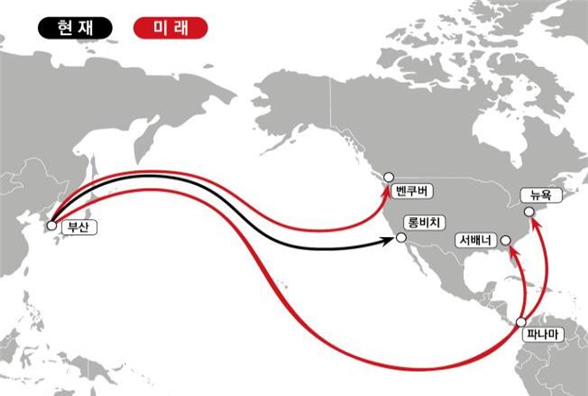 The Present and Future of the United States' Core Logistics Supply Chain. Korea Chamber of Commerce and Industry
The report revealed that the U.S. trade volume with China sharply declined from $660 billion in 2021 to $580 billion in 2023. Additionally, over the past three years, the average annual growth rate of U.S. imports was 7.5% from Mexico and -5.4% from China, shifting the largest U.S. import partner from China (import value of $430 billion last year) to Mexico (import value of $480 billion in 2023).
The Korea Chamber of Commerce and Industry noted that although Trump pledged a 25% tariff on Mexican imports to block Mexico's circumvention exports aimed at avoiding U.S. tariffs on China, the overall trend is decoupling from China. Therefore, the logistics supply chain is expected to be reorganized around Mexico and Canada, tied by the USMCA, as well as existing economic allies such as South Korea and Taiwan.
The report presented strategic measures for logistics companies in response to the reorganization of the U.S. logistics supply chain following Trump's second term.
First, it argued that strategic Asian allies newly entering the North American supply chain, such as Vietnam and Indonesia, need to develop and target customized business models specialized for the North American market so that they can use Korean ports as transshipment hubs. South Korea, as a key economic ally of the U.S. with advanced logistics systems (customs clearance, port infrastructure, etc.), is highly likely to be perceived as an attractive logistics hub offering fast and stable logistics services to these countries.
Furthermore, since Korean logistics companies lack experience in performing local logistics services, approaching new logistics hubs on an individual company basis has limitations. Therefore, efforts to seek symbiosis through building cooperative networks and sharing information among logistics companies are necessary.
The report proposed three government policy tasks to support companies in securing logistics hubs: ▲ establishing integrated governance for logistics policy ▲ creating a win-win foundation between shippers and logistics companies ▲ supporting logistics supply chain infrastructure.
First, it emphasized the need to integrate policy governance among logistics-related government ministries such as the Ministry of Land, Infrastructure and Transport, the Ministry of Oceans and Fisheries, and the Ministry of Trade, Industry and Energy, and to strengthen inter-ministerial collaboration by establishing a logistics supply chain committee. It also argued that infrastructure such as ports and terminals should be secured at logistics supply chain hubs, and a cooperative system for joint entry of shippers and logistics companies into new logistics hubs should be proactively established.
The report forecasted that, in the mid to long term, as manufacturing investment expands in the U.S., domestic industrialization (factory base establishment) of key industries such as semiconductors and secondary batteries will progress, changing the global import-export logistics supply chain patterns. In the past, Korea's materials, parts, and equipment (MP&E) and intermediate goods moved to the U.S. via China, but going forward, Korean intermediate goods will directly cross to North America, be processed and assembled within the region, become final products, and then be consumed domestically in the U.S. or partially exported overseas.
Lee Sung-woo, head of the Korea Maritime Institute's Korea-U.S. Logistics Supply Chain Center (located in New Jersey), analyzed, "The U.S. is expanding domestic production of major core technology products such as semiconductors, secondary batteries, electric vehicles, AI, and quantum computing. Once production facilities are completed within the next five years, consumption in the U.S. domestic market will increase, and exports overseas, especially to the Asian region, are expected to expand."
Jang Geun-moo, president of the Korea Chamber of Commerce and Industry's Distribution and Logistics Promotion Institute, emphasized, "South Korea has global competitiveness in key fields that the U.S. aims to foster intensively, such as semiconductors and secondary batteries, and possesses capabilities in logistics sectors like shipping and aviation. In the context of supply chain changes, it is necessary to explore logistics business opportunities such as 3PL, fulfillment services, and terminal infrastructure operations."
© The Asia Business Daily(www.asiae.co.kr). All rights reserved.

![Clutching a Stolen Dior Bag, Saying "I Hate Being Poor but Real"... The Grotesque Con of a "Human Knockoff" [Slate]](https://cwcontent.asiae.co.kr/asiaresize/183/2026021902243444107_1771435474.jpg)















