Meeting with Trade and Foreign Exchange Experts at the External Economic Advisory Council
Experts: "Trump Poses Downside Risk to Korean Economy"
"Diplomatic Sector Requires Political and Strategic Negotiation Strategies"
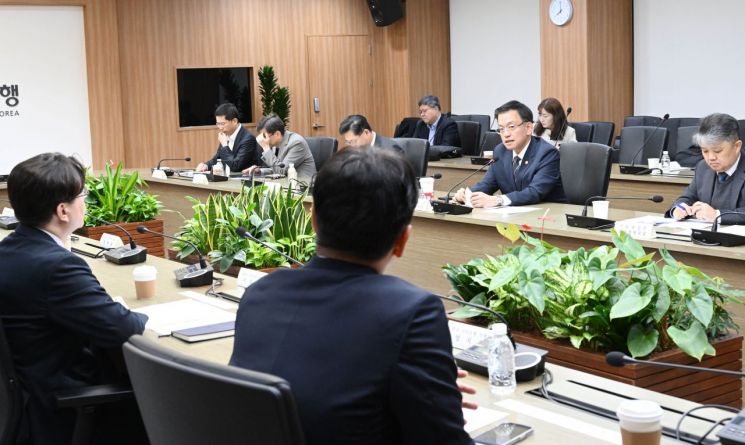
Choi Sang-mok, Deputy Prime Minister for Economy and Minister of Strategy and Finance, stated on the 11th, "While closely monitoring changes in conditions following the U.S. presidential election results, it is necessary to respond swiftly according to different scenarios and cooperate closely with the United States."
On the same day, Deputy Prime Minister Choi discussed prospects for the formation of the new U.S. administration's cabinet and domestic economic sector response strategies with trade, foreign exchange, and financial experts at the 7th Foreign Economic Advisory Meeting held at the Korea Eximbank. The meeting was attended by the Ministry of Strategy and Finance's International Economic Management Officer, Director-General of Foreign Economic Affairs, and experts in trade, foreign exchange, and finance.
Presiding over the meeting, Deputy Prime Minister Choi said, "Given the results of the presidential election held on the 5th, it is difficult to uniformly predict the impact of the new U.S. administration's policies, but they are expected to have diverse effects not only on our external economic conditions such as industry, trade, diplomacy, security, supply chains, and financial markets but also across all sectors."
He added, "While closely monitoring the economic impact of the U.S. presidential election results, it is necessary to prepare sector-specific response directions based on thorough analysis."
The experts attending the meeting anticipated policy shifts such as unilateral pressure and negotiations centered on the U.S. from diplomatic, security, economic, and trade perspectives, emphasizing the need to develop political and strategic negotiation strategies that protect core interests while presenting proposals to the U.S.
From a macroeconomic and foreign exchange perspective, they assessed that the inauguration of the new U.S. administration could pose some downside risks to South Korea's economic growth; however, positive factors such as price declines due to falling energy prices and domestic investment activation following the inclusion of Korean government bonds in the World Government Bond Index (WGBI) are also mixed in.
Concluding the meeting, Deputy Prime Minister Choi emphasized that, as he pledged to maintain the economic cooperation relationship between South Korea and the U.S. like a "solid rock," it is necessary to keep all possibilities open, closely monitor changes in conditions without gaps, respond swiftly according to different scenarios, and cooperate closely with the U.S.
The Foreign Economic Advisory Meeting was established to gather opinions from domestic and international experts and reflect them in policies to seek strategic response measures against global uncertainties such as the recent surge in geopolitical risks. Since April, a total of six meetings have discussed prospects for the Middle East situation, U.S. tariff increases on China, and economic cooperation directions of the new Japanese cabinet.
© The Asia Business Daily(www.asiae.co.kr). All rights reserved.
![Clutching a Stolen Dior Bag, Saying "I Hate Being Poor but Real"... The Grotesque Con of a "Human Knockoff" [Slate]](https://cwcontent.asiae.co.kr/asiaresize/183/2026021902243444107_1771435474.jpg)
















