Resident doctors at Sajik Hospital insist on 7 major demands including 'Complete cancellation of medical school expansion'
KMA Delegates Assembly: "Participation in the consultative body requires cooperation from the Emergency Committee and DAEJEON Association"
"Emergency Committee Chair's term is less than a month... Difficult to make major decisions"
Although the president of the Korean Medical Association stepped down just six months after taking office, the participation of the medical community in the ruling and opposition parties' medical council remains unlikely.
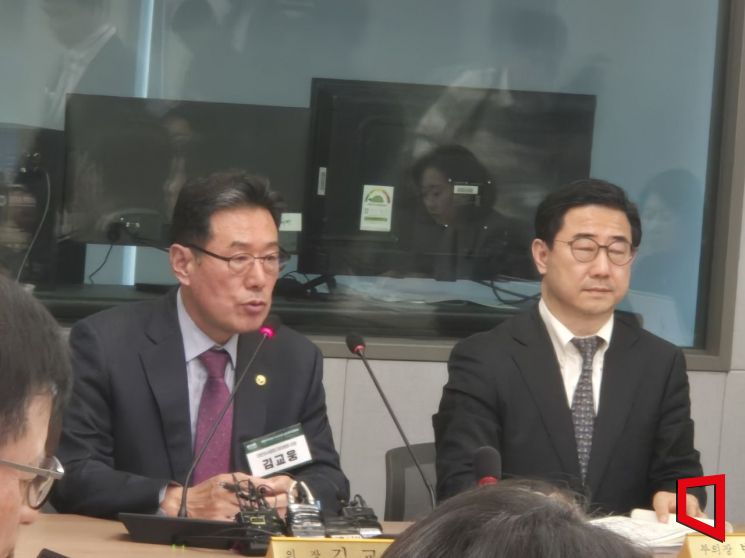 Kim Gyo-ung, Chairman of the Korean Medical Association Delegate Council (left), is speaking at a briefing held after the extraordinary delegate general meeting at the KMA Hall in Yongsan-gu, Seoul, on the 10th. Photo by Choi Tae-won
On the 10th, the Korean Medical Association (KMA) Delegate Assembly held an extraordinary general meeting at the KMA Hall in Yongsan-gu, Seoul, and passed a vote of no confidence against President Im Hyun-taek. According to KMA regulations, if the no-confidence vote is passed, the president is immediately suspended from duty, and a by-election must be held within 60 days.
Until a new president is elected through the by-election, the emergency response committee will fill the executive vacancy. The KMA announced a call for candidates for the emergency committee chairperson on the 11th, received applications on the 12th, and plans to conduct the chairperson vote from 8 p.m. on the 13th. The vote will be conducted via mobile and only delegates can participate. If no candidate receives a majority, a runoff vote will be held. The term of the emergency committee chairperson lasts until the next president is elected.
Accordingly, whether the KMA, the only statutory organization in the medical community, will participate in the council is expected to be decided by the newly elected emergency committee chairperson. However, since the opinions of the resigning residents were repeatedly emphasized as important during the meeting, participation in the council is expected to be difficult for the time being. This is because the resigning residents continue to demand a progressive change in the government's stance.
Kim Gyo-ung, chairman of the KMA Delegate Assembly, said at a briefing after the extraordinary general meeting, "It is not that the emergency committee chairperson cannot decide on participation in the council," adding, "Since many resigning residents are expected to participate in the emergency committee, their opinions will be reflected." Kim also added, "Regarding participation in the council, cooperation from the new emergency committee chairperson and the Korean Intern Resident Association (Daehyeon) is also necessary."
Earlier, before the mass resignation of residents in February, Daehyeon presented seven demands to the government, including ▲ complete withdrawal of the plan to increase medical school admissions by 2,000 and the essential medical package ▲ establishment of a physician supply and demand forecasting body ▲ expansion of specialist recruitment at training hospitals ▲ legal burden relief for unavoidable medical accidents ▲ improvement of resident training environments ▲ withdrawal and apology for unfair orders ▲ complete abolition of work commencement orders, and has maintained its position.
Critical views on the medical community's council also remain. Kim said, "The ruling and opposition parties' medical council is not important; rather, there should be a procedure for Yongsan (the Presidential Office) to accept any decisions made by the council," adding, "If the Presidential Office had been able to accept those (council decisions), this situation would not have occurred."
There are concerns that if the KMA Delegate Assembly pushes for a by-election for the next president, the interim emergency committee chairperson may find it difficult to make a major decision such as participating in the council. According to regulations, the by-election must be held within 60 days. However, the KMA Delegate Assembly plans to complete the election of the next president within 30 days for rapid stabilization of the situation. A professor from a medical school in the metropolitan area who is a KMA delegate said, "I think it will be difficult for an emergency committee chairperson with a term of less than a month to decide on participation in the council."
© The Asia Business Daily(www.asiae.co.kr). All rights reserved.

















