The Bank of Korea's Influence on the Private Sector Grows as Monetary Policy Shifts
'Dynamic Characteristics of Macroeconomic Forecasts and the Bank of Korea's Influence' Report
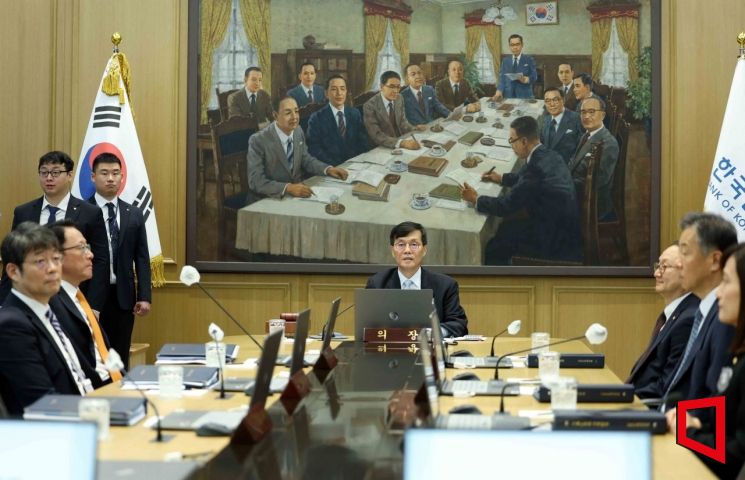
It has been found that the Bank of Korea's economic growth forecasts have an increasing impact on the private sector during monetary policy pivot periods when the base interest rate is either lowered or raised. It is pointed out that during these monetary policy transition periods, the Bank of Korea needs not only to make more accurate economic forecasts but also to engage in more proactive communication with the market.
According to the report titled "Dynamic Characteristics of Macroeconomic Forecasts and the Influence of the Bank of Korea" by the Korea Capital Market Institute on the 11th, the impact of the Bank of Korea's economic growth forecasts on private institutions varied significantly depending on changes in monetary policy stance. The report tracked how the economic forecasts of a total of 18 private forecasting institutions?including 16 global investment banks (IBs) and 2 domestic securities firms?changed from January 2018 to June 2024 in response to fluctuations in the Bank of Korea's economic outlook.
The analysis showed that the periods when the Bank of Korea's forecasts had the greatest influence on the private sector were June 2019, August 2021, and September 2023, in that order. Amid growing economic concerns due to the expansion of the US-China trade dispute, the Bank of Korea lowered the base interest rate from 1.75% to 1.50% in July 2019. The report analyzed that the ripple effect of the Bank of Korea's economic growth forecast at that time more than doubled compared to a year earlier.
Subsequently, the base interest rate was lowered to a zero-rate level of 0.5% during the COVID-19 pandemic period, and the ripple effect of the forecasts also dropped to a bottom level.
Kang Hyun-joo, Senior Research Fellow at the Macroeconomic and Financial Research Division of the Korea Capital Market Institute and author of the report, stated, "Contrary to expectations that the influence of the Bank of Korea's economic forecasts would have greatly increased due to the high uncertainty of economic growth forecasts during the COVID-19 spread period, the ripple effect stabilized downward," adding, "This is presumed to be because, after mid-2020, the consensus formed around a negative growth outlook and the base interest rate was perceived to be close to the effective lower bound, significantly reducing expectations for further monetary easing."
The ripple effect index of the Bank of Korea's forecasts rebounded again in August 2021, when the base interest rate, which had been kept low due to the COVID-19 spread, began to rise. At that time, the Bank of Korea raised the base interest rate from 0.5% to 0.75%. Breaking a freeze of over a year and starting a pivot caused the ripple effect index to rebound sharply. Subsequently, as the base interest rate hike was halted in January 2023 and the possibility of a freeze increased, the influence declined again.
The most recent rebound in the index occurred in September 2023. At that time, with the high interest rate stance of 3.5% maintained for a long period and concerns over economic slowdown expanding due to simultaneous sluggishness in domestic demand and exports, it is interpreted that expectations for a Bank of Korea rate cut increased.
The report interprets the changing influence of the Bank of Korea's economic forecasts on private economic predictions over time as indicating that the central bank's economic outlook serves as a signaling mechanism for monetary policy. The Bank of Korea's economic forecasts contain information that can help assess the desirable interest rate level or policy preferences of the monetary authorities, especially the prioritization among potentially conflicting policy goals such as price stability and financial stability, depending on the situation.
Monetary policy pivot periods are closely related to inflection points in the economic cycle, where the directions of economic indicators diverge, increasing uncertainty and making it difficult to determine the appropriate timing and pace of policy shifts. During such times, major forecasting institutions actively try to detect signals about the monetary authorities' preferences or policy strategies through the Bank of Korea's forecasts, the report analyzes.
Senior Research Fellow Kang emphasized, "During monetary policy pivot periods, the Bank of Korea needs to enhance the accuracy of its forecasts and clarify communication to ensure that the market does not develop excessive expectations for rate cuts and move too far ahead," adding, "If the Bank of Korea's economic forecasts are announced based on the Monetary Policy Committee's interest rate outlook in conjunction with the Committee's forward guidance, it could greatly help strengthen market communication."
© The Asia Business Daily(www.asiae.co.kr). All rights reserved.

















