Over 100 Civic Action Group Members Sign 'Joint Implementation Agreement'
Incorporating Citizen-Proposed Policies... Traffic System Reform
Mayor Kang: "We Will Definitely Achieve Cooperation, Participation, and Support with the Action Group"
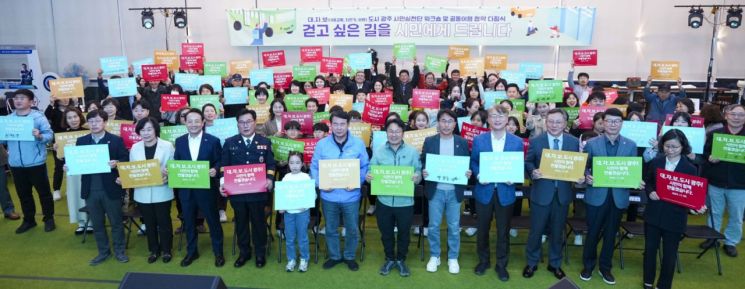 Gwangju Mayor Kang Ki-jung is taking a commemorative photo after signing the joint implementation agreement with Gwangju Superintendent of Education Lee Jeong-seon, Dong-gu District Mayor Im Taek, Seo-gu District Mayor Kim Yi-gang, and members of the action group at the "Public Notice City Joint Implementation Agreement Ceremony" held at the City Hall Citizen Hall on the afternoon of the 9th. Provided by Gwangju City
Gwangju City has taken a strong step forward with its citizens toward becoming a ‘Dae·Ja·Bo (public transportation·bicycle·pedestrian-centered) city Gwangju.’ The city previously decided that realizing a sustainable Dae·Ja·Bo city requires not only bold policies but also active cooperation, participation, and practice from its citizens, leading to the recruitment of a citizen action group. About 100 members of the citizen action group study, practice, and actively promote the Dae·Ja·Bo city Gwangju policies.
On the afternoon of the 9th, Gwangju City held the ‘Dae·Ja·Bo City Gwangju Citizen Deliberation and Joint Implementation Agreement Ceremony’ at the City Hall Citizen Hall, officially declaring the realization of a people-centered ‘Dae·Ja·Bo city Gwangju’ together with its citizens.
The ceremony was attended by Mayor Kang Gi-jung, Gwangju City Council member Park Pil-soon, Gwangju Superintendent of Education Lee Jeong-seon, Dong-gu District Mayor Im Taek, Seo-gu District Mayor Kim Yi-gang, Gwangju Transportation Corporation President Jo Ik-moon, children including Han Ga-yoon, and about 100 members of the Dae·Ja·Bo city citizen action group.
According to the agreement, they pledged to actively work on establishing inter-agency cooperation systems, jointly promoting the ‘Walkable Streets’ creation project, and implementing the citizen action group’s ‘citizen proposals’ to realize the ‘Dae·Ja·Bo city Gwangju.’ In particular, they will unite their efforts to transition the transportation system for a sustainable city.
The city plans to establish concrete action plans to realize the vision of the ‘Dae·Ja·Bo city Gwangju,’ and each institution will lead practical cooperation and encourage citizen participation.
Han Ga-yoon, a member of the Dae·Ja·Bo city citizen action group, said, “I am currently riding a four-wheeled bicycle, but I am practicing to ride a two-wheeled bicycle. I want to ride bicycles with my family all around Gwangju,” adding, “My dream is to ride a bicycle all the way to the Yeongsan River.”
Mayor Kang Gi-jung said, “The Dae·Ja·Bo city is the future for our children and an urgent task that must be implemented immediately to respond to the climate crisis. Nevertheless, to realize this, we must go through many persuasion and discussion processes to gain more citizens’ empathy. I will stand at the forefront and break through together with the citizen action group. Please join hands for the Dae·Ja·Bo city, the new path of urban revolution today.”
Before the agreement, 100 members of the citizen action group participated in a ‘citizen deliberation workshop.’ The workshop included explanations about the city’s ongoing projects such as the road diet for the Urban Railway Line 2 section and special transportation measures for the Gwangcheon area, as well as introductions to domestic and international cases for realizing the Dae·Ja·Bo city.
Based on the citizen proposals and administrative suggestions presented at the event, the city plans to establish a concrete execution plan for the ‘Dae·Ja·Bo city’ project. To this end, it will promote a 3+1 citizen empathy policy implementation plan, combining elements such as creating demonstration spaces, publicizing the Dae·Ja·Bo city, and citizen-led planning and practice to encourage active citizen participation.
Meanwhile, Gwangju City recently formed a dedicated task force (TF) to successfully promote the ‘Dae·Ja·Bo city Gwangju’ project, held its first meeting to share the vision, and discussed cooperation methods by institution.
Starting from the 11th, the city will launch the ‘Dae·Ja·Bo Commute Challenge’ using public transportation, bicycles, and walking. Key figures and public officials in Gwangju will take the lead in participating, promoting citizen involvement, and making the transition to a Dae·Ja·Bo city a reality. Additionally, to improve public transportation accessibility, the city plans to introduce the ‘Gwangju G-pass’ in January next year, open the first phase of Urban Railway Line 2 in December 2026, and completely reorganize bus routes.
To promote bicycle use, the city will establish the ‘Hwangryonggang Bicycle Gateway Tourist Course’ and a bicycle-only road section for the first phase of Urban Railway Line 2 by June next year, and create the ‘Pyeongdong 15-minute Bicycle Pilot Zone’ in July. For pedestrian-centered road space restructuring, the city plans to start with the ‘Youth Light Pocha Street’ next month, create the ‘Seochang Emotional View Path’ in March next year, and operate the ‘Car-Free Culture Center Road’ in April.
© The Asia Business Daily(www.asiae.co.kr). All rights reserved.

















