A nano-transfer printing-based patterning technology that helps uniformly coat the surface of carbon nanotubes (CNTs) has been developed in South Korea.
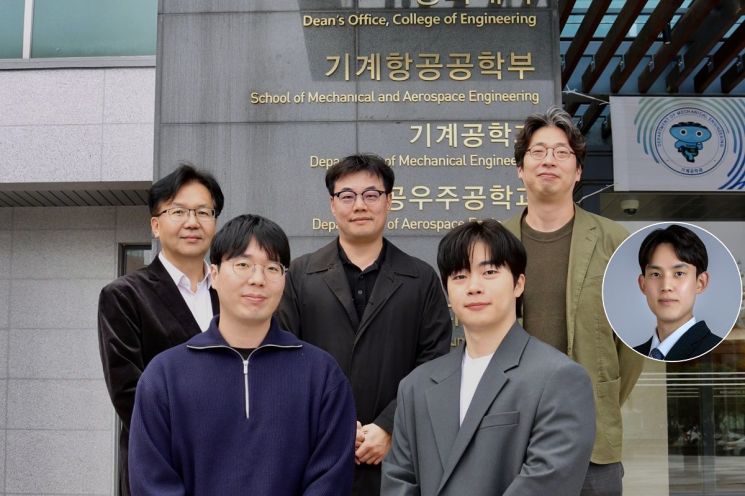 (From left) Dr. Junho Jeong, Postdoctoral Researcher Jihwan Ha, Professor Inkyu Park of KAIST, PhD candidate Inyoung Yang, Professor Sanha Kim, Professor Junseong Ahn of Korea University. Provided by KAIST
KAIST announced on the 10th that a joint research team consisting of Professors In-Kyu Park and Sanha Kim from the Department of Mechanical Engineering at KAIST, Professor Junseong Ahn from Korea University Sejong Campus, and Dr. Junho Jeong from the Korea Institute of Machinery and Materials developed a "high-precision nano patterning technology to improve the atomic permeability of carbon nanotubes."
Carbon nanotubes are long tubular structures with a diameter of 1 nanometer, composed of carbon atoms connected in hexagonal rings, the main component of diamond. They have a strength greater than steel and are used in various applications such as semiconductors, sensors, chemical, and defense industries.
However, to realize high-performance semiconductors, sensors, and energy devices, it is essential to coat functional materials on the surface of vertically grown carbon nanotubes. Until now, synthesized carbon nanotubes have shown limitations due to high aggregation rates and low atomic permeability, making it impossible to uniformly coat functional materials inside.
To overcome this, strategic technologies such as micro-patterning of carbon nanotubes have been under development, but the implementation of carbon nanotubes with enhanced atomic permeability for uniform coating remains insufficient.
However, the joint research team developed a process combining nanoimprinting capable of transferring precisely fabricated metal or metal oxide nanostructures. By implementing carbon nanotube growth following various nano-pattern shapes, they succeeded in improving atomic permeability and enhancing the quality of functional material coatings.
For example, nano-patterned carbon nanotubes coated with ceramic atoms using atomic layer deposition improved the uniformity of ceramic atom deposition, overcoming the limitations caused by the high aggregation rate of conventional carbon nanotubes. As a result, ceramic coating could be uniformly applied at the nanoscale from the top to the bottom of the nano-patterned carbon nanotubes.
The improved ceramic coating quality through this process is expected by the joint research team to enhance the mechanical recovery properties of carbon nanotubes, contributing to the repetitive use and industrial application of semiconductor, sensor, and energy devices.
Professor Park said, "The nano-patterning process of vertically aligned carbon nanotubes developed by the joint research team is expected to solve the fundamental problem of low atomic permeability in functional coating applications of carbon nanotubes." He added, "This technology could lead to the broad industrial utilization of carbon nanotubes, including mechanical and chemical applications in the future."
Meanwhile, this research was conducted with support from the Ministry of Science and ICT, the Ministry of Trade, Industry and Energy, and the Korea Advanced Institute of Science and Technology. It was funded by the Korea Research Foundation’s Mid-career Researcher Support Program, the Industrial Technology Alchemist Project, and the Leap Research Project.
© The Asia Business Daily(www.asiae.co.kr). All rights reserved.

















