Natural Monument No. 201 'Great Swan' Begins First Feeding Activity
Arrival of Hooded Cranes and Others... Birdwatchers Continue to Visit
City: "Committed to Creating an Ecological City of Human-Nature Coexistence"
Suncheon City, Jeollanam-do (Mayor Noh Gwan-gyu) announced on the 8th that the Greater Swan, Natural Monument No. 201, began its first feeding activity at the Saeseommaejagi restoration site in the Suncheon Bay mudflat on the 7th.
The Greater Swan belongs to the Anatidae family and Cygnus genus, designated as Natural Monument No. 201 and a Class 2 endangered wild species under international protection. Its body length ranges from 140 to 165 cm, and it weighs between 8 and 20 kg, making it the largest winter migratory bird species overwintering in Suncheon Bay. It mainly feeds on the tubers of Saeseommaejagi (a type of sedge) in the mudflats or the roots of aquatic plants near rivers during winter.
 Natural Monument No. 201, the Whooper Swan, began its first feeding activity on the 7th at the Saeseommaejagi restoration site in the Suncheon Bay mudflat. Provided by Suncheon City
In 2012, about 170 Greater Swans overwintered in Suncheon Bay, but as the Saeseommaejagi colonies, their food source, declined, their numbers gradually decreased, and by 2022, they were no longer observed.
This year, the city received national funding support from the Cultural Heritage Administration to plant 100,000 Saeseommaejagi plants over 10,000㎡ of Suncheon Bay mudflats and 3,300 roots annually over 25,000㎡ of farmland to create a stable food source, striving to make Suncheon Bay a regular habitat for the Greater Swan.
In particular, the planting of Saeseommaejagi in the mudflats is regarded as a successful case of restoration led by the Suncheon Bay fishing community residents, who directly participated in the restoration by riding mud boats, restoring the Saeseommaejagi colonies in Suncheon Bay mudflats with their own hands.
As a result, after two Greater Swans first arrived at Suncheon Bay on the 2nd, 4 arrived on the 4th, and 8 on the 7th, totaling 14 swans that have started feeding at the Saeseommaejagi restoration site.
An official from the city stated, “The Greater Swan is a flagship species connecting Suncheon Bay and the urban area,” adding, “We will enhance the biodiversity of Suncheon Bay to create an environment where endangered species can enter the inner city. We will do our best to build Suncheon as an ecological city where humans and nature coexist.”
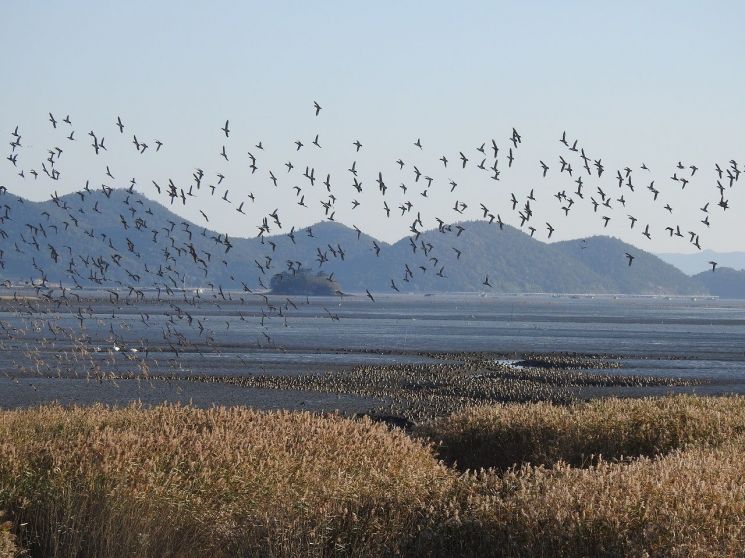
Meanwhile, since the 7th, about 7,600 Hooded Cranes, 70 Yellow-billed Spoonbills, and 10,000 Gadwalls have been overwintering in Suncheon Bay, attracting continuous visits from birdwatchers.
© The Asia Business Daily(www.asiae.co.kr). All rights reserved.

















