October International Finance and Foreign Exchange Market Trends
Stock Investment Funds Show Net Outflow for 3 Consecutive Months
Bond Investment Funds Show Net Inflow for 7 Consecutive Months
Foreign investors' funds in domestic stocks have been in net outflow for three consecutive months due to concerns about the growth potential of domestic semiconductor companies and global geopolitical risks.
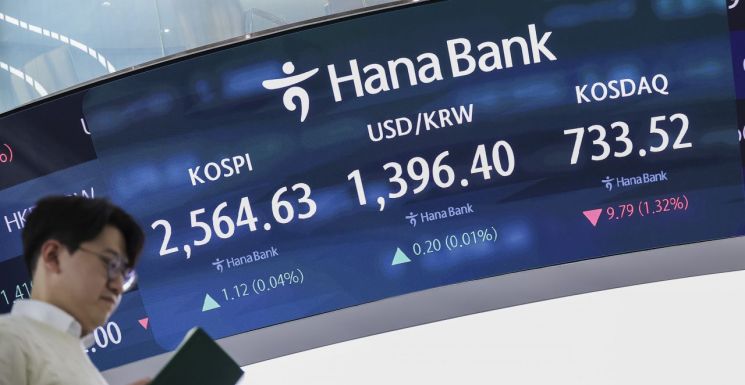
According to the 'International Financial and Foreign Exchange Market Trends since October' released by the Bank of Korea on the 8th, foreign investors' funds in domestic stocks recorded a net outflow of $4.17 billion in October. However, the scale of net outflow shrank compared to last month (-$5.57 billion).
Based on the KRW-USD exchange rate at the end of last month (1,379.9 KRW), this amounts to approximately 5.75 trillion KRW. Foreign investors' funds in domestic stocks have been in net outflow for three consecutive months since August (-$1.85 billion).
A Bank of Korea official stated, "Stock funds experienced net outflows due to concerns about the growth potential of domestic semiconductor companies and global geopolitical risks. However, the scale of net outflow narrowed as some bargain hunting inflows occurred."
On the other hand, foreign investors' funds in bonds recorded a net inflow of $4.05 billion, an increase compared to last month ($3.04 billion). The Bank of Korea explained that the scale of net inflow expanded due to continued incentives for short-term arbitrage trading and a decrease in the volume of matured bonds.
Foreign investors' funds in bonds have maintained a net inflow trend for seven consecutive months since April.
Including both stocks and bonds, foreign investors' funds in domestic securities continued net outflows for the second consecutive month. However, although net outflows in stock funds persisted, the expansion of net inflows in bond funds led to a reduction in the overall net outflow scale compared to last month (-$2.53 billion).
The KRW-USD exchange rate rose sharply from 1,307.8 KRW at the end of September to 1,379.9 KRW at the end of October, an increase of 72.1 KRW. As of the 6th of this month, it remains at a high level of 1,396.2 KRW.
The Bank of Korea explained, "The KRW-USD exchange rate surged significantly influenced by the weakening expectations of additional interest rate cuts by the U.S. Federal Reserve (Fed), concerns over the escalation of conflicts in the Middle East, and the global dollar strength due to the Trump trade."
The volatility of the KRW-USD exchange rate remained at the same level as the previous month. The daily fluctuation range of the KRW-USD exchange rate in October was 4.9 KRW, maintaining the same level as September (4.8 KRW). The volatility rate was 0.36%, unchanged from the previous month.
The credit default swap (CDS) premium for South Korean government bonds (based on the 5-year Foreign Exchange Stabilization Fund bonds) averaged 32 basis points (1 bp = 0.01 percentage points) last month, the same as the previous month.
CDS is a financial derivative product with an insurance nature that compensates for losses when the issuing country or company defaults. When the economic risk of the country increases, the premium generally rises as well.
© The Asia Business Daily(www.asiae.co.kr). All rights reserved.

















